Spraying ants you can see doesn’t work — it only kills workers while the colony keeps producing more. Here’s the bait-first approach that actually eliminates the colony and keeps ants out for good.
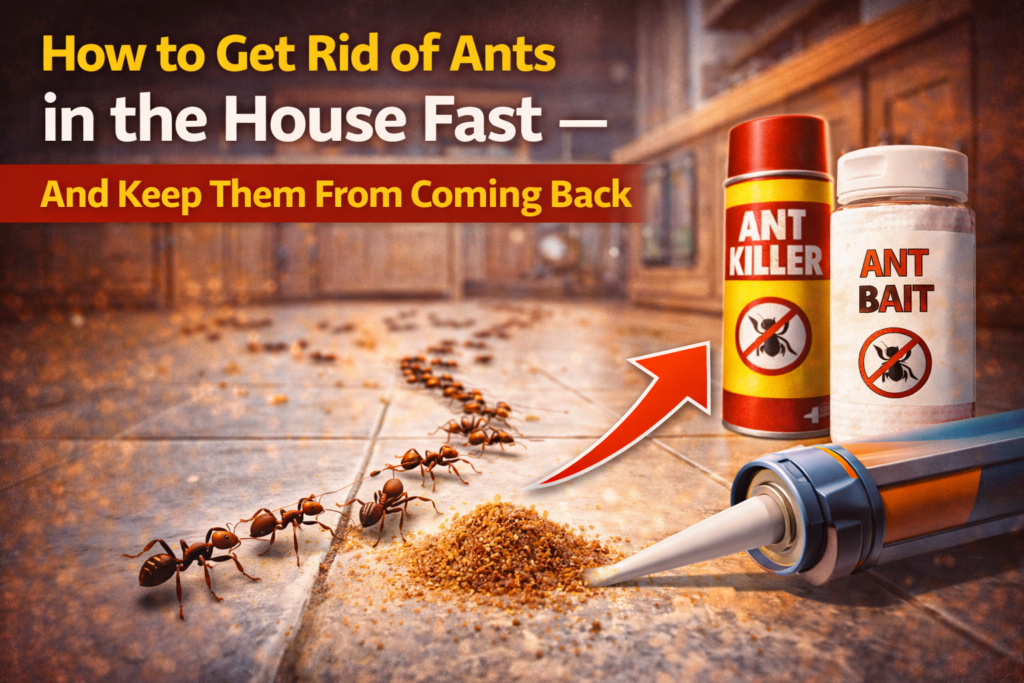
You spot a line of ants crossing your kitchen counter on a Tuesday morning. You grab a spray and kill every one you can see. By Wednesday afternoon there’s a new line in the same spot. You spray again. They come back again. This cycle repeats until you either give up or figure out what’s actually going on.
Here’s what’s actually going on: the ants you can see are worker ants — scouts and foragers that represent maybe five to ten percent of the colony’s total population. The other ninety percent, including the queen who is producing hundreds of new workers every day, are back in the nest somewhere outside or inside your walls. Killing the workers you can see is like cutting the visible part of a weed off at the soil line. The root is still there and it grows back.
Getting rid of ants permanently requires eliminating the colony. And eliminating the colony means getting poison to the queen — which means using bait that worker ants willingly carry back to the nest themselves. Once you understand this, the whole approach changes and the problem actually gets solved.
Understanding Why Ants Are in Your House
Ants don’t enter homes randomly. They enter because a scout found something worth bringing back to the colony — food, water, or a nesting site — and left a pheromone trail for other workers to follow. That trail is invisible to you but functions like a highway for every other worker in the colony. As long as the trail leads to a reward and stays active, ants will keep following it.
The most common reasons ants enter homes are straightforward: food residue on counters or floors, crumbs under appliances, pet food left out, fruit on the counter, grease splatter near the stove, moisture from a leaky pipe or condensation, and sweet or protein-rich garbage. Any of these can trigger and sustain an ant trail.
Entry points are typically tiny — gaps in weatherstripping, cracks in the foundation, gaps around utility penetrations, spaces under doors, and gaps around window frames. Ants can squeeze through a gap as small as 1mm. The same gaps that let in stink bugs and cluster flies let in ants, though ants can exploit much smaller openings. The same kind of overlooked openings can also allow pests into ductwork, as explained in Reasons Bugs Might Invade Your Home’s Air Vents.
Understanding the trail and the entry point is important because both need to be addressed. Eliminating the colony through bait solves the immediate infestation. Sealing entry points and removing attractants prevents the next colony from establishing a trail into your home.

The Most Common Ants You’re Dealing With
Different ant species behave differently and respond to different treatments. Knowing what you have helps you pick the right approach.
Odorous House Ants
The most common indoor ant in North America. Small, dark brown to black, and they emit a distinctive rotten coconut smell when crushed — which is how they got their name. They’re highly attracted to sweets and moisture. Odorous house ants nest outdoors but forage indoors extensively, and their colonies can be massive with multiple queens. They’re one of the harder species to eliminate because multi-queen colonies can split and relocate when threatened.
Pavement Ants
Small, dark brown ants that typically nest under concrete slabs, driveways, and foundations — hence the name. They enter homes through cracks in the foundation and gaps around plumbing. They eat almost anything and are common in kitchens and bathrooms. Pavement ant colonies are typically smaller than odorous house ant colonies and respond well to bait.
Carpenter Ants
Large black ants — significantly bigger than most other household species, sometimes up to half an inch long. Carpenter ants don’t eat wood but they excavate it to build nests, which means a carpenter ant infestation can cause structural damage over time. They’re attracted to moist, decaying wood and their presence indoors often indicates a moisture problem — a leaky roof, water-damaged framing, or a wet basement. If you’re seeing large black ants, especially near wood structures, treat it seriously and look for the moisture source.
Fire Ants
Common in the southern United States, fire ants are reddish-brown and known for their painful sting. They nest outdoors in soil but occasionally enter homes. If you suspect fire ants, treat carefully — disturbing a nest triggers an aggressive defensive response.
Pharaoh Ants
Tiny, pale yellow ants that are extremely difficult to eliminate. Pharaoh ant colonies have multiple queens and when threatened — including by insecticide spray — they split the colony and scatter, making the problem significantly worse. Pharaoh ants should never be sprayed. Bait only, always.
Never spray if you suspect Pharaoh ants. Spraying triggers colony splitting — one infestation becomes several. Pharaoh ants are tiny and pale yellow. If that matches what you’re seeing, use bait exclusively and be patient.


Step One: Bait the Colony
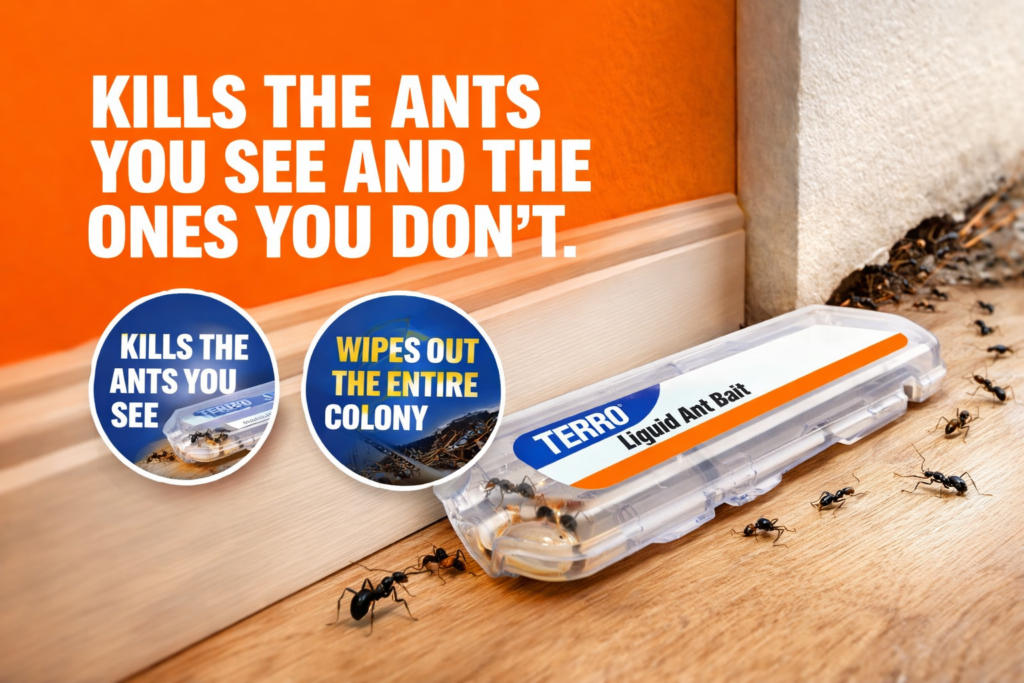
Bait is the foundation of effective ant control and should always be your first move. Ant bait works by exploiting the colony’s own behavior — worker ants find the bait, eat it, and carry it back to share with the rest of the colony including the queen. The active ingredient is slow-acting by design, giving workers time to distribute it through the nest before dying. Done right, the entire colony is eliminated within one to two weeks.
Best ant bait: TERRO Liquid Ant Killer Bait Stations are the gold standard for sweet-eating ants — odorous house ants, pavement ants, and most common household species. The borax-based liquid bait is highly attractive to workers and slow-acting enough to reach the queen. Place stations wherever you see ant activity and along the trail. A 12-pack gives you enough to cover multiple entry points and trail locations simultaneously.
How to Use Bait Correctly
Placement matters more than most people realize. Put bait stations directly on the ant trail — as close to where you’re seeing ant activity as possible. Ants are more likely to find and feed on bait that’s right in their path than bait placed away from their trail.
Use multiple stations. A single station in one location misses ants entering through other points. Cover every area where you’re seeing activity.
Do not spray anywhere near the bait stations. Insecticide residue near bait repels ants and prevents them from feeding on it — which defeats the entire purpose. If you’ve already sprayed, wipe the area with a damp cloth before placing bait and wait 24 hours for the residue to dissipate.
Leave the bait alone for at least a week. The most common mistake is removing bait stations after seeing large numbers of ants feeding on them. That activity is a sign it’s working — workers are feeding and carrying bait back to the nest. Removing it at that point stops the process before the colony is eliminated. Let it run its full course.
Seeing more ants after placing bait is normal. Worker ants recruit more foragers to a food source they’ve found. For the first few days after placing bait you’ll likely see more ant activity, not less. This is the bait working. Resist the urge to spray. Within 7-14 days activity drops off sharply as the colony collapses.
Step Two: Perimeter Barrier Spray
Once bait is placed and working on the colony, a perimeter spray creates a chemical barrier that kills ants crossing into your home and deters new colonies from establishing trails. The spray works on contact and leaves a residual barrier that stays active for weeks.
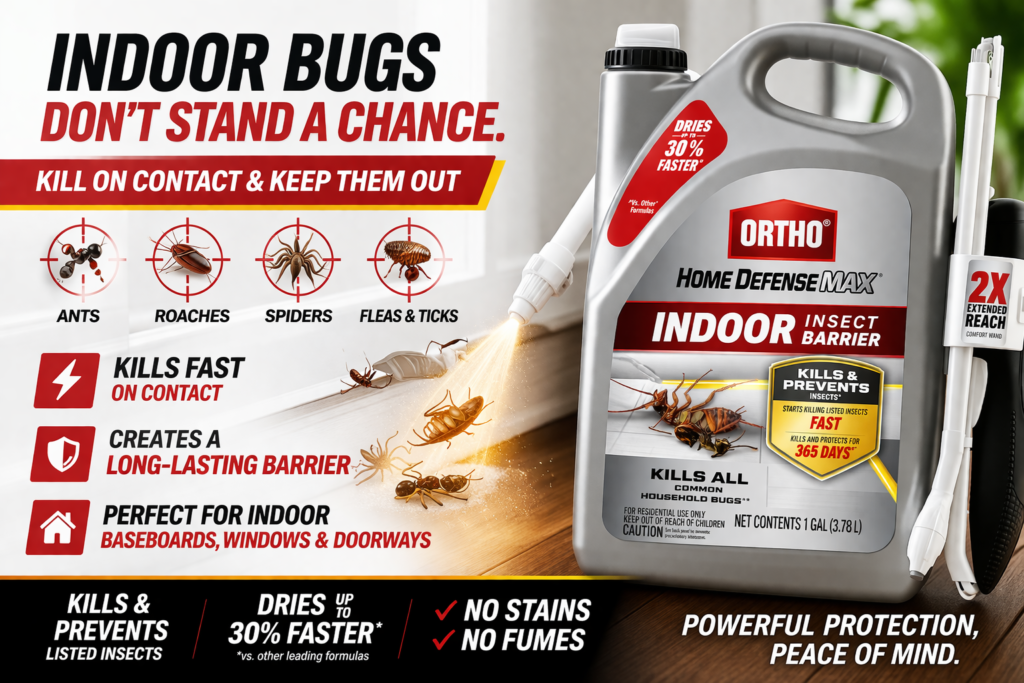
Perimeter spray: Ortho Home Defense Max Indoor Insect Barrier is specifically designed for this — spray along baseboards, around door frames and window frames, along the foundation line where the house meets the ground, and around any utility penetrations. It kills ants on contact and the residual barrier keeps working long after the spray dries. Apply indoors along baseboards and at every potential entry point.
Apply the perimeter spray after bait is placed and working — not before. Spraying first disrupts the ant trail, makes ants scatter, and may prevent them from finding the bait. The sequence matters: bait first to eliminate the colony, perimeter spray after to prevent reinfestation.
For outdoor application, spray around the full perimeter of the foundation, around window and door frames, and along any ant trails you can see leading to the house. Reapply after heavy rain.

Step Three: Find and Seal the Entry Points
Eliminating the current colony through bait is the fix for right now. Sealing entry points is the fix for next year and the year after. Ants will keep finding ways into a house that has gaps — a new colony will establish a trail through the same entry points a previous colony used.
Where to Look
The most common ant entry points are gaps in weatherstripping around doors and windows, cracks in the foundation, gaps where utility lines enter the house (plumbing, electrical, cable), spaces under door thresholds where the sweep has worn out, gaps around window frames where exterior caulk has failed, and gaps in siding where different materials meet.
Follow the ant trail backward from where you see ants inside the house. Trails almost always lead directly to the entry point if you’re patient enough to watch. Finding the entry point tells you exactly where to seal.
How to Seal Them
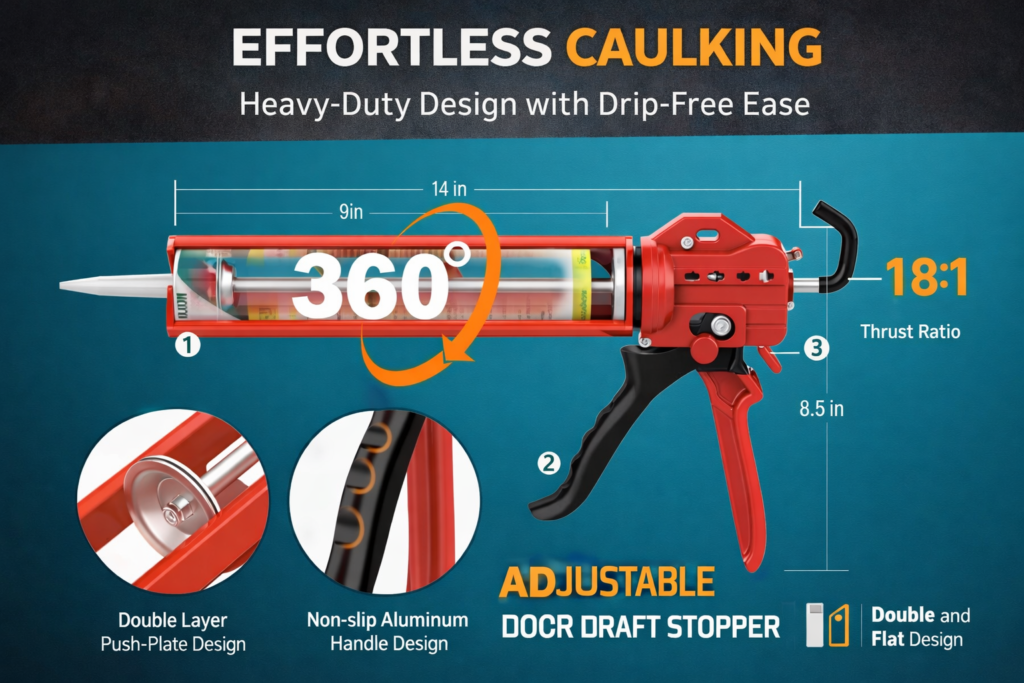
Clear silicone caulk handles the majority of ant entry points — gaps around window frames, cracks in baseboards, gaps around utility penetrations, and gaps between different construction materials. The same silicone caulk you’d use for weatherproofing windows works perfectly for ant exclusion. It bonds to wood, metal, masonry, and vinyl, stays flexible, and doesn’t crack over time.

For gaps under doors where the sweep has worn out, a replacement door sweep seals the threshold gap completely. Our article on stopping drafts and bugs with weather stripping covers threshold and door frame sealing in detail — the same work that keeps out drafts and stink bugs also keeps out ants.
Foundation cracks are worth sealing with hydraulic cement or a masonry crack filler before caulking over the top. Small cracks — hairline to about 1/4 inch — can be caulked directly. Larger cracks should be filled with a masonry product first.
Step Four: Remove What’s Attracting Them
Even a perfectly sealed house with a treated perimeter can get ants if there’s a strong enough attractant inside drawing scouts to find new entry points. Removing food and moisture sources is part of a complete solution.
Kitchen and Food Storage
Wipe down counters after every meal — ant scouts can detect food residue that you can’t see or smell. Store all sugar, honey, syrup, and baking products in sealed containers rather than their original packaging. Keep fruit in the refrigerator during ant season rather than in a bowl on the counter. Clean under the stove and refrigerator — grease and crumb accumulation in those spaces is a major ant attractant that rarely gets addressed.
Pet food is one of the most overlooked ant attractants. Don’t leave pet food bowls out between feeding times. If your pet grazes throughout the day, place the food bowl inside a larger shallow dish filled with a small amount of water — ants can’t cross the water barrier to reach the bowl.
Moisture Sources
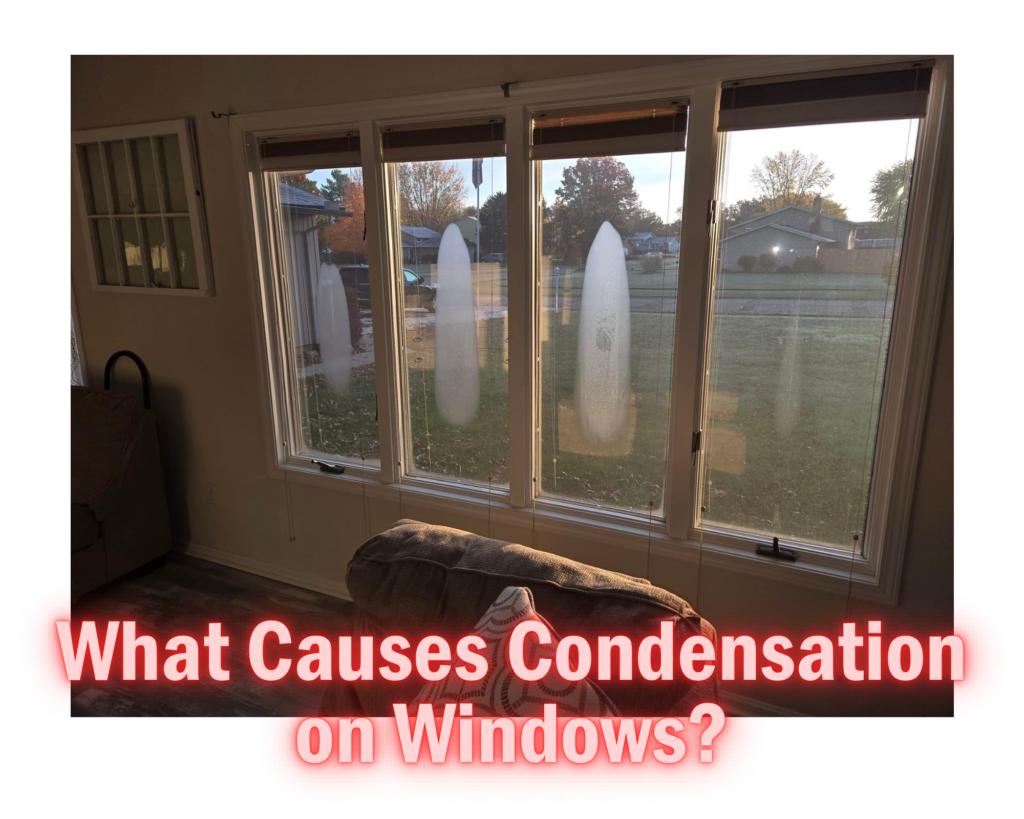
Ants need water and are strongly attracted to moisture. Fix any dripping faucets, leaking pipe connections under sinks, and condensation issues around pipes. Wipe down the sink basin after use. Check the area under the refrigerator for condensation drips from the drain pan — a full or improperly positioned drain pan creates a consistent moisture source that ants find and exploit.
Garbage and Recycling
Keep indoor garbage cans sealed with a lid. Take garbage out frequently — don’t let it sit long enough for food waste to attract scouts. Rinse food containers before putting them in recycling, and keep the recycling bin away from the house or inside a sealed container.



Dealing With Ants in Specific Locations
Ants in the Kitchen
Kitchen ant infestations are almost always odorous house ants or pavement ants following a food or moisture trail. Place TERRO bait stations under the sink, behind the stove, in the back corner of any cabinet where you’re seeing activity, and along the baseboard where the trail runs. Apply Ortho Home Defense along the baseboard perimeter after bait is established. Deep clean under and behind the refrigerator and stove — these are high-priority attractant zones that are rarely cleaned thoroughly.
Ants in the Bathroom
Bathroom ants are almost always there for moisture. Check under the sink for slow drips from the supply lines or the drain trap connection. Check around the toilet base for any moisture at the floor seal. Check the shower and tub caulk for failed sections that allow water to penetrate behind tile. Fix the moisture source and the ant trail loses its reason to exist. Place bait stations under the sink and along the baseboard while the bait works on the colony.
Ants Coming Up Through the Floor or Foundation
If ants are appearing in the basement or coming up through gaps in the floor, pavement ants nesting under the slab are the most likely culprit. Place bait stations along the trail and at any visible entry points in the floor. Apply a perimeter spray along the foundation both inside and outside. Sealing cracks in the concrete floor and foundation walls with hydraulic cement followed by concrete caulk removes the entry points long term.
Carpenter Ants — A Special Case
Carpenter ants require a different approach because their nest is typically inside wood rather than in soil. Finding the nest is the most important step — look for sawdust-like frass near wood structures, particularly in areas with any moisture history. Listen at night for a faint rustling sound in walls where carpenter ants are active.
Carpenter ant bait is available in both liquid and granular form and works on the same principle as other ant bait — slow-acting poison carried back to the nest. Gel bait injected directly into wall voids through small drilled holes reaches the nest more directly. If you suspect carpenter ants in a structural member like a floor joist or wall stud, professional evaluation is worth pursuing — the combination of moisture damage and carpenter ant excavation can compromise structural integrity over time.
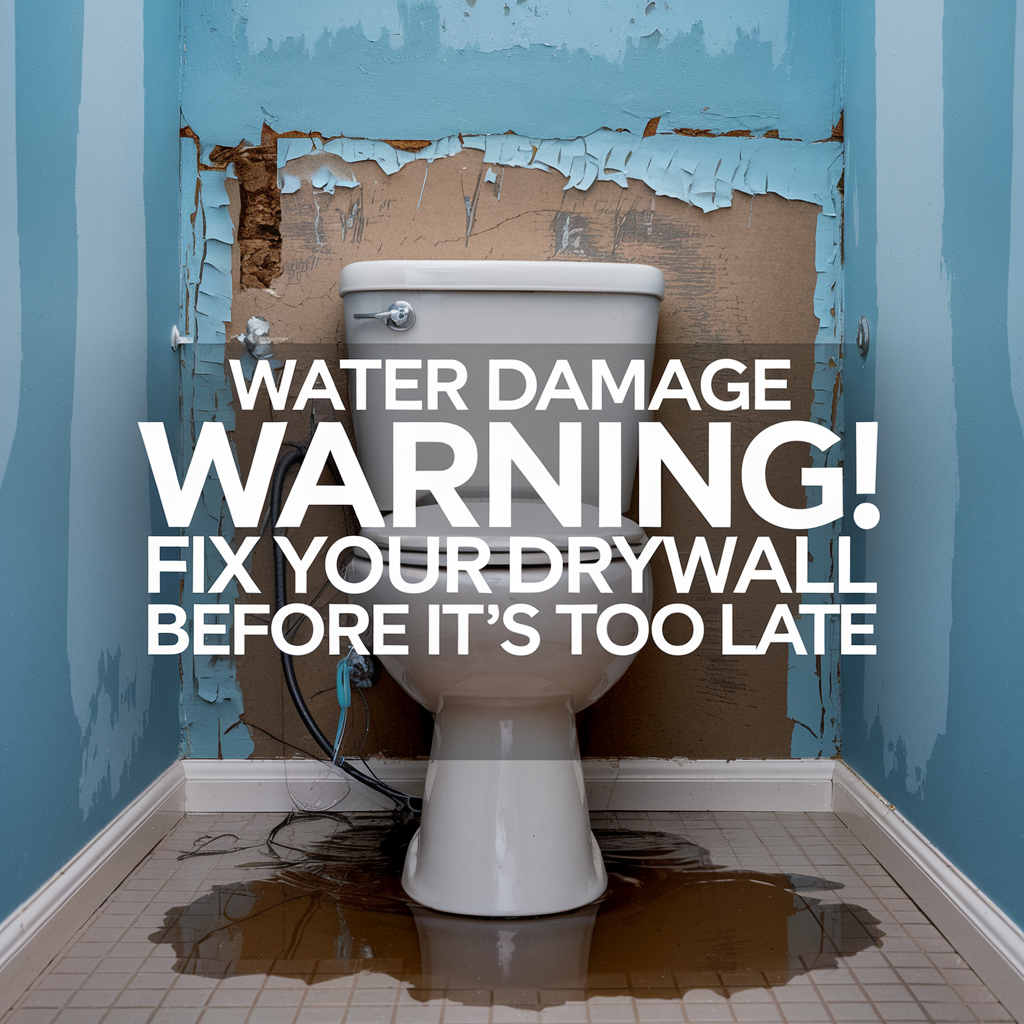
Most importantly, find and fix the moisture source. Carpenter ants don’t establish nests in dry, sound wood. Their presence indoors almost always means there’s wet or decaying wood somewhere — a roof leak that’s gotten into framing, a chronic moisture problem in the basement, or water-damaged wood around a window or door frame. Our article on repairing water damaged drywall is relevant here — water damage that’s reached the drywall has almost certainly reached the framing behind it.
Natural and Non-Toxic Options
For homeowners who want to avoid chemical insecticides — particularly those with young children or pets — there are effective non-toxic approaches worth knowing about, though they generally require more patience and consistency than bait-based approaches.
Diatomaceous Earth
Food-grade diatomaceous earth is a fine powder made from fossilized algae that kills insects by damaging their exoskeletons and causing them to dehydrate. Sprinkled along ant trails, in cracks, and around entry points it kills ants that walk through it. It’s non-toxic to humans and pets but must be kept dry to remain effective — it loses its killing power when wet. Reapply after any moisture exposure.
Borax and Sugar Bait
A homemade bait can be made by mixing borax with powdered sugar in a roughly 1:3 ratio and placing small amounts near ant trails. The sugar attracts workers, the borax kills them slowly enough to be carried back to the colony. This is essentially the same active ingredient as TERRO bait but in a less refined form — commercial bait stations are more consistent and convenient, but the homemade version works if applied correctly.
Cinnamon, Peppermint, and Vinegar
These are frequently recommended as natural ant repellents and they do have some short-term repellent effect — ants avoid strong scents that interfere with their pheromone trails. But they don’t eliminate colonies, the effect is temporary, and ants find ways around them within days. They’re useful as a supplement alongside bait but not as a standalone solution.

When the Problem Keeps Coming Back
If you’ve used bait, applied a perimeter spray, and sealed visible entry points but ants keep returning, a few things are likely happening.
The colony may be larger than typical or have multiple queens — odorous house ants in particular can have supercolonies with thousands of queens that are extremely difficult to fully eliminate. Keep bait fresh and in place continuously through the active season rather than pulling it after one round.
There may be entry points you haven’t found. Follow trails carefully and look for points of entry you may have missed — particularly high up near the roofline, in the garage, or in the basement where inspection is less thorough.
There may be a new colony establishing from outside. A perimeter spray reapplied monthly during peak ant season — spring through early fall — maintains the barrier against new trail establishment. This is particularly important if you live near wooded areas or have significant landscaping close to the foundation.
Mulch and wood chips directly against the foundation are a significant ant harborage that many homeowners don’t consider. Organic mulch retains moisture, provides nesting material, and sits right against the entry points into your home. Keep mulch at least six inches away from the foundation and consider switching to stone or rubber mulch in the immediate foundation zone.
The Year-Round Prevention Routine
Once you’ve dealt with an active infestation the goal is preventing the next one. A few consistent habits make a significant difference.
In spring — when ant colonies become active and scouts begin searching for food — apply a fresh perimeter spray around the full foundation before you see any ants inside. Getting the barrier in place before trails are established is far more effective than applying it after ants are already coming in.
Check and refresh weatherstripping and door sweeps annually. Worn weatherstripping that lets in drafts lets in ants. Our guide on stopping drafts and bugs with weather stripping covers what to look for and how to replace it. The same annual inspection that keeps your home energy-efficient keeps it pest-resistant.
Keep the exterior of the house clean of food attractants — fallen fruit from trees, bird seed spilled from feeders, and compost piles close to the house all draw ants that then find their way inside. Move bird feeders away from the house and use a tray to catch spilled seed.
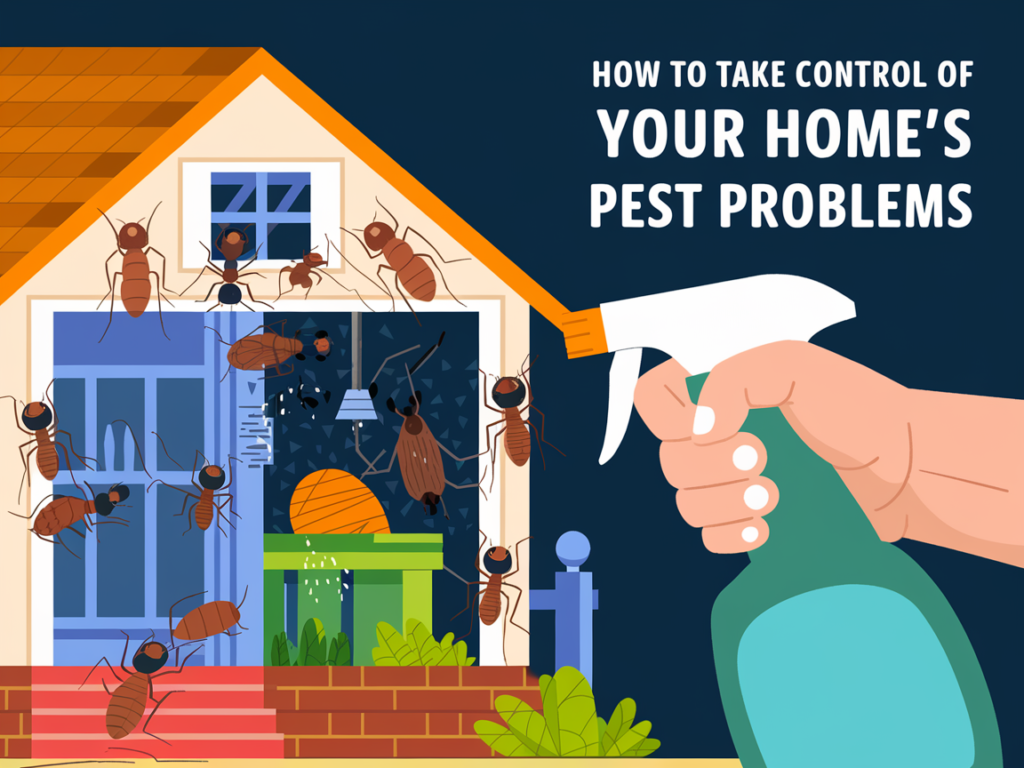
For broader pest prevention throughout the home our article on DIY pest control for homeowners covers the full spectrum of common household pests and the integrated approach that keeps them out year-round.
The Bottom Line
Ants are one of the most common household pest problems and one of the most commonly mishandled. Spraying the ants you can see feels satisfying but accomplishes almost nothing — the colony keeps producing new workers and the trail keeps bringing them back. The fix that actually works is bait that reaches the queen, paired with a perimeter barrier spray and sealing of the entry points they’re using.
Place TERRO bait stations directly on the trail and leave them alone for at least a week. Apply Ortho Home Defense along baseboards and around the foundation after bait is established. Seal gaps in weatherstripping, around windows, and at utility penetrations. Remove food and moisture attractants. Done in that order, most ant infestations are fully resolved within two weeks and don’t come back.
About the Author — Tom Whitfield
Tom Whitfield worked in residential pest control for twelve years before moving into home improvement writing. He’s seen every ant species that commonly invades homes across the eastern United States and watched homeowners make the same mistakes repeatedly — mostly reaching for a spray can when they should be reaching for bait. He writes for DIY Home Wizard on pest control, home sealing, and seasonal home maintenance topics.