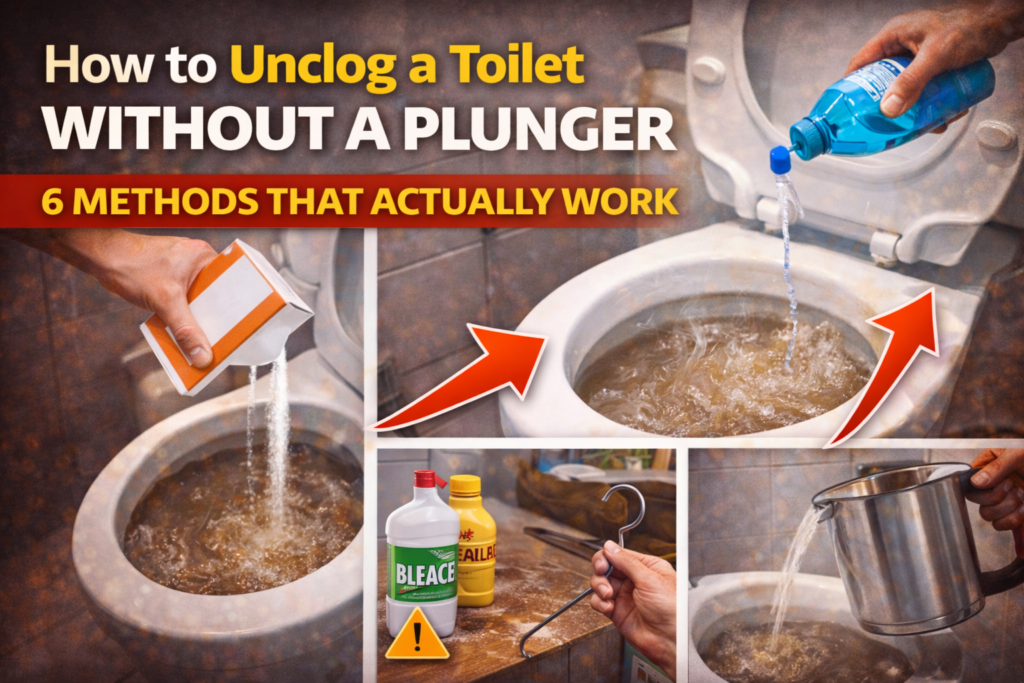
No plunger? The hot water and dish soap method clears most toilet clogs in 20-30 minutes and works on the vast majority of standard blockages. If that doesn’t work, baking soda and vinegar is your next move, followed by a wire hanger snake for stubborn clogs. This article covers every method ranked from easiest to most involved so you can work through them in order.
It happens at the worst possible time. You flush, the water rises instead of draining, and you realize there’s no plunger anywhere in the house. Or you’re at someone else’s home, a hotel, or a vacation rental and there’s nothing under the sink but cleaning spray and air freshener.
Before you panic — most toilet clogs are partial blockages of organic material that respond well to heat, lubrication, and a little patience. You don’t always need a plunger. You need to understand what’s causing the clog and apply the right method to break it up or move it through.
Here are every method that actually works, ranked from easiest and least messy to most involved, so you can work through them in order until the clog clears.
First — Don’t Flush Again
This is the most important instruction in this entire article. If the toilet didn’t drain after the first flush, do not flush again. A second flush on a clogged toilet adds more water to a bowl that can’t drain and almost always results in overflow. The toilet bowl will fill to the rim and potentially spill onto the floor.
If the water level is high and you’re worried about overflow, remove the tank lid and push the flapper down to stop more water from entering the bowl. The flapper is the rubber valve at the bottom of the tank — pressing it closed stops the tank water from continuing to flow into the bowl. This buys you time to work on the clog without the bowl overflowing.
Let the water level drop naturally before attempting any method. Most partial clogs will allow slow drainage over 10-15 minutes, which gives you a safer water level to work with.

Method 1: Hot Water and Dish Soap
This is your first move and it works on the majority of standard toilet clogs. The dish soap lubricates the clog and helps it slide through the drain. The hot water adds heat that softens organic material and provides hydraulic pressure to push the blockage through.
Squirt a generous amount of dish soap — a few good squirts, roughly a quarter cup — directly into the toilet bowl. Let it sit for 5-10 minutes to work its way down toward the clog. While it sits, heat water on the stove or in a kettle. You want hot water — not boiling. Boiling water can crack a porcelain toilet bowl due to thermal shock. Water that’s hot to the touch but not at a rolling boil is ideal, around 120-140 degrees Fahrenheit.
Pour the hot water into the bowl from waist height rather than at the surface. Pouring from height increases the force of the water and helps drive the soap and heat into the clog. Pour a full gallon if you have it.
Wait 20-30 minutes. The combination of soap lubrication and heat softening works on its own given time — you don’t need to do anything else during this period. Come back and check. In most cases the water level will have dropped significantly or the clog will have cleared entirely. If the water level has dropped, that’s your signal to try a flush. A single flush at this point often clears whatever remains.
Repeat if needed. If the water level dropped but didn’t fully clear, do the process again — more dish soap, another gallon of hot water, another 20 minutes. Two rounds clears the vast majority of clogs that the first round didn’t fully resolve.


Method 2: Baking Soda and Vinegar
The chemical reaction between baking soda and vinegar produces carbon dioxide gas and fizzing action that can break up organic clogs and help move the blockage through the drain. It’s less immediately powerful than hot water and dish soap but it’s a good second method if the first didn’t fully clear the clog, and it’s particularly effective on clogs with any organic buildup component.
Make sure the water level in the bowl is manageable — not at the rim — before starting. Pour one cup of baking soda directly into the bowl, distributing it as evenly as possible. Follow immediately with two cups of white vinegar. The mixture will fizz vigorously — this is normal and expected. Don’t add anything else and don’t flush for at least 30 minutes.
The fizzing action works into the clog and the acidity of the vinegar helps break down organic material. After 30 minutes try flushing. If the toilet is draining slowly rather than completely blocked at this point, hot water from height can provide the final push to clear whatever remains.
Don’t mix with bleach. If you’ve already poured bleach into the toilet bowl — which some people do as a cleaning step — do not add vinegar. Bleach and vinegar produce chlorine gas, which is toxic. If bleach is present, skip this method and move to Method 3.
Method 3: Plastic Wrap Suction Method
This one sounds strange but works remarkably well for creating plunger-like suction without an actual plunger. You need plastic wrap — the kind used for food storage — and enough to cover the entire toilet bowl opening with several layers.
Dry the rim of the toilet bowl with a towel so the plastic wrap has a surface to adhere to. Stretch plastic wrap tightly across the entire bowl opening, pressing it firmly against the rim all the way around to create an airtight seal. Apply two or three layers for a stronger seal.
Now flush the toilet. The flush mechanism sends water into the bowl and since the plastic wrap is sealing the top, it creates pressure. You’ll see the plastic wrap dome upward as the water pressure builds underneath it. Push down firmly on the center of the dome with both hands — this forces the pressurized air and water down into the drain with significant force, exactly like a plunger.
It takes a firm push and some commitment but the hydraulic force created is genuinely effective. Most clogs respond to two or three pushes with this method. Remove the plastic wrap carefully after the clog clears.


Method 4: Wire Coat Hanger Snake
When the clog isn’t responding to liquid and pressure methods, it’s likely a more solid obstruction — something that flushed partially but is lodged in the trap. A wire coat hanger straightened out and bent at one end can reach into the trap and physically break up or hook and remove the obstruction.
Unwind a wire coat hanger completely and straighten it as much as possible. Bend one end into a small hook or loop — this gives you something to grab with rather than just poking with a sharp wire end. Wrap the hook end with a rag or tape to avoid scratching the porcelain.
Insert the hanger into the drain opening and work it around the bend of the trap. You’re either trying to hook the obstruction and pull it back out, or to break it up enough that it can pass through. Work it back and forth with gentle rotating motions rather than aggressive stabbing — the goal is to feel for the blockage and either dislodge it or pull it toward you.
This method requires patience and a tolerance for an unpleasant task, but it works well on clogs caused by objects that shouldn’t have been flushed — wipes, excessive toilet paper, small items — that are sitting in the trap.
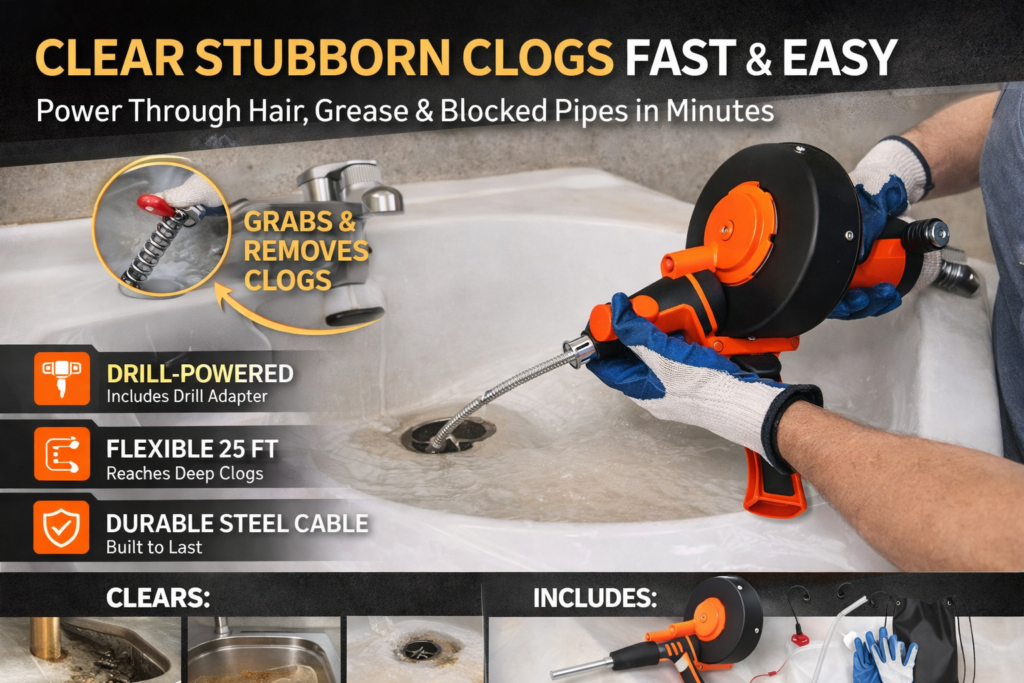
If clogs are a recurring problem: A proper 25 Ft Drain Auger with Drill Adapter reaches well beyond what a coat hanger can access and clears stubborn clogs that have moved past the trap into the drain line. It’s the right tool for clogs that resist every other method and for recurring slow-drain problems that indicate partial blockage further down the line.
Method 5: Toilet Brush Pressure Method
If there’s a toilet brush in the bathroom — and there usually is — it can serve as a makeshift plunger in a pinch. It won’t create the same seal as a real plunger but it can generate enough pressure to dislodge many clogs.
Push the brush head as far into the drain opening as it will go, angling it to get the head into the drain rather than just resting on the surface. Work it in and out with firm pumping motions — the same motion as a plunger. The bristles create some resistance against the water which translates into pressure against the clog.
This is less effective than a real plunger but more effective than doing nothing while you wait for hot water and dish soap to work. Use it in combination with Method 1 — apply the hot water and dish soap, wait, then use the brush to provide additional pressure when you check back.



Method 6: Enzyme Drain Cleaner
For clogs that are clearly organic material — too much toilet paper, waste buildup — enzyme-based drain cleaners break down organic matter effectively without the harsh chemistry of traditional drain cleaners. They work more slowly than chemical cleaners but they’re safe for pipes, septic systems, and porcelain.
Pour the enzyme cleaner into the bowl according to package directions and leave it overnight. The enzymes digest organic material in the clog, breaking it down into liquid that passes through the drain. This is an overnight fix rather than an immediate one, so it works best when you have another bathroom available or when you discover the clog at the end of the day.
Enzyme cleaners are worth keeping under the sink for slow-drain situations and partial clogs before they become complete blockages. Monthly use as a maintenance treatment prevents organic buildup in the trap and drain line.
What Not to Use
A few things frequently recommended online that either don’t work or actively cause problems.
Chemical Drain Cleaners Like Drano
Standard chemical drain cleaners — the ones based on sodium hydroxide or sulfuric acid — are designed for sink and shower drains, not toilets. In a toilet the clog is typically in the trap which is porcelain, and these chemicals can damage the porcelain finish over time with repeated use. More importantly, if the chemical doesn’t clear the clog you now have a bowl full of caustic chemical that’s dangerous to work around and difficult to remove safely. Avoid chemical drain cleaners in toilets.
Boiling Water
Boiling water — at a full rolling boil — can crack the porcelain of a toilet bowl due to thermal shock. Hot water works. Boiling water is too hot and risks an expensive repair. This is a commonly repeated mistake — always use hot but not boiling water.
Multiple Flushes
Already covered this at the top but worth repeating because it’s the most common mistake that turns a manageable clog into a flooded bathroom floor. One flush to confirm the clog. Then stop. Work on the clog. Only flush again once you have reason to believe the blockage has cleared or significantly loosened.


When the Toilet Won’t Unclog No Matter What
If you’ve worked through all the methods above and the toilet still won’t drain, one of a few things is happening.
There’s a non-organic object lodged in the trap — a toy, a phone, a brush head, something that got flushed accidentally. These require either a proper toilet auger that can reach and hook the object, or in some cases removal of the toilet to clear the trap from below. A toilet auger — different from a standard drain snake, designed specifically for the toilet trap geometry — is the right tool here and available at any hardware store for under thirty dollars.
The clog may be further down the drain line than the toilet trap — in the branch line or main drain. If multiple drains in the house are slow or backing up simultaneously, the clog is in the main line and requires a professional drain snake or hydro-jetting to clear. Our article on DIY plumbing repairs covers when a drain problem has moved beyond DIY territory.
If the toilet drains but fills again slowly — or if you hear gurgling from other drains when the toilet flushes — there may be a venting problem rather than a true clog. A blocked sewer vent pipe prevents air from entering the drain system as water flows through, causing slow drainage and gurgling. Our article on clogged sewer vent pipe symptoms and fixes covers this specific problem in depth.
Getting a Plunger — And the Right Kind
Once you’ve resolved the immediate situation, get a plunger and keep it in every bathroom. It’s the right tool for toilet clogs and having one eliminates the need for workarounds next time.
There are two types and the distinction matters. A cup plunger — the classic red rubber cup on a stick — is designed for flat drains like sinks and showers. It doesn’t work well on toilets because it can’t seal against the toilet’s drain opening geometry. A flange plunger — which has a cup plus an extended rubber flap that fits into the drain opening — is designed specifically for toilets and works far better. If your current plunger is a flat cup type, that’s likely why it hasn’t worked well in the past.

Right tool for the job: Our article on the best toilet plunger covers exactly what to look for — the difference between cup and flange plungers, what makes a good seal, and which ones are worth buying. A good flange plunger under fifteen dollars handles the vast majority of toilet clogs in under two minutes.


Preventing Future Clogs
Most toilet clogs are preventable. The vast majority are caused by flushing things that shouldn’t be flushed, using too much toilet paper in a single flush, or gradual buildup in older pipes with partial obstructions.
Flushable wipes are one of the biggest causes of toilet clogs despite the name. They don’t break down the way toilet paper does and they catch on any partial obstruction in the drain line, rapidly building into a complete blockage. Don’t flush them regardless of what the packaging says.
Paper towels, facial tissues, cotton balls, feminine hygiene products, and any other paper product besides toilet paper should never go in the toilet. They all have fiber structures that don’t dissolve in water and they cause clogs.
For older homes with galvanized or cast iron drain pipes, mineral buildup and corrosion gradually narrow the pipe diameter and create surfaces that catch material. A monthly enzyme treatment keeps organic material from accumulating on these surfaces and reduces clog frequency significantly.
If a specific toilet clogs repeatedly despite normal use, there may be a partial obstruction further down the line that catches material every time. A drain snake run through that line periodically clears the partial obstruction before it becomes a complete one. Our article on why your toilet is flushing slowly covers the diagnosis and fix for recurring slow-flush problems that often precede recurring clogs.

And if your toilet has other issues beyond clogging — running constantly, flushing weakly, or making noise — our complete toilet troubleshooting articles cover those problems: how to fix a running toilet, identifying the cause of a running toilet, and toilet won’t stop running.
The Bottom Line
No plunger is not a crisis. Hot water and dish soap clears the majority of toilet clogs given 20-30 minutes to work. Baking soda and vinegar handles most of what the first method doesn’t. The plastic wrap pressure method provides genuine plunger-like force when liquid methods aren’t enough. And a straightened wire coat hanger reaches into the trap for solid obstructions that need physical removal.
Work through the methods in order, don’t flush again until you have reason to believe the clog has cleared, and get a proper flange plunger before you need it next time.
About the Author — Dave Pritchard
Dave Pritchard spent fifteen years as a residential building inspector before transitioning to full-time writing about home repair and maintenance. He’s seen the inside of more walls, crawl spaces, and drain lines than he can count, and his approach to home problems is always the same: find the actual cause before reaching for a fix. He contributes regularly to DIY Home Wizard on plumbing, pest exclusion, and home maintenance topics.