
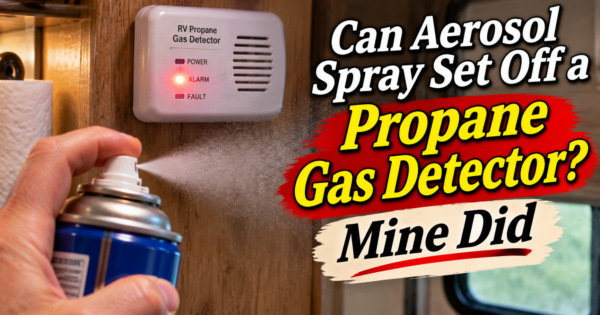
A gas detector going off inside your house will make your stomach drop fast.
That happened to me after my grandma had been over and left not feeling well. I sprayed a bunch of aerosol germ killer in the house, then maybe twenty minutes later, the gas detector started sounding downstairs.
Of course, I immediately worried about propane.
We have a propane furnace downstairs, and this spring I had a new propane line run from the house out to our deck for the grill. My mind went straight to that line, the furnace, or something else that could be leaking.
Then I moved the detector upstairs, and it went off upstairs too.
At that point, I was ready to have my HVAC guy come out and test everything. I cracked a window while I waited, kept thinking through what had changed that day, and finally connected the timing to the aerosol spray.
About an hour later, I plugged the detector back in and it showed zero.
That was a major relief, but it also taught me something I did not know before. Some gas detectors can react to aerosol sprays, cleaners, solvents, alcohol-based products, paint fumes, and other airborne chemicals.
That does not mean an alarm should ever be ignored. It means knowing the difference between a possible false alarm and a real gas leak can get confusing in a hurry.
Yes, aerosol spray can set off some propane gas detectors
A lot of aerosol products use propellants or chemicals that a combustible-gas sensor can notice.
That can include things like:
- Disinfectant spray
- Air freshener
- Hair spray
- Spray paint
- Adhesive spray
- Cleaning products
- Rubbing alcohol or alcohol-heavy cleaners
- Gasoline vapors
- Paint thinner or solvents
- Some bug sprays
A detector is not necessarily “broken” just because it reacts to something besides propane. Many combustible-gas detectors are designed to sense a broad range of vapors, not one perfect chemical in one perfect situation.
That is why a strong aerosol spray can sometimes make one go off even when there is no propane leak.
Still, I would never start with, “It is probably just the spray.”
I started by treating it like a real propane concern because that is what an alarm is supposed to make you do.


A propane detector is not the same thing as a carbon monoxide detector
This part matters more than I realized before this happened.
A carbon monoxide detector watches for CO, which is an odorless gas created when fuel does not burn correctly. A propane detector watches for combustible gas, including propane or natural gas depending on the detector.
They are not interchangeable.
A home with propane appliances can benefit from having both:
- Carbon monoxide alarms near sleeping areas and on each level of the home.
- Propane or combustible-gas detectors placed according to that detector’s directions.
- Smoke alarms where they belong.
A propane leak can create a fire or explosion hazard. Carbon monoxide can create a poisoning hazard. Both deserve respect, but they are different problems with different detectors.
For a home with a propane furnace, water heater, fireplace, stove, generator hookup, or an outdoor grill line like mine, I think a plug-in detector adds another useful layer of warning.
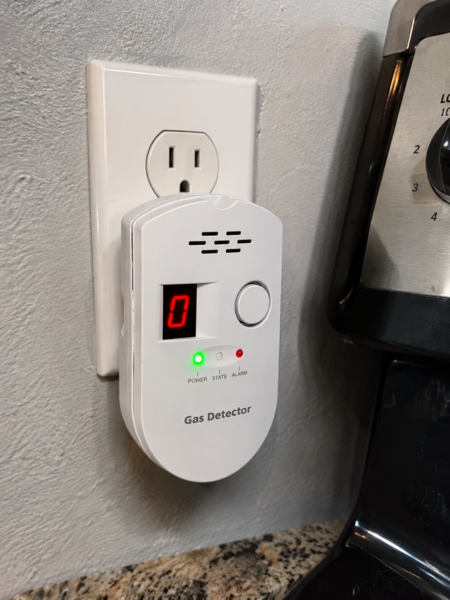
See this plug-in natural-gas and propane detector here if you want one that gives you a visible reading instead of only an alarm sound.
Why I did not immediately assume the detector was bad
My first thought was that the detector might be defective.
Then it went off upstairs too.
That made me think the problem had to be something larger than one outlet, one corner of the basement, or one malfunctioning detector. I was thinking propane line, furnace, or some kind of leak moving through the house.
But the timing with the aerosol spray made more sense once I slowed down and looked at the day.
The detector did not go off before I sprayed. It went off after I sprayed heavily. Then, after the house had aired out and some time passed, it returned to zero.
That pattern made the aerosol a very plausible explanation.
It did not prove the propane system was perfect forever. It only explained why the alarm likely happened at that moment.
That is an important difference.
What I would do if a propane detector goes off again
If you smell propane, hear hissing, see a damaged line, or have any reason to think gas is actively leaking, get everybody away from the area immediately.
Do not start switching lights on and off. Do not plug or unplug electrical items. Do not light a match, smoke, vape, start a vehicle nearby, or try to hunt down the leak inside the house.
Get outside, away from the home, and call your propane supplier, fire department, or 911 from a safe location.
A propane leak is not the time to become your own emergency gas technician.
Even if there is no obvious propane smell, an alarm that stays active or keeps returning deserves a real inspection. Propane odor can be difficult for some people to notice, especially if they are sick, congested, distracted, or simply not used to the smell.


Do not use dizziness alone to decide whether it is a gas leak
When an alarm starts blaring, your body can react before your brain has caught up.
I know I felt uneasy and lightheaded once I started worrying about propane and the furnace. The noise, the fear, and the sudden realization that there could be a problem in your home can make you feel off pretty quickly.
But how you feel is not a reliable way to decide whether an alarm is real or harmless.
If anyone has a headache, dizziness, nausea, confusion, chest discomfort, trouble breathing, or feels unusually sick while a carbon monoxide or gas alarm is sounding, get outside to fresh air and call for emergency help.
Do not wait around inside trying to prove that the detector is wrong.
Why moving the detector upstairs did not really prove much
I moved mine upstairs because I wanted to see whether it would react somewhere else.
When it alarmed upstairs too, I took that as another reason to worry. Looking back, though, moving a detector around is not a perfect test.
Airborne aerosol chemicals can drift through a house. A detector can also react differently depending on how close it is to a spray source, airflow from the furnace, open doors, stairways, return vents, and how much product was used.
Propane itself behaves differently from many aerosol vapors too. Propane is heavier than air, which is why propane detector placement matters so much.
The most important thing is to follow the installation instructions for your particular detector. Some are meant to be plugged in low on the wall. Others have specific mounting guidance, minimum distances from appliances, and locations to avoid.
Do not put one right beside a furnace, directly in a kitchen, beside a bathroom, in a damp area, or somewhere spray fumes are constantly floating around unless the manufacturer specifically says it is appropriate.


A visible number can help you notice when something is off
One thing I liked about having a detector with a display is that I could see it return to zero after the house aired out.
That gave me more information than an alarm that only beeps.
A number is still not a reason to ignore an emergency, though. It is just another clue.
I would rather have a detector that gets my attention over a detector that stays quiet through something serious. The trick is learning what can cause a temporary reading and knowing when the situation needs a professional.
This home propane and natural-gas alarm with an LED display is the kind of simple plug-in protection I think makes sense around fuel-burning appliances and propane systems.
Strong aerosol products can confuse sensitive sensors
The day this happened, I had sprayed much more aerosol germ killer than I normally would.
That matters.
One little quick spray across the room may not bother a detector at all. Spraying a lot in a closed or partly closed house can leave vapors hanging in the air long enough for a sensitive sensor to notice them.
That is especially true in colder weather when windows stay shut and the house is not getting as much fresh-air exchange.
I would avoid spraying aerosol cleaners, paint, air freshener, adhesive, bug spray, or other strong products close to a gas detector. If I need to use a lot of something, I would ventilate the area according to the product label and keep detectors in their proper normal locations once the job is done.
The point is not to disable a detector every time you clean. The point is to avoid blasting airborne chemicals directly around it.
A propane line to an outdoor grill deserves regular checks
The newer propane line to our deck was the first thing I worried about, and honestly, that was not an unreasonable concern.
Any propane line, regulator, quick-connect fitting, shutoff valve, appliance connection, or flexible hose can eventually develop a problem. Outdoor connections deal with weather, temperature swings, insects, accidental bumps, shifting decks, and wear from being used over time.
A basic visual look is worthwhile from time to time.
Look for cracked hoses, damaged fittings, corrosion, missing caps, a loose connection, unusual frost, dead vegetation near an outdoor line, or the unmistakable rotten-egg odor added to propane.
Do not use a lighter or flame to check for a leak. Ever.
A soap-and-water leak test can be useful for certain accessible connections when the system is handled correctly, but a handheld gas detector gives you another way to check around fittings without relying only on your nose.
That is why I like the idea of keeping a portable sniffer as a backup tool instead of only having one plug-in alarm sitting in the house.
When a handheld gas detector makes sense
A plug-in alarm is there to warn you that something may be in the air.
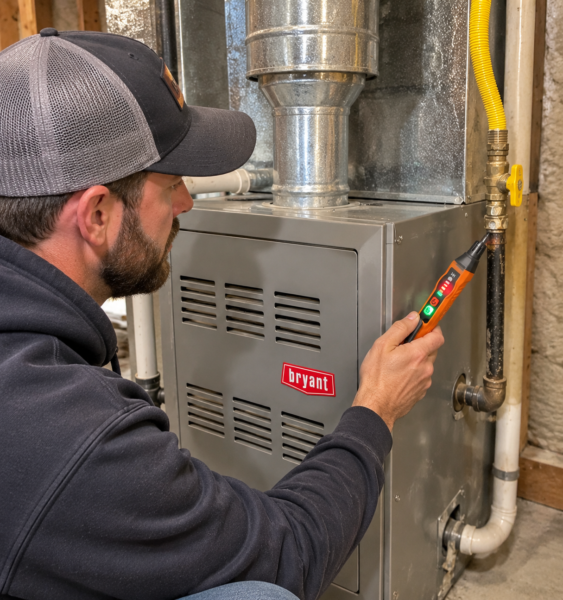
A handheld detector is more useful when you need to carefully check around a suspected source, such as a propane line connection, grill fitting, regulator, shutoff valve, furnace connection, or appliance hookup.
It is not a replacement for emergency action. If you have an active alarm, a strong propane odor, or a clear leak concern, get out and call for help first.
But for routine checks around outdoor grill lines and accessible connections, a handheld detector can be a very useful tool to have.
The TopTes handheld propane and natural-gas leak detector is the kind of portable sniffer that can help narrow down where a questionable smell or connection needs more attention.
How I would tell the difference between “possible spray reaction” and “call somebody now”
Aerosol spray becomes more believable as the cause when all of these things are true:
- The alarm began shortly after heavy spray, cleaning, painting, staining, or chemical use.
- There is no propane odor or hissing sound.
- No gas appliance is acting strangely.
- The detector settles back down after the house has aired out.
- The alarm does not return later when no chemicals are being used.
- A qualified person has no reason to suspect a real leak.
A real leak becomes more concerning when any of these things are true:
- You smell the rotten-egg propane odor.
- You hear hissing near a propane line, tank, appliance, or connection.
- The detector keeps alarming after the spray fumes should be gone.
- The reading rises again with no aerosol, cleaner, or solvent nearby.
- You see damaged hose, loose fittings, frost, corrosion, or an obvious problem around a connection.
- Anyone in the home feels sick, confused, unusually dizzy, or has breathing trouble.
- The alarm is near a propane appliance, furnace, water heater, fireplace, or line and you cannot confidently explain why it activated.
When in doubt, treat it like a real leak. It is much better to make a cautious call than to talk yourself out of taking an alarm seriously.

What I learned from my own alarm scare
I learned that I need to know exactly what each detector in my house is designed to sense.
I learned that strong aerosol sprays can affect combustible-gas detectors.
I learned that a number returning to zero after ventilation is reassuring, but it is not a lifetime certificate that every propane line is perfect.
And I learned that a detector making you nervous is not a bad thing. That is what it is there for.
The next time I use a lot of aerosol germ spray, paint, cleaner, adhesive, or another strong airborne product, I will think about the gas detector before I start wondering whether the house has a propane leak.