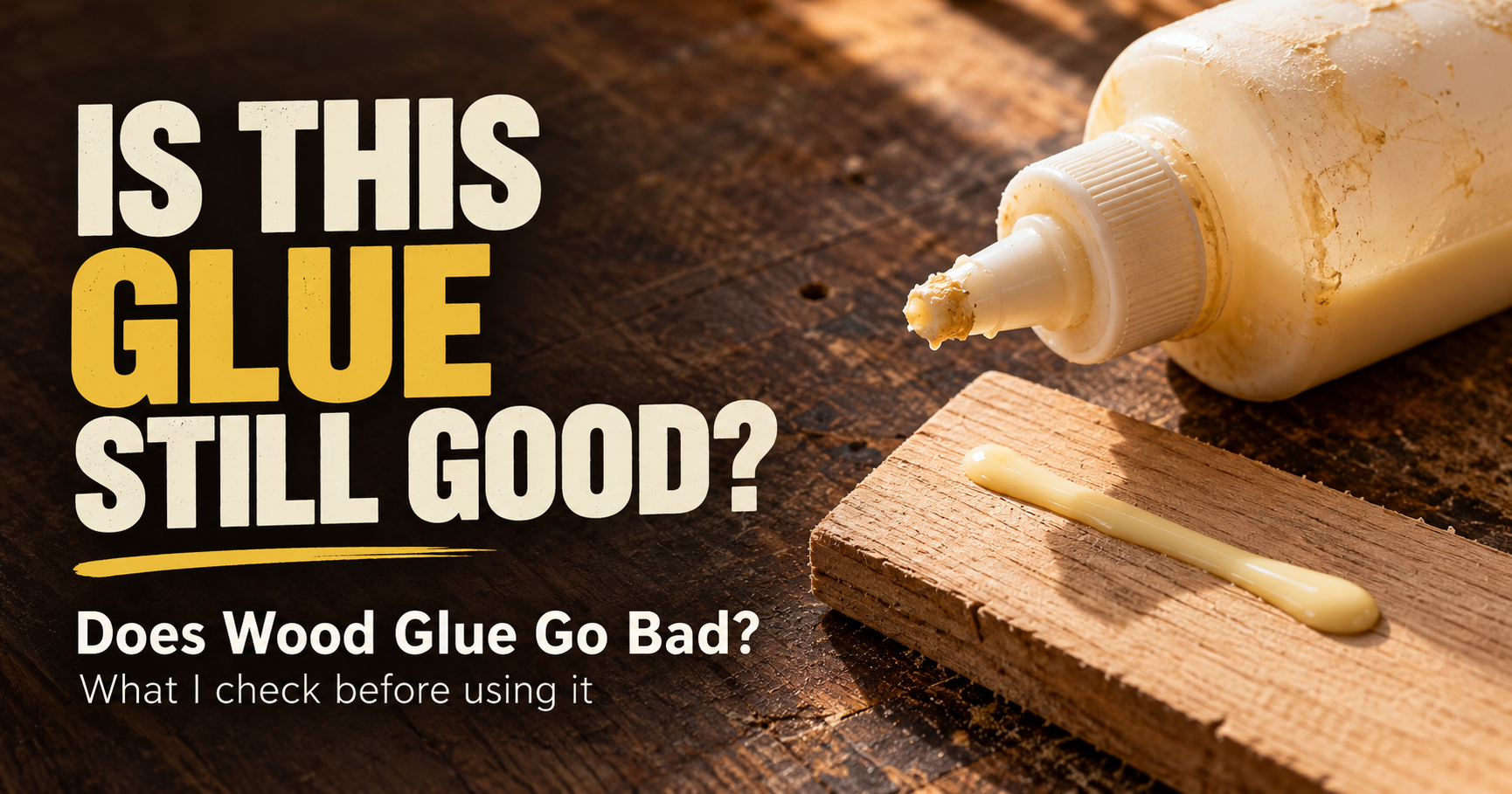
Wood glue absolutely can go bad. It may still pour from the bottle and look close enough to normal, but that does not mean I trust it on a chair, cabinet door, cutting board, or anything that has to stay together.
I have learned that the worst time to find out glue is bad is after clamps have been on a project for an hour. You take everything apart, expect a solid joint, and one piece slides loose like the glue was only pretending to work.
Before I use an older bottle, I check its age, texture, smell, and how it spreads on a scrap piece of wood. That small test is a lot cheaper than rebuilding a project that was almost done.
How long does wood glue last?
Most unopened bottles of wood glue last about one to two years when stored properly. Once opened, I try to use the bottle within a year, and sooner is better if it has been through a hot summer or a cold winter in the garage.
The label on the bottle is the place to start. Some brands print a date code, a manufacture date, or a recommended shelf life. If the bottle is well past that date, I do not automatically throw it away, but I do not blindly trust it either.
A bottle that has been sitting in a climate-controlled shop has a much better chance than one that spent two summers on a shelf by the garage door and froze twice in January.
Wood glue is inexpensive compared with the lumber, time, finish, and frustration that can go into a project. If I am gluing something important, fresh glue is one of the cheapest forms of insurance I can buy.

What does bad wood glue look like?
Good wood glue should look smooth and uniform when it comes out of the bottle. Most common yellow or white PVA glues should have a creamy, even consistency, almost like a thick sauce.
Bad glue often gives itself away right at the nozzle.
I watch for these signs:
- Lumps, rubbery bits, or little clots in the glue.
- Watery liquid separating from a thicker paste.
- Glue that looks grainy, curdled, or cottage-cheese-like.
- A bottle that is swollen, cracked, or leaking.
- Glue that has turned much darker than expected.
- A sour, rotten, or unusually sharp smell.
- Material that will not spread into a thin, even film.
A dried plug in the bottle tip is not always a disaster. Sometimes I can pull it out, wipe the nozzle clean, and find perfectly usable glue behind it.
But if chunks keep appearing as I squeeze, that bottle has earned retirement.
The simple scrap-wood test I use
When I am unsure about a bottle, I do not test it on the actual project. I grab two small scraps of the same kind of wood, spread a thin coat of glue, press them together, and clamp them.
I let the test joint cure based on the instructions on the bottle. Then I try to break it apart.
A good glue joint often makes the wood fibers tear before the glue line lets go. That is what I want to see.
If the pieces come apart cleanly along the glue line, the glue did not bond well enough. I do not care how smooth it looked coming out of the bottle. It is not going on my project.
This also catches another problem people sometimes blame on old glue: bad surface prep. If the wood was dusty, oily, painted, or coated with finish, even brand-new glue can fail. The test works best with fresh, bare wood surfaces.
Can wood glue go bad if it freezes?
Yes. Freezing can ruin many common wood glues.
Most yellow and white wood glues are water-based PVA products. When they freeze, the ingredients can separate. After the bottle thaws, the glue may look a little thicker, grainier, or less consistent than it used to.
Sometimes it seems normal until you try spreading it. Then it drags, clumps, or refuses to wet the wood evenly.
I do not store wood glue in an unheated garage through a Missouri winter if I can help it. A shelf in a basement, heated shop, or inside utility room is much safer.
A bottle that froze once is not necessarily useless, but it needs the scrap-wood test before I trust it. A bottle that froze repeatedly is usually not worth the gamble.

Can wood glue go bad from heat?
Heat is not as instantly destructive as a hard freeze, but long stretches of high heat are still rough on glue.
A hot garage, shed, or truck cab can make the glue break down faster. The bottle may thicken, separate, or start forming skin around the cap. Heat also shortens the useful life of an opened bottle because the glue has more opportunity to dry around the nozzle and cap.
I have seen bottles that were technically still within their date range but had obviously lived a hard life on a hot shelf. If the bottle is swollen or the glue smells odd, I do not talk myself into using it just because the date says I could.
Why wood glue gets thick and lumpy
Air exposure is usually the main culprit after a bottle has been opened.
Every time the cap comes off, a little air gets in. Glue around the nozzle begins drying first, and if the cap is not tightened well, the problem moves farther down into the bottle.
Old glue can also change from age alone. The ingredients slowly stop behaving the way they did when the bottle was new.
Freezing can separate the glue. Repeated heating and cooling can make it worse. Contamination can do it too. If sawdust, dried glue flakes, or dirt end up in the bottle, the glue may not stay smooth.
I try not to touch the nozzle directly to the wood when applying glue. It seems convenient in the moment, but that is a quick way to drag dust and wood fibers back into the bottle.

Is thick wood glue still usable?
Sometimes. Thickness by itself does not always mean the glue is bad.
A bottle that has been open awhile may become slightly thicker but still spread smoothly and bond well. If it looks uniform, has no chunks, and passes a scrap-joint test, I may use it for a normal project.
The question is whether it will still wet the wood properly.
Wood glue needs to spread into a thin layer across both mating surfaces. If it is too thick to spread easily, it can leave dry areas and prevent the joint from closing all the way.
I do not add water to a bottle just because it feels thick. That may seem like an easy fix, but it can change the glue’s performance and make it harder to know what strength I am getting.
For a minor shop jig or a quick repair, I might take a chance on a slightly thick bottle that passes a test. For furniture, cabinets, or something that will get handled every day, I use fresh glue.
What if wood glue separates in the bottle?
A small amount of separation does not always mean the bottle is ruined.
I shake the bottle with the cap tightly closed for a minute or two, then squeeze a small amount onto cardboard or scrap wood. If it mixes back into a smooth, creamy glue, it may still be okay.
If watery liquid comes out first, followed by thick clumps, I do not use it on anything important. The ingredients are no longer staying mixed the way they should.
The same common-sense rule I use with old caulk before sealing a project applies here: a tube or bottle can look fine from the outside while the material inside is no longer dependable.

Does yellow wood glue expire?
Yes. Yellow wood glue, often called carpenter’s glue, can expire.
It is usually a PVA glue and is great for many indoor wood projects. It works well for furniture repairs, face frames, trim, crafts, and plenty of basic shop work when the surfaces fit together correctly.
But yellow glue is still affected by time, freezing, heat, and air exposure. It does not stay perfect forever just because the bottle has a sturdy cap.
If I am using yellow wood glue on a chair rung, table leg, drawer, or other piece that will be under stress, I want a bottle that is smooth and reasonably fresh.
Does white wood glue expire too?
White wood glue can go bad for the same basic reasons as yellow glue.
White glue is often used for crafts, small repairs, and lighter woodworking jobs. It may be a little thinner than yellow carpenter’s glue, but it still should be smooth and even when it comes out of the bottle.
If it has become chunky, watery, stringy, or smelly, I do not use it. It might hold for a while, but I do not want to find out later that the repair was only held together by optimism.

Does Gorilla Wood Glue go bad?
Yes. Gorilla Wood Glue can go bad over time, just like other PVA wood glues.
The name on the bottle does not make it immune to freezing, overheating, or sitting half-open on a shelf. The right way to judge it is still the same: check the date, inspect the texture, and test it on scrap wood.
One thing I do not assume is that every Gorilla product behaves the same way. Gorilla Wood Glue, polyurethane glue, construction adhesive, and super glue are different products with different storage needs. I always check the label on the exact bottle rather than assuming one rule covers all of them.
Does Titebond wood glue go bad?
Titebond can go bad too, although a well-stored bottle can stay usable for a long time.
Titebond makes several formulas, including Original, II, and III, and they are not all meant for the same use. Titebond III, for example, is a popular choice when a project needs better water resistance, but it still needs proper storage and a working bottle.
I have found that clean storage makes a bigger difference than people think. A bottle with a wiped nozzle, snug cap, and indoor shelf usually stays usable much longer than one left crusted over in a cold garage.
No matter the brand, I would rather test older glue than assume the label guarantees it is still good.
How to tell whether old wood glue will still hold
The best answer is a real glue test, not just looking at the bottle.
Here is the process I use:
- Cut or grab two clean scraps of bare wood.
- Spread a thin, even layer of glue on one surface.
- Press the pieces together and clamp them firmly.
- Wipe off the squeeze-out and let the joint cure for the full time listed on the bottle.
- Try to break the pieces apart by hand or with gentle leverage.
- Look closely at where the failure happens.
If wood fibers tear away, the glue bond is doing its job.
If the two pieces pop apart right along the glue line, I consider the glue suspect. I would rather lose twenty minutes on a test than lose a finished project later.
Will bad wood glue dry at all?
Sometimes bad glue still dries. That is what makes it tricky.
A weak or old glue can form a dry-looking surface while producing a poor bond underneath. It may feel firm for a day, then fail when the joint is stressed.
That is why I do not judge it only by whether it gets hard on cardboard. A proper test joint tells me much more.
A good woodworking glue joint needs the glue to wet the wood fibers, close under clamp pressure, and cure correctly. If any part of that goes wrong, the joint may look fine until it is asked to do real work.
Can you use old wood glue for anything?
If a bottle seems questionable but still spreads reasonably well, I may use it for a low-stakes shop task after testing it.
That could mean a temporary jig, a simple mock-up, a small craft item, or something that will not carry weight or be handled much.
I do not use questionable glue for:
- Chairs, stools, benches, or ladders.
- Table legs, aprons, or joints that take stress.
- Cabinets, drawers, or doors.
- Cutting boards or food-contact items.
- Exterior projects.
- Repairs someone could get hurt from if they fail.
- Anything I would be annoyed to rebuild.
The word “probably” has no place in a glue joint that needs to stay put.
How to store wood glue so it lasts longer
Good storage is simple, and it makes a noticeable difference.
I keep the cap tight, wipe the nozzle after use, and store the bottle upright. That keeps dried glue from building up where I need it most.
I also keep it away from freezing temperatures and direct heat. A shelf inside the house, a heated shop, or a basement cabinet is usually better than an uninsulated garage.
I try to avoid storing it directly on a concrete floor too. Concrete can stay surprisingly cold, especially in winter. Setting the bottle in a cabinet or on a wood shelf is an easy improvement.
If I have more than one bottle, I use the older one first. It sounds obvious, but a fresh bottle is easy to grab while the older one gets quietly pushed to the back until it becomes a science experiment.
What is the shelf life of unopened wood glue?
For many common wood glues, unopened shelf life is around one to two years. Some formulas may differ, so I always check the manufacturer’s label when I have it.
The real answer depends on storage. A bottle kept at stable room temperature may last longer than expected. A bottle that froze, overheated, or sat in direct sun can fail much sooner.
If I find an unopened bottle that is old but looks normal, I test it before using it. If it is important enough to build, it is important enough to spend two minutes checking the glue.
Why did my wood glue fail if it was not expired?
Glue age is only one possible reason a joint fails.
Even brand-new wood glue can fail when:
- The wood surfaces are dusty, oily, painted, or finished.
- The pieces do not fit tightly together.
- Too little glue was applied.
- The glue was spread unevenly.
- The joint was clamped too loosely.
- The joint was clamped so hard that almost all the glue was squeezed out.
- The project was moved before the glue had enough cure time.
- The wrong type of glue was used for outdoor exposure or high moisture.
I pay attention to the joint fit before I ever open the glue bottle. Wood glue fills very small gaps, but it is not meant to rescue a loose, sloppy joint that needs a mechanical repair first.
Can I use wood glue that is past its date?
You can, if it still looks normal and passes a proper scrap-wood test. I just would not use it blindly.
The closer the project is to finished, expensive, or hard to remake, the less likely I am to gamble on old glue. Fresh glue is cheap. Rebuilding a cabinet door because the rail joint gave up later is not.
How do I know if wood glue is bad?
Bad wood glue may be lumpy, separated, grainy, stringy, unusually dark, sour-smelling, or difficult to spread. The surest check is gluing two wood scraps together and seeing whether the wood fibers tear before the glue line fails.
Can frozen wood glue still be used?
Maybe, but it needs testing first. Freezing can permanently separate water-based glue, even if it looks almost normal after thawing. If it does not become smooth again or fails a scrap-joint test, replace it.
Can I thin thick wood glue with water?
I do not recommend it for a project that matters. Adding water can change the glue’s performance and leave you unsure how strong the final bond will be. A fresh bottle is the safer move.
Should wood glue smell bad?
Fresh wood glue usually has a mild chemical smell, not a strong sour or rotten odor. If the smell seems noticeably off and the texture looks strange too, I treat that as a sign the bottle is done.
Is dried glue around the cap a problem?
Not necessarily. Clean the nozzle, remove the dried plug, and squeeze out a small test amount. If the glue behind it is smooth and passes a bond test, the bottle may still be usable.
Calder Voss writes about practical home fixes, garage projects, and the everyday household questions that usually show up five minutes before a project starts.