
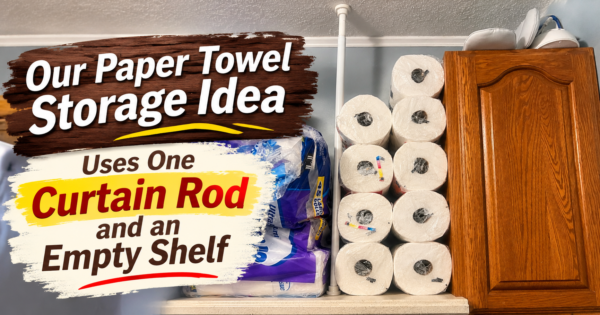
Paper towels are one of those things we always need but never seem to have a good place to put. We had room on the top shelf in our laundry room, but stacking the rolls was another story. They wanted to lean and tumble over instead of staying where we put them.
My wife came up with a simple paper towel storage idea that fixed the problem: she placed a curtain rod vertically between the shelf and the ceiling. The rod acts like a side wall, keeping the paper towel rolls contained between it and the cabinet next to the shelf.
That is it. No fancy organizer or complicated project. Just a curtain rod used in a way I would not have thought of.
Why Our Paper Towels Would Not Stay Stacked
We keep extra household supplies in our laundry room, and the upper shelf seemed like a reasonable place for paper towels. They are lightweight, and the space was already there.
The problem was their shape. A paper towel roll does not have a flat side to lean against the next roll. Once we tried to stack several, they could shift and tip without anything holding the outside of the pile in place.
On one side of our shelf, we have a tall cabinet. That gave the rolls something solid to rest against on the right. The other side was open.
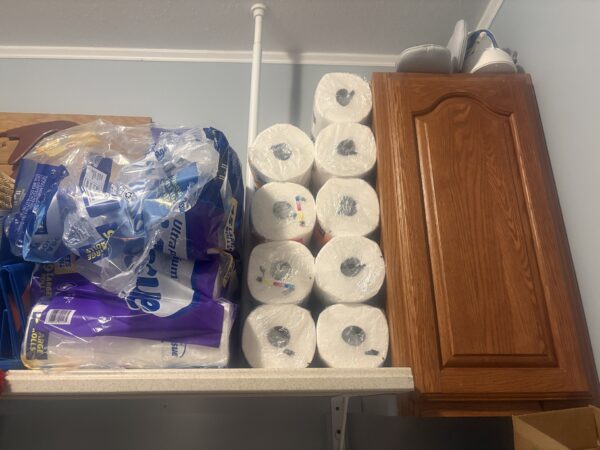
My wife’s idea was to give that open side a simple barrier. She positioned the curtain rod upright, with one end against the shelf and the other against the ceiling. Now the rolls sit between the rod and the cabinet instead of spreading across the shelf.
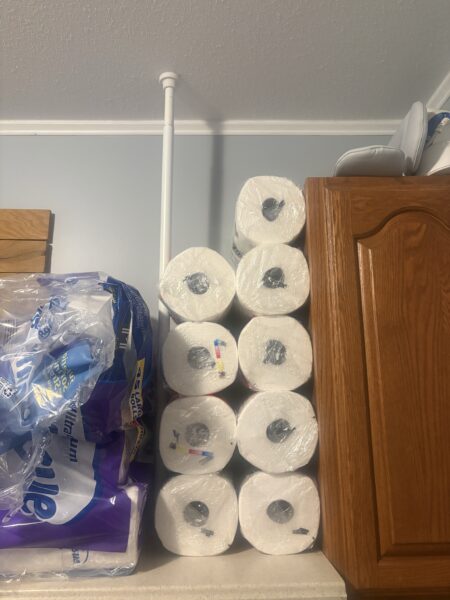
In our photos, you can see how the rolls are stacked in two columns with the round ends facing outward. The curtain rod runs up the left side, and the cabinet keeps the other side of the stack in place.
It is such a simple change, but it made that awkward space much more useful.
How the Curtain Rod Holds the Paper Towels in Place
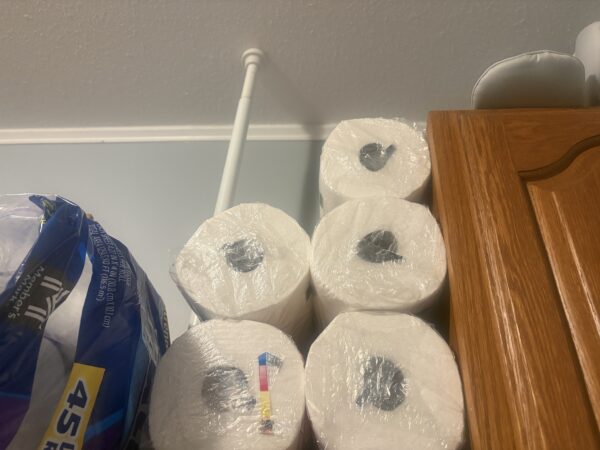
The rod is not running through the cardboard tubes, and the rolls are not hanging from it. The shelf supports their weight.
Think of the rod as a divider or a narrow fence post. It gives the rolls something to lean against so the stack does not fall sideways.
Our cabinet forms the other boundary. The wall behind the shelf helps define the space, too. Together, those surfaces turn an open section of shelf into a spot where we can stack the extra rolls.
That distinction matters if you try this yourself. The rod is there to contain lightweight rolls, not to hold up a heavy load.
You may need to adjust where the rod sits depending on the size of your rolls, the depth of your shelf, and what is on the other side of the stack.
What You Need for This Paper Towel Storage Idea
The setup itself is straightforward:
- A sturdy shelf with open space above it.
- An adjustable curtain rod or tension rod that fits between the shelf and the ceiling or the underside of another shelf.
- A wall, cabinet, or other suitable support on the opposite side of the rolls.
- Paper towel rolls, toilet paper, or another lightweight item to organize.
The important measurement is the distance from the top of the shelf to the surface above it. Check that measurement against the rod’s adjustable range before buying one. A rod that is too short will not reach, and one that is too long will not fit.
You also want to make sure the shelf and the surface above it can handle the pressure of a tension rod. If either surface flexes, feels loose, or could be damaged by pressure, find a sturdier location.
How to Make a Paper Towel Divider With a Tension Rod
If you have a similar shelf, here is how I would set one up.
Measure the Height Above the Shelf
Measure from the top surface of your shelf straight up to the ceiling or the underside of the shelf above it.
Do not assume every curtain rod adjusts to the same length. Check the minimum and maximum length on the package, and choose one that fits your measured space.
Also look at where the ends will make contact. They need stable surfaces, not a sagging shelf or a loose ceiling panel.
Decide How Wide You Want the Storage Area
Set a couple of paper towel rolls on the shelf next to the cabinet or wall that will support one side.
This gives you a better idea of where the rod should go. You want enough room for the rolls to fit without forcing them in, but not so much room that the stack can lean and tumble sideways.
Our setup fits two columns of paper towels between the rod and the cabinet. Yours might work better with one column, especially if the shelf space is narrow.
Place the Rod Vertically
Position the rod between the shelf and the surface above it, following the rod manufacturer’s instructions. If it is a tension-style rod, adjust it until it is secure without forcing it hard enough to damage either surface.
Make sure the rod is straight and that both ends are making solid contact.
Give it a gentle check before stacking anything beside it. If it slides, shifts, or will not stay secure, do not rely on it to contain the rolls. Try another location or a different organizer.
Stack the Rolls and Check the Fit
Place the rolls on their sides on the shelf, with the round ends facing outward, as we did in our laundry room.
Build the stack gradually and see whether the rolls stay between the rod and the cabinet or wall. Leave enough room to remove one without pulling the whole stack forward.
This is not a fixed rack, so you may need to experiment a little. If the rolls can slip past the rod or roll off the front of the shelf, lower the stack or add a suitable front barrier. A single vertical rod does not prevent movement in every direction.


Can You Use This Idea for Toilet Paper Too?
Yes. Extra toilet paper could work the same way, as long as the rolls fit securely in the space and the stack stays stable.
The smaller rolls may need a narrower space than paper towels. You could adjust the rod closer to the wall or cabinet, or use a separate section of shelf if you have enough room.
I would keep toilet paper and paper towels somewhere dry and away from leaks, dampness, and cleaning products that could spill. Their packaging helps, but it is not a good reason to store them next to a dripping pipe.
This could be useful in a bathroom closet, linen closet, pantry, laundry room, or utility room. The idea is the same: use an existing shelf for support and create a boundary where the rolls would otherwise tip over.
What If You Do Not Have a Cabinet Next to the Shelf?
Our setup works well because the cabinet provides a solid side for the paper towels. If your shelf is open on both ends, one rod alone might not give the rolls enough support.
One possibility is a second properly secured tension rod on the other side. Depending on the shelf and how the rolls sit, you might also need something across the front to keep them from rolling forward.
Another option is a shelf divider or a lightweight bin that fits the space. The goal is not to force this exact setup onto every shelf. It is to give the rolls enough support that you can actually use the vertical space without creating a paper towel avalanche.
Before loading it up, test whether the rolls stay put when you gently remove one. If the whole arrangement shifts, it needs a better boundary or a shorter stack.


Keep the Stack Easy to Reach
Our shelf is up high, which is useful for storing extra supplies but means we still need to be sensible about reaching them.
If a shelf is above your comfortable reach, use a stable step stool rather than climbing on the washer, dryer, or a nearby chair. Keep the area below clear, and do not reach blindly into a tall stack.
I would also avoid packing the rolls so tightly that you have to yank one free. The goal is to grab a roll when you need it, not start a wrestling match with the laundry room shelf.
Because paper towels are lightweight, this can be a practical use for higher storage. Heavy detergent bottles and bulky containers are better kept where you can lift them safely.
A Few Things I Would Avoid
This idea is simple, but a curtain rod is not a permanent wall.
- Do not use it to brace heavy objects. The shelf holds the paper towels. The rod only helps keep the lightweight stack contained.
- Do not overtighten it. Too much pressure can damage a ceiling, shelf, paint, or finish.
- Do not put the ends against weak or movable surfaces. A loose shelf or ceiling panel is not a good anchor point.
- Do not assume it cannot slip. Check the rod occasionally, especially after moving rolls or cleaning the shelf.
- Do not stack higher than the arrangement can safely contain. If the top rolls wobble or can fall forward, take a few down.
- Keep paper products clear of heat sources. Do not store them against a furnace, water heater, heater vent, or other hot equipment. Follow the appliance’s required clearances.
If you are organizing the rest of the laundry room too, our guide to whether laundry detergent expires covers another question that tends to come up when you find an old bottle hiding behind everything else.

Why I Like This Better Than Leaving the Rolls in a Pile
The best part of my wife’s idea is that it uses a space we already had. We did not need to find room for a large new cabinet just to store paper towels.
It also lets us see how many rolls are left. Instead of digging through a bulky package, we can look up at the shelf and see what we have.
And when we need to rearrange the shelf, the divider does not have to be a permanent addition. If your rod is a removable tension rod, you can reposition it as your storage needs change. Just check it again afterward to make sure it is secure.
Can you use a regular curtain rod vertically?
An adjustable tension-style curtain rod can work if it fits the space and the manufacturer’s instructions allow it to be secured between the surfaces. A rod that requires wall brackets is not automatically suitable for this setup.
Do you need two rods to store paper towels?
Not always. We use one rod because the cabinet next to our shelf supports the opposite side of the rolls. An open shelf may need another barrier, and some arrangements may also need a front stop.
Will the paper towels roll off the shelf?
They can if the stack is too tall, the rolls project beyond the shelf, or nothing prevents forward movement. Test the arrangement gently, keep the rolls fully supported, and add a suitable front barrier if needed.
Can this work without drilling?
It can if you use a properly fitted tension rod on suitable surfaces. Check the instructions for your particular rod, and remember that pressure can still leave marks or damage a delicate surface.
Can you use the same idea for other supplies?
It may work for other lightweight, soft items that fit securely on the shelf. I would not rely on a tension rod to contain heavy bottles, tools, glass containers, or anything that could cause injury if the rod slipped.