
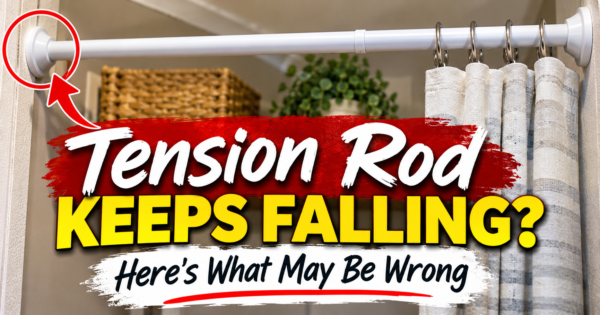
A tension rod that keeps falling usually has a problem with its fit, the surfaces it presses against, or the rod itself. Too much weight can also pull it loose. The frustrating part is that all of those problems can look exactly the same when the rod is lying on the floor.
I would start by taking everything off the rod and checking whether it can stay in place by itself. If it slips while empty, adding more weight is not going to improve its attitude.
My wife recently used a curtain rod vertically in our laundry room to help keep paper towels stacked on a shelf. That setup made me appreciate how useful a little rod can be when it is in the right place. It also got me thinking about what happens when one will not stay where you put it.
Whether yours is holding a shower curtain or acting as a lightweight shelf divider, the answer is not always “twist it harder.” Sometimes the rod is the wrong size, the end pads are worn, or the surface simply does not give it a dependable grip.
First, Figure Out What Actually Moved
Before reinstalling the rod, take a good look at how it came down. The way it moved can give you a useful clue.
One End Slid Down the Wall
If one end is lower than the other, that end probably lost its grip. The wall might be wet, dusty, uneven, or too slick for the end pad. The pad itself could also be worn or dirty.
A rod installed at an angle may be more likely to shift because the ends are not sitting squarely against the surfaces.
The Rod Became Shorter
Some adjustable rods have sections that twist or lock together. If the rod has shortened, its adjustment mechanism may not have been set correctly, or it may no longer be holding.
Check the manufacturer’s instructions for your particular rod. Not every tension rod tightens the same way, and twisting the wrong section can loosen it instead.
The Rod Stayed Up Until You Added Weight
If an empty rod holds but falls after you hang the curtain, shelf organizer, or other item, the load may be too heavy for the rod or the way it is installed.
A curtain can also pull on a rod when the rings catch. The issue might not be the curtain’s weight alone. A hard sideways tug every morning can slowly work a marginally fitted rod loose.


Take the Weight Off and Test the Rod by Itself
This is the quickest way I know to separate a fitting problem from a load problem.
- Remove the curtain, liner, hooks, or other items.
- Inspect both ends of the rod.
- Reinstall the empty rod according to its instructions.
- Check that it is level or straight for its intended position.
- Give it a gentle check for movement without hanging anything underneath it.
If the empty rod will not stay in place, focus on the fit, end pads, and surfaces first.
If it stays up empty but slips once the curtain goes back on, look at the load and whether the rings glide smoothly. Do not stand directly beneath the rod while testing it, and keep children and pets clear in case it falls.
Make Sure the Rod Fits the Opening
A tension rod needs two opposing surfaces to press against. For a shower rod, those are usually the walls at either end. For our laundry room shelf divider, the rod sits vertically between the shelf and the ceiling.
Measure the distance at the exact spot where the rod will go. Walls are not always perfectly parallel, and a measurement near the floor may not match one near the top of a shower.
Compare that measurement with the adjustable range printed on the rod or its packaging.
A rod outside its stated range is not the right fit. If it barely reaches the opening, it may not be able to maintain the intended tension. If it has to be forced into a space that is too narrow, it could bow or damage the surfaces.
I would also check that each end can sit flat. If one pad lands partly on trim, a grout line, a rounded corner, or an uneven patch, it may not make enough contact to grip properly.
Clean and Dry the Contact Surfaces
A tension rod relies on contact and friction at both ends. Soap residue, dust, moisture, oil, or a loose layer of old paint can interfere with that grip.
Remove the rod and clean the spots where the end caps touch. Use a cleaner appropriate for the surface, rinse if needed, and let the area dry completely before reinstalling.
Wipe the rod’s end pads too. If they are coated in soap film or dust, cleaning the wall alone may not solve the problem.
This is especially relevant in a shower. A rod might seem secure on dry tile, then start moving after moisture and soap residue build up around the ends.
Avoid mixing cleaning products while cleaning the area. You do not need a collection of chemicals to remove a little soap film.

Look Closely at the End Caps
Those small pads on the ends do a lot of work. If one is missing, cracked, flattened, hardened, or covered in residue, it may not grip the way it should.
Check that both caps are:
- Present and firmly attached.
- Clean and dry.
- Making full contact with the wall, shelf, or ceiling.
- Free of obvious cracks or damage.
- Appropriate for the surface according to the manufacturer.
If the manufacturer sells replacement end caps for your model, that may be an option. Otherwise, replacing the rod can make more sense than trying to make a damaged end grip with extra pressure.
A rod is inexpensive compared with repairing a damaged wall or having a loaded shelf arrangement come down.
Adjust the Tension the Way Your Rod Requires
Not every rod works the same way.
Some use a spring that compresses between the two surfaces. Others use a twist-to-adjust mechanism or a combination of an adjustable length and a spring. The correct installation method depends on the model.
If you still have the instructions, start there. If not, look for the manufacturer and model number on the rod or packaging.
The goal is firm contact, not maximum force.
Do not keep tightening until the wall dents or the shelf bends. A ceiling, drywall surface, cabinet panel, or shelf can be damaged by too much pressure. If the rod only stays up when you force it excessively tight, the fit or the mounting surfaces may be the problem.
Also, do not assume the rod is locked just because it feels tight for a moment. Some models need a specific adjustment or locking step. Follow the instructions and then check that it remains secure.
Check Whether the Curtain or Load Is Too Heavy
A tension rod may be fine for a lightweight shower curtain but a poor choice for a heavy curtain, a loaded hanging organizer, or several wet towels.
Look for a weight rating from the rod manufacturer. Remember that a stated rating depends on proper installation and suitable surfaces. A rating is not a guarantee that every wall, tile surface, or shelf can support that load.
If the rod is being used for storage, consider both the weight and the direction of the force.
A horizontal rod carrying hangers has weight pulling downward. A vertical rod used as a divider may have items pushing sideways against it. Those are different demands.
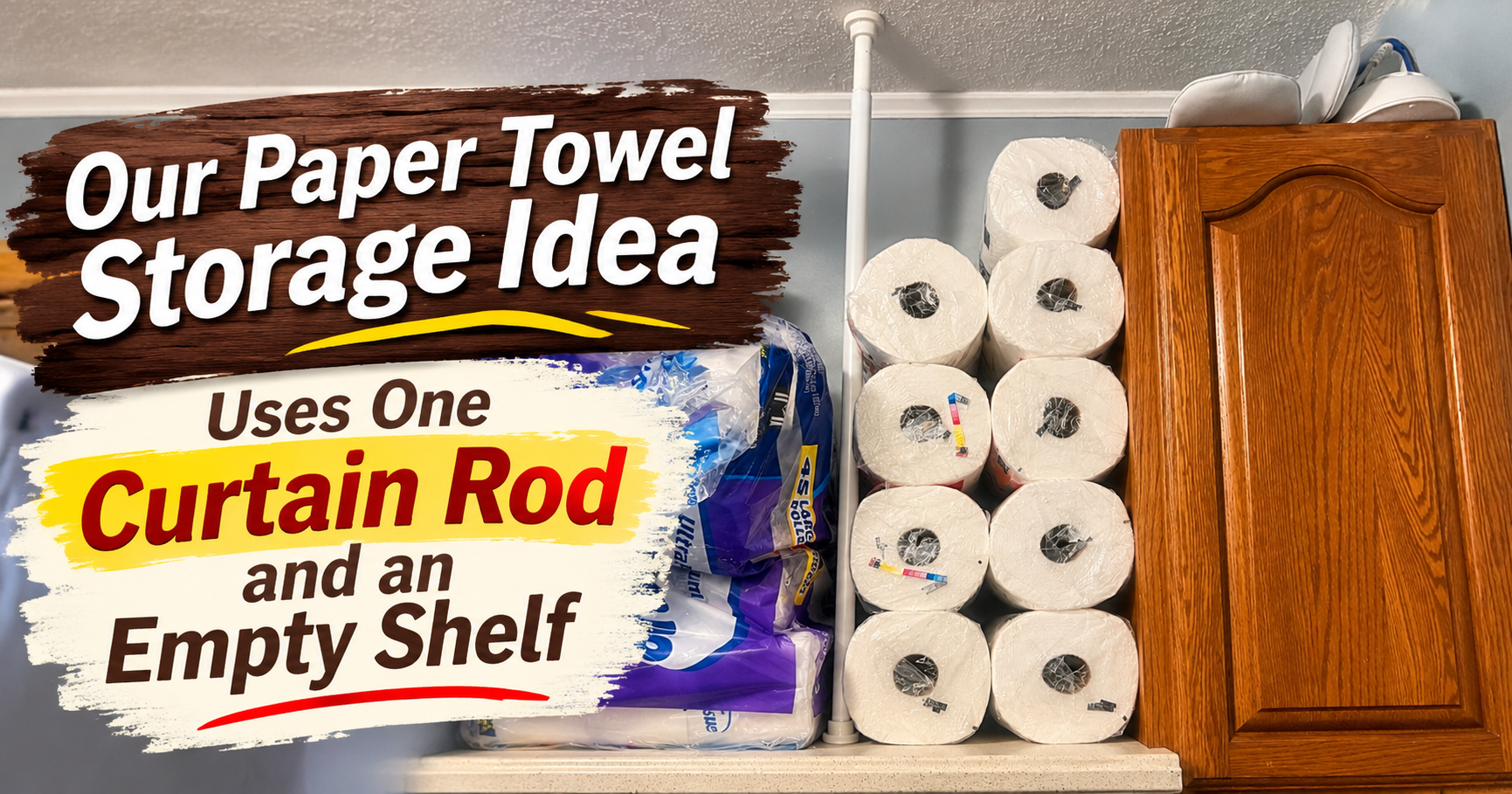
In our laundry room, the shelf supports the paper towels. My wife’s rod helps keep the lightweight rolls contained between it and the cabinet. It is not holding up a stack of heavy detergent bottles. You can see the arrangement in our curtain rod paper towel storage idea.
If removing some weight makes the rod stay put, that is useful information. Keep the load lighter or switch to a properly installed, load-rated solution.
Make Sure Shower Curtain Rings Move Easily
A shower curtain rod takes more than a steady load. Every time someone opens or closes the curtain, the rings can pull against it.
If the rings catch on a joint in the rod or drag across a rough spot, a hard tug can pull one end out of position.
Check for:
- A raised connection where the two rod sections meet.
- Damaged or bent curtain rings.
- Rust or rough spots on the rod.
- A curtain that is unusually heavy when wet.
- A rod that shifts when the curtain is opened.
Try sliding the curtain gently after reinstalling the rod. If the rings consistently catch, fix that issue rather than compensating by overtightening the rod against the walls.
And if the rod moves when the curtain is pulled normally, I would not trust it to stay in place just because it survived one careful test.

What If a Vertical Tension Rod Keeps Slipping?
A vertical rod, like one used between a shelf and ceiling, needs the same basics: a suitable rod, two solid contact surfaces, and the correct adjustment.
But there is an extra thing to consider. The stored items may push sideways against the rod when you add or remove them.
If a vertical rod slips:
- Take the items off the shelf before adjusting it.
- Check whether the shelf flexes when pressure is applied.
- Make sure the top and bottom ends are flat against solid surfaces.
- Check the rod’s fit and end pads.
- Reduce the number of items pressing against it.
- Test the arrangement gently before loading it again.
If the shelf moves downward when the rod is tightened, the rod may lose tension or damage the shelf. A loose ceiling panel is not a dependable upper contact point either.
For paper towels, a rod can act as a lightweight side divider when the arrangement is stable. It does not prevent rolls from falling forward, and it should not be treated as a structural support.
Can You Use Rubber Pads to Stop a Tension Rod From Slipping?
Some manufacturers sell compatible non-slip pads or protective cups for their rods. If yours does, check whether they are suitable for the surface and for the way the rod is being used.
I would be cautious about adding random pieces of rubber, putty, tape, or adhesive under the ends. They can shift, leave marks, damage finishes, or prevent the end cap from sitting flat. A pad that helps on one surface may make another setup less dependable.
If you try a manufacturer-approved accessory, follow its instructions and check the surface first. Painted walls, wallpaper, tile, and finished cabinets can react differently to pressure or adhesive.
A tension rod is often described as “no drill,” but no drill does not always mean no marks. Test a discreet area when appropriate, and do not use an accessory that requires you to apply excessive pressure to make the rod stay put.
When It Is Better to Replace the Rod
Sometimes a slipping rod is telling you it is done.
I would consider a replacement if:
- The end caps are damaged and cannot be replaced.
- The rod will not lock at the adjusted length.
- The spring or internal mechanism no longer maintains tension.
- The rod is bent or badly corroded.
- The opening is outside its intended size range.
- It repeatedly slips despite being clean, properly fitted, and lightly loaded.
A new rod is not automatically the answer if the walls are unsuitable or the load is too heavy. But a damaged rod is not going to improve because you have argued with it for another twenty minutes.
When to Use a Bracket-Mounted Rod Instead
Tension rods are handy because they can often be installed without drilling. They are not the best solution for every opening.
A properly mounted rod may be more dependable when:
- The curtain or stored items are too heavy for a tension rod.
- The opening is unusually wide.
- The walls are uneven or the contact surfaces are weak.
- The rod is repeatedly pulled sideways.
- A falling rod could injure someone or damage something below.
A bracket-mounted rod needs the right fasteners and a suitable wall structure. Screws driven into unsupported drywall are not the same as a properly secured installation. Follow the hardware instructions or get help if you are unsure how the wall is built.
In a rental, check the lease or ask the property owner before drilling. If drilling is not an option and a tension rod will not stay secure, a different storage arrangement may be the safer choice.
Common Questions About Tension Rods Falling
Why does my tension rod keep falling even when it feels tight?
It may be the wrong size, sitting at an angle, slipping on a dirty or smooth surface, or pressing against a damaged end pad. The adjustment mechanism may also be loosening. Remove the load and check each possibility before adding more pressure.
Can a tension rod damage drywall?
Yes. Excessive pressure, a rod that slips, or an unsuitable end pad can dent, scuff, or damage drywall and paint. Use the rod as directed and stop if the surface begins to deform.
Will a longer tension rod stay up better?
Not necessarily. The rod needs to fit within its manufacturer’s stated range. A longer rod that is wrong for the opening can be just as troublesome as one that is too short.
Why does my shower curtain rod fall when I close the curtain?
The rings may be catching, the rod may be loose, or the curtain may be too heavy for the setup. Check that the rings slide smoothly and that the empty rod is secure before putting everything back.
Can I use a tension rod vertically for storage?
A suitable rod can sometimes be used vertically as a lightweight divider between solid surfaces. Check the manufacturer’s instructions, make sure it is secure, and do not depend on it to hold heavy items. The shelf should support the stored items.
Should I glue a falling tension rod to the wall?
I would not rely on glue as a quick fix. Adhesive can damage the surface or fail under load, and it may hide the real problem. Check the fit, end caps, and surfaces first. If you need permanent support, use hardware designed for that purpose.