
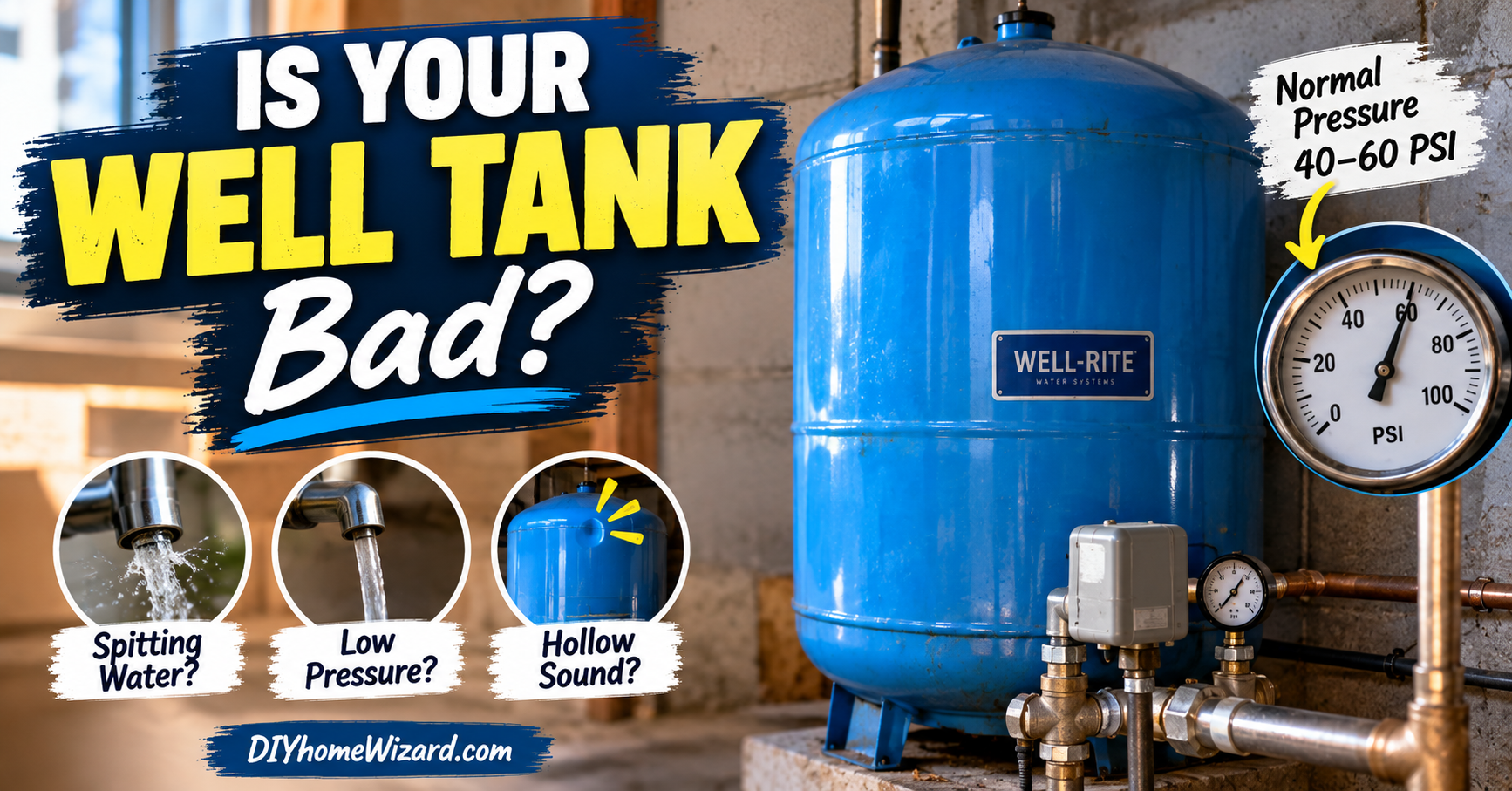
A well pressure tank may be bad if the pump turns on every few seconds, water pressure surges, the tank will not hold its air charge, or water comes out of the air valve. The most convincing sign of a failed bladder tank is water at the air valve, but I check the entire pressure system before buying a replacement.
That last part matters. A bad pressure switch, clogged filter, plumbing leak, failing check valve, or weak pump can create similar symptoms.
Pressure tanks are big, heavy, and not especially cheap. I want more evidence than “the shower feels weird” before dragging a new one into the basement.
What Does a Well Pressure Tank Actually Do?
The pressure tank gives the well pump room to breathe.
Without a working tank, the pump might have to start every time someone briefly opens a faucet, flushes a toilet, or fills a glass. Those repeated starts create heat and wear inside the pump motor.
The tank stores a smaller amount of usable water under pressure. When I open a faucet, compressed air inside the tank pushes that water into the plumbing.
As water leaves, system pressure falls. The pressure switch eventually reaches its cut-in setting and starts the pump.
The pump supplies the house and refills the pressure tank. Once pressure reaches the switch’s cut-out setting, the pump shuts off.
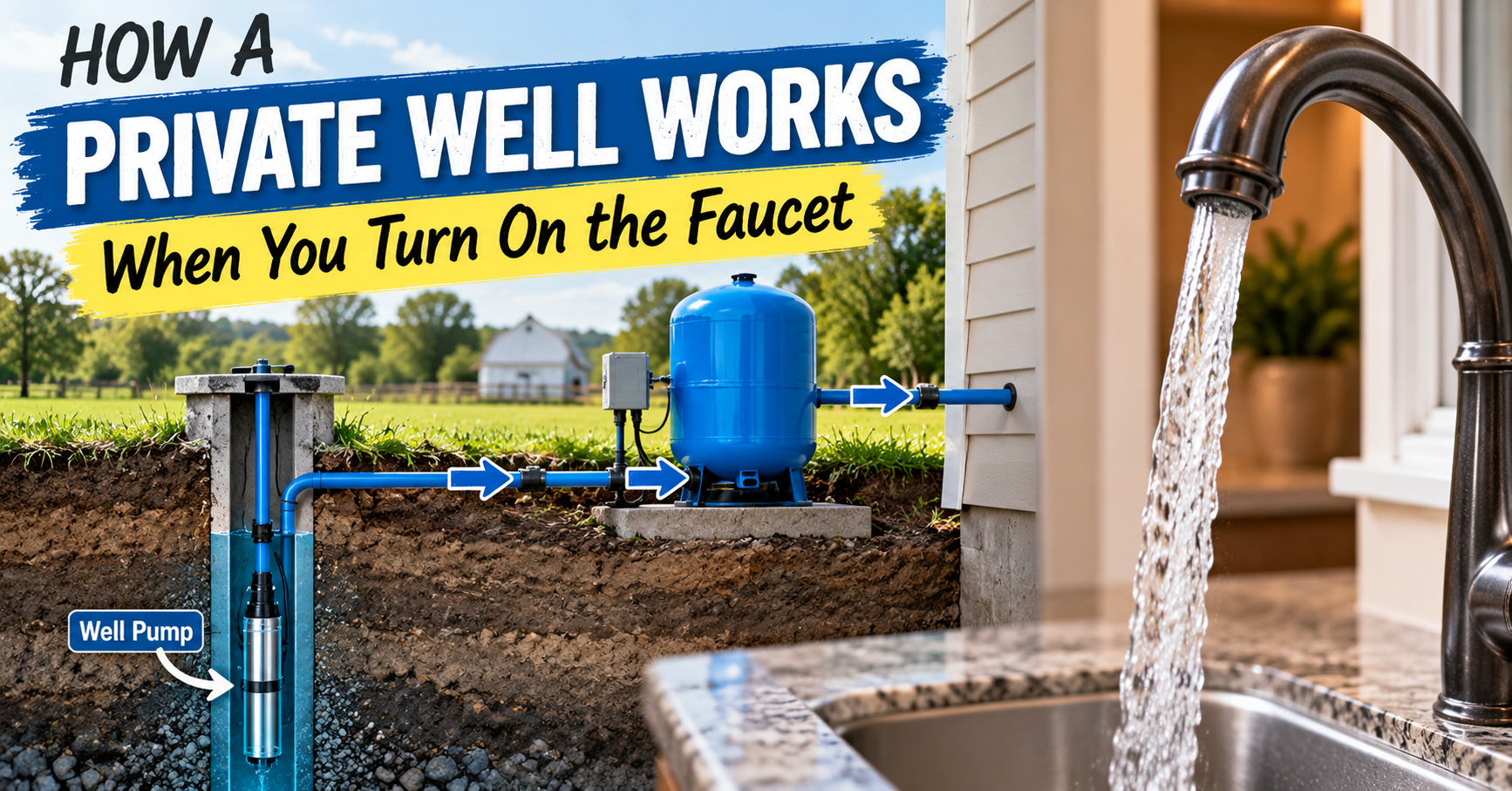
Our guide explaining how a private well supplies water when a faucet opens walks through the complete process from the groundwater to the plumbing fixtures.
When the pressure tank stops doing its part, the pump is forced to pick up the slack. That is often when the clicking, surging, and rapid cycling begin.

The Biggest Warning Signs of a Bad Well Pressure Tank
A pressure tank can fail suddenly, but the symptoms often appear gradually.
I pay attention to changes in how the system behaves rather than waiting until the house completely loses water.
Common signs of a bad well pressure tank include:
- The well pump starts and stops every few seconds.
- Water pressure repeatedly becomes stronger and weaker.
- The pump starts after using only a small amount of water.
- The tank has lost its air charge.
- Water comes out of the tank’s air valve.
- The pressure gauge rises and falls unusually fast.
- The tank makes new banging or thumping sounds.
- The pump runs much more frequently than it used to.
- The tank or its connection is leaking.
- The pump cycles while one steady faucet remains open.
None of those symptoms alone proves the tank is bad. However, several of them happening together make the tank a much stronger suspect.


Why Does a Bad Pressure Tank Make the Pump Cycle So Fast?
A properly operating tank provides drawdown. Drawdown is the usable amount of water the tank supplies before the pump needs to start again.
The tank creates this drawdown with compressed air.
As the pump adds water, the air becomes compressed. That compressed air then pushes water back out when a fixture opens.
If the tank loses its air cushion or the internal bladder fails, there may be very little stored water available. Opening a faucet causes pressure to drop almost immediately.
The pressure switch starts the pump. Because the tank cannot accept a normal volume of water, pressure quickly reaches the cut-out setting.
The pump stops.
A few seconds later, pressure falls and the pump starts again. The system gets trapped in a rapid start-stop pattern known as short cycling.
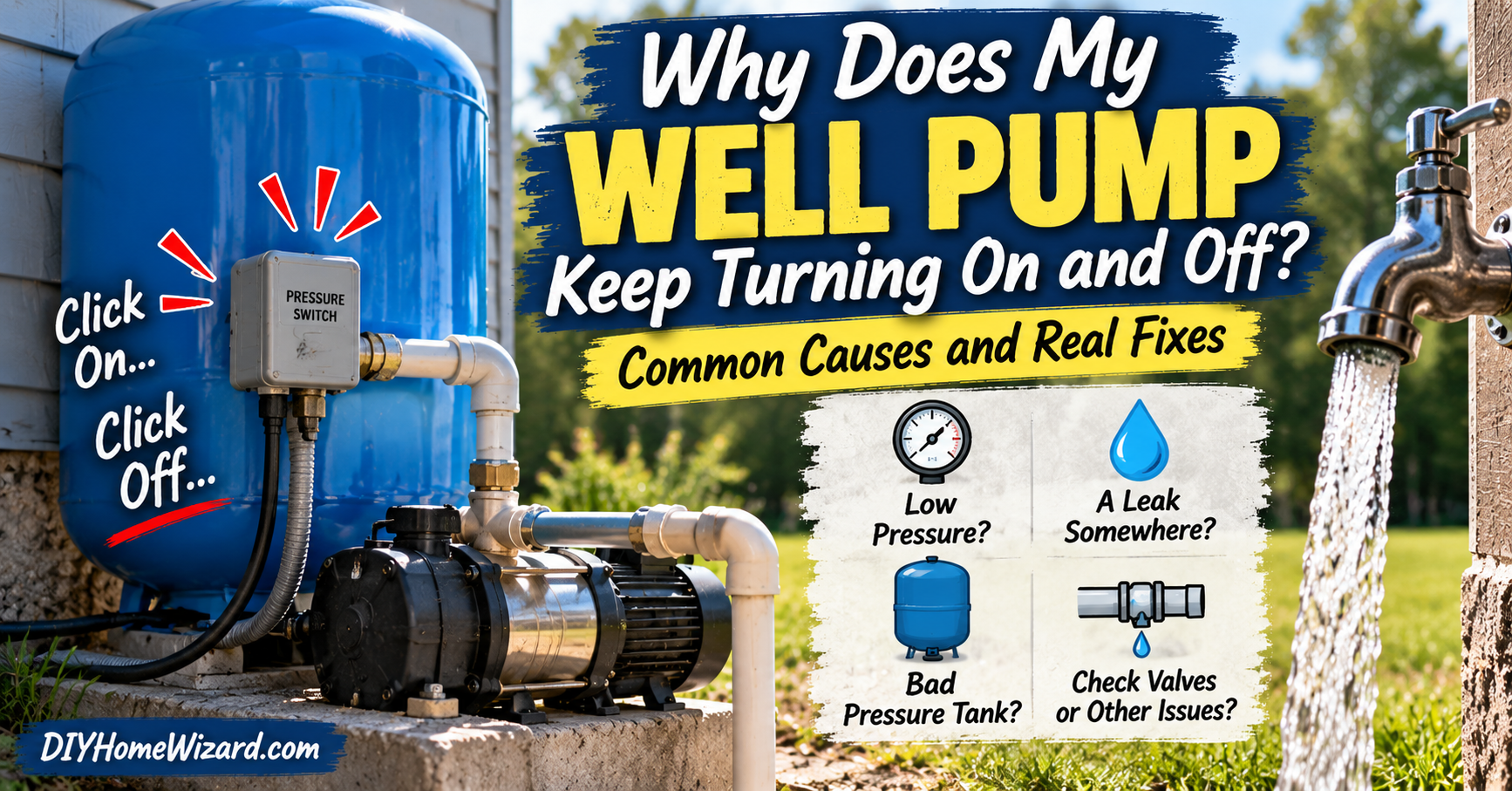
If that is what your system is doing, our guide to why a well pump keeps turning on and off explains the other possible causes worth checking.
Is My Pressure Tank Bad If the Pump Runs Every Few Seconds?
Rapid cycling is one of the strongest pressure-tank warning signs, but I do not convict the tank without checking for other evidence.
A plumbing leak can repeatedly lower pressure. A failed check valve can allow water to flow backward. A clogged pressure-switch connection can make the switch behave unpredictably.
The pattern helps narrow it down.
If the pump rapidly starts and stops while I run one steady faucet, the tank may have lost most of its drawdown.
If the pump starts every few minutes while nobody is using water, I become more suspicious of a leak or failed check valve.
If the pump runs continuously and struggles to build pressure, I look beyond the tank toward the pump, well yield, underground pipe, or another restriction.
The tank is certainly involved in controlling cycles. That does not mean it caused every strange pump cycle.



Water Coming From the Air Valve Is a Major Clue
Most modern bladder pressure tanks have an air valve near the top. It looks similar to the valve used on a car or bicycle tire.
Behind that valve should be compressed air.
If water comes out of the air valve, the internal bladder or diaphragm has probably failed. Water has crossed into the side of the tank that is supposed to contain air.
That is one of the clearest signs that a bladder-style pressure tank needs replacement.
I do not repeatedly press the valve while the system is running. If the bladder has failed, releasing more air can make the cycling problem worse.
A quick, careful check may provide the answer, but I still confirm the tank type and follow the manufacturer’s instructions. Older air-over-water tanks operate differently and should not be diagnosed exactly like modern bladder tanks.
What If Only Air Comes Out of the Valve?
Air coming from the valve does not automatically mean the tank is healthy.
The tank may still have the wrong precharge. It could be several pounds low, far too high, or leaking air slowly.
A correct pressure reading requires the tank to be empty of water.
That means I must:
- Shut off electrical power to the well pump.
- Open a faucet or drain valve.
- Allow the water pressure to fall completely to zero.
- Confirm the pressure gauge reads zero.
- Measure the tank’s air pressure with an accurate gauge.
- Compare the reading with the tank and pressure-switch requirements.
I do not check precharge while the tank remains pressurized with water. That reading includes pressure from the water system and does not tell me the tank’s true empty precharge.
I also do not start draining or adjusting a tank unless I know how to safely isolate and restart the system. A contractor is cheaper than flooding the mechanical room and then needing a contractor anyway.



What Should the Air Pressure Be in My Well Tank?
For many bladder-style systems, the empty-tank precharge is set approximately 2 PSI below the pressure switch’s cut-in setting.
A 30/50 system commonly uses about 28 PSI of precharge.
A 40/60 system commonly uses about 38 PSI.
Those are common examples, not universal instructions. I verify the actual switch setting and the tank manufacturer’s directions before changing anything.
I never rely only on what is printed inside the pressure-switch cover. A previous owner may have adjusted the switch, replaced it with a different model, or changed the tank without matching everything correctly.

I watch the operating pressure to identify the actual cut-in and cut-out points. Our existing guide on checking household water pressure with a gauge helps explain what the readings mean. A water pressure test gauge can make those cut-in and cut-out readings easier to verify.
Amtrol lists a 38 PSI factory precharge for several of its residential tanks, but the installed precharge still needs to match the particular system. The company provides tank-specific specifications and instructions through its Well-X-Trol pressure tank information.
Can I Add Air and Fix the Pressure Tank?
Sometimes a tank has simply lost air and can be recharged. Other times, adding air only hides a failed bladder temporarily.
If the bladder is intact and the tank holds pressure, restoring the correct precharge may return the system to normal operation.
If the air pressure falls again, I begin looking for an air-valve leak, failed bladder, or damaged tank.
If water comes from the air valve, adding air will not repair the ruptured internal barrier. It may temporarily change how the system behaves, but the tank is still bad.
Older air-over-water tanks can gradually lose their air cushion without having a bladder failure because they do not contain a bladder. Those systems may use an air-volume control or another method of maintaining the air charge.
This is why I identify the tank style before using advice intended for a different design.
A pressure tank is one of those things that looks wonderfully simple from the outside. Unfortunately, it has no little window where I can watch the bladder misbehave.



Does Knocking on the Tank Tell Me If It Is Waterlogged?
The knock test is popular because it requires no tools and makes a person look like they know exactly what they are doing.
The basic idea is that the upper portion of a healthy bladder tank should sound more hollow because it contains air. The lower water-filled area should sound heavier or duller.
A completely waterlogged tank may sound solid or dull over most of its height.
This can provide a clue, but I would not replace a tank based only on how it sounds when I tap it.
Tank shape, construction, water level, nearby walls, and insulation can all affect the sound. A tank can also have an incorrect precharge without being completely waterlogged.
I use the knock test as one piece of evidence. Pump-cycle timing, pressure behavior, the air-valve check, and a correctly performed precharge test tell me much more.
If I find myself knocking on it for ten minutes hoping it will confess, it is time to get the pressure gauge.
How Can I Measure the Tank’s Drawdown?
Drawdown is one of the best ways to judge whether the tank is still providing useful water storage.
I start with the pump off at its normal cut-out pressure and make sure no other fixtures are running. Then I collect or measure the water from one fixture until the pump starts.
The amount of water used before the pump starts is the tank’s approximate drawdown under those operating conditions.
I compare that amount with the expected drawdown for the tank model and pressure setting.
A large tank that produces only a cup or two before the pump starts clearly is not doing much for the system.
However, measuring drawdown is not always as easy as placing a bucket under a faucet. A high-flow fixture can be difficult to measure accurately, and the expected capacity varies with pressure settings.
I treat this as another diagnostic clue rather than a laboratory-perfect test.
If the tank’s label is readable, I look up the manufacturer’s drawdown chart for the actual model and operating pressure. That is more useful than comparing the tank with a random chart for a completely different model.


Why Is My Water Pressure Surging?
A bad pressure tank can make water pressure swing between noticeably strong and weak.
I may feel the shower become forceful when the pump starts, then gradually weaken as pressure falls. The cycle repeats over and over.
Some fluctuation is normal on a conventional pressure system. A 40/60 setup naturally operates through a pressure range rather than holding exactly one pressure all the time.
The warning sign is a rapid or extreme change.
A waterlogged tank may move through the entire pressure range after only a small amount of water is used. The pump starts, pressure quickly climbs, and the pump stops again.
A clogged filter can also make pressure feel weak while water is flowing. That is why I compare the pressure-gauge movement with what I feel at the fixture.
If the gauge cycles normally but the shower remains weak, a clogged filter, restricted pipe, valve, or showerhead may be more likely.
If the gauge races up and down alongside the surging water, the pressure tank or controls deserve a closer look.
Could a Clogged Filter Look Like a Bad Pressure Tank?
Yes. A clogged whole-house filter can create low flow, falling shower pressure, and disappointing performance throughout the house.
The difference is often visible at the pressure gauge.
If the pump and pressure tank cycle normally but water flow becomes weak after passing through the filter, the tank may be fine.
I check whether the problem began gradually as the filter collected sediment. I also look at when the cartridge was last replaced.
If an outside faucet branches off before the filter, I compare its flow with an indoor fixture located after the treatment equipment.
Strong flow before the filter and weak flow after it point toward a restriction in the filtration or household plumbing.
I follow the filter manufacturer’s instructions if the system has a bypass. I do not loosen a filter housing while it is under pressure unless I want the basement ceiling washed from below.
Could a Plumbing Leak Make the Tank Look Bad?
A leak can make the pump cycle when nobody is intentionally using water.
The tank supplies water to the leak, pressure falls, and the pump starts. After the pump restores pressure, the process begins again.
A quiet toilet leak is a common culprit. Water slips from the tank into the bowl, the toilet refills, and the well pump becomes an unwilling participant.
Other possibilities include an outside faucet, irrigation line, livestock waterer, water softener, filter drain, underground pipe, or leaking water heater.
I close every fixture and watch the pressure gauge.
If pressure steadily falls while no water should be moving, I look for a leak or backward flow before blaming the pressure tank.
A failed tank tends to reveal itself most clearly during water use because it has lost drawdown. A leak can make an otherwise healthy system cycle while the house is quiet.
Could the Check Valve Be the Real Problem?
A check valve prevents water from flowing backward toward the well after the pump stops.
If the valve no longer seals, system pressure can gradually fall without any household water use. The pump restarts to replace the water that slipped backward.
This can look like a tank problem from across the room. The pump keeps cycling, but the timing is different.
A tank with almost no drawdown may cause cycles seconds apart while a faucet is open. A leaking check valve may cause cycles several minutes apart while every fixture is closed.
A buried water-line leak can produce a similar pattern. I cannot identify the exact cause solely by watching the gauge.
A well contractor may need to isolate parts of the system, measure pressure loss, and inspect equipment inside the well.
I would rather pay for a proper diagnosis than replace the pressure tank and discover the pump is still waking me up every ten minutes.
Can the Pressure Switch Cause Similar Symptoms?
The pressure switch tells the pump when to start and stop. Problems with the switch or the small pressure-sensing connection beneath it can create irregular cycling.
Iron, sediment, rust, or mineral buildup may clog the narrow fitting that carries water pressure to the switch.
The switch may then respond late, chatter, or operate at inconsistent pressures.
I become more suspicious of the switch when:
- It clicks rapidly or chatters.
- The gauge and switch behavior do not seem to match.
- The pump starts at different pressures from one cycle to another.
- The pump continues past its expected cut-out pressure.
- The switch has visible corrosion or heat damage.
- There is a burned electrical smell.
I can inspect the outside without opening anything. I leave internal electrical testing to someone who knows how to verify the power is off and evaluate the controls safely.
The pressure-switch cover is small, but the voltage inside is very real.
Is the Pressure Gauge Giving Me Bad Information?
A pressure gauge can stick, clog, or fail.
If the needle never moves, jumps suddenly, or remains at an impossible reading after the system is completely depressurized, I question the gauge.
Sediment can block the small opening feeding it. Internal parts can also wear out.
I do not diagnose an expensive pressure tank from one questionable gauge. I compare its reading with the system’s actual behavior and, when needed, have the pressure verified with a reliable test gauge.
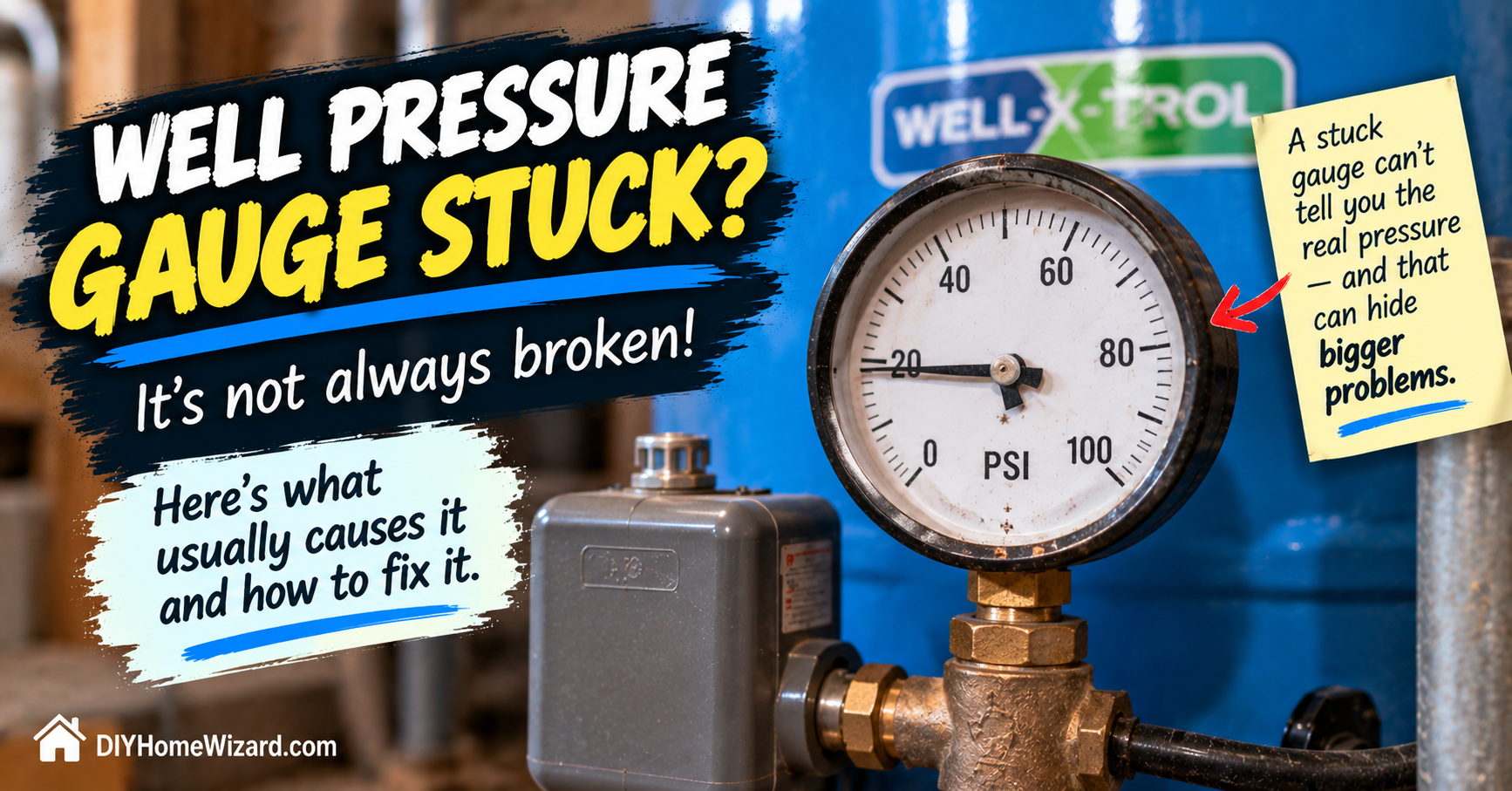
A bad gauge does not usually cause the pump to short cycle by itself. It makes the cycling harder to understand because I cannot see what the pressure is actually doing. Before interpreting the cycling, A bad gauge shows how to verify whether the pressure reading is trustworthy.
Replacing a faulty gauge may be a relatively small repair, but the system must be shut down and depressurized before removing it.
Water under pressure has an impressive ability to find the one direction I did not want it to go.
Can a Pressure Tank Be Bad Without Leaking?
Absolutely.
The steel shell can look clean and dry while the bladder inside has failed. The tank may lose its drawdown without leaving a puddle on the floor.
That is why I do not judge a tank only by its outside appearance.
A visible leak does confirm a problem. Water around the tank connection may come from a loose fitting, corroded tank tee, relief valve, drain, or the tank itself.
A tank leaking through its steel shell should be replaced. Rust can weaken the metal, and patching a pressurized tank is not a repair I trust.
A dry tank can still be bad internally. A wet floor simply makes the diagnosis louder.
How Long Does a Well Pressure Tank Usually Last?
Many pressure tanks last roughly 10 to 15 years, but that range is not a promise.
Water quality, tank construction, installation, pump cycling, pressure settings, moisture, and maintenance all affect lifespan.
A correctly sized tank in a dry location may last much longer. A small tank forced through constant cycles may fail sooner.
Corrosive water can damage metal components. Condensation can also rust the tank from the outside, particularly in a damp basement or crawl space.
I consider age when evaluating symptoms, but I do not replace a working tank simply because it reached a certain birthday.
An older tank with rapid cycling, lost precharge, rust, or water at the air valve has a stronger case against it. An older tank that still holds air and provides proper drawdown may have useful life left.
Can a Pressure Tank Be Too Small?
A tank can be perfectly healthy and still be too small for the pump.
An undersized tank provides limited drawdown. The pump starts more frequently because the stored water is used quickly.
Tank sizing should consider the pump’s flow rate, motor size, pressure-switch range, and required minimum run time.
The number of people in the house matters because it affects water demand, but it is not the only factor.
A larger tank generally provides more drawdown and can reduce pump starts. However, simply buying the largest tank that fits through the door is not a complete sizing method.
If frequent cycling has occurred since the system was installed, I consider undersizing or incorrect setup.
If the cycling began suddenly after years of normal operation, a failing bladder, lost air charge, leak, or control problem is more likely.
Should I Replace the Tank or Try Recharging It?
I base that decision on what actually failed.
If the bladder is intact and the tank merely has an incorrect air charge, adjusting the precharge may solve the problem.
If the tank repeatedly loses air, I check for a leaking air valve or internal failure.
If water comes from the air valve, the bladder has probably ruptured and the tank normally needs replacement.
I also replace a tank with severe exterior corrosion, a leaking shell, damaged connection, or pressure rating that does not match the system.
Repeatedly adding air to a failed tank may temporarily reduce short cycling, but it does not restore the internal bladder. The problem will return.
There is no prize for keeping a failing pressure tank alive with a compressor and stubbornness. The goal is to protect the pump and restore dependable water pressure.
What Happens If I Ignore a Bad Pressure Tank?
A failed pressure tank can force the pump to start far more often than intended.
Repeated starts create heat and electrical stress in the pump motor. They also wear the pressure-switch contacts and other controls.
The tank may be the part that failed first, but the pump may become the much more expensive casualty.
The National Ground Water Association’s maintenance guidance identifies frequent cycling as a warning sign that the system needs professional attention.
Short cycling can also create annoying pressure swings throughout the house. Showers surge, toilets affect faucets, and appliances receive inconsistent water flow.
I do not panic because the pump cycled twice while several fixtures were running. I become concerned when it repeatedly starts and stops within seconds during ordinary use.
That pattern deserves attention before the pump is damaged.
My Quick Pressure-Tank Checklist
Before deciding the well pressure tank is bad, I gather a few basic facts.
I write down:
- How often the pump starts.
- How long each cycle lasts.
- Whether cycling happens while water is running.
- Whether it happens with every fixture closed.
- The approximate cut-in pressure.
- The approximate cut-out pressure.
- Whether the gauge moves smoothly.
- Whether pressure surges at the faucets.
- Whether the tank or fittings are leaking.
- Whether water appears at the air valve.
- The tank’s model and approximate age.
- Whether the problem started suddenly or gradually.
That information gives a well contractor something useful to work with. “The blue tank seems upset” is accurate in spirit, but it does not narrow the diagnosis much.
When I Stop Testing and Call Someone
Some checks can be made by watching the gauge and listening to the pump. Other situations call for professional help immediately.
I shut off power and stop using the system when I notice:
- Water spraying near electrical components.
- A burning smell.
- Smoke, melted plastic, or visible sparks.
- A pressure switch chattering violently.
- Pressure climbing past the normal shutoff point.
- The pump repeatedly tripping its breaker.
- Severe tank corrosion or an active shell leak.
- The pump running continuously without building pressure.
- Grinding or other severe pump noises.
- Any situation I cannot safely depressurize or isolate.
I never bypass the pressure switch, hold electrical contacts closed, or keep resetting a tripping breaker. Those actions may force the pump to run, but they can also create a much larger problem.
The Signs I Trust Most
No single symptom identifies every failed pressure tank. I look for a pattern.
The strongest combination is rapid pump cycling, almost no usable water between starts, wild movement on the pressure gauge, and water coming from the tank’s air valve.
Water at the air valve is especially convincing on a bladder-style tank. It means water reached an area intended for compressed air.
If the tank simply has low precharge but holds air after correction, it may not need replacement.
If pressure falls while nobody uses water, I investigate leaks and check-valve trouble too.
When I am trying to tell if my well pressure tank is bad, I avoid starting with the tank’s age or the sound it makes when tapped. I watch what the water pressure does, measure the empty-tank precharge correctly, look for water at the air valve, and rule out the simpler causes before replacing anything.
Calder Voss writes for DIY Home Wizard about private wells, pressure tanks, pump problems, and the practical checks that help homeowners understand what is actually going wrong.