When I turn on a faucet, I do not normally stop and think about how the water got there. I just expect water to come out. Preferably clear, pressurized, and without smelling like someone hid a dozen rotten eggs under the sink.
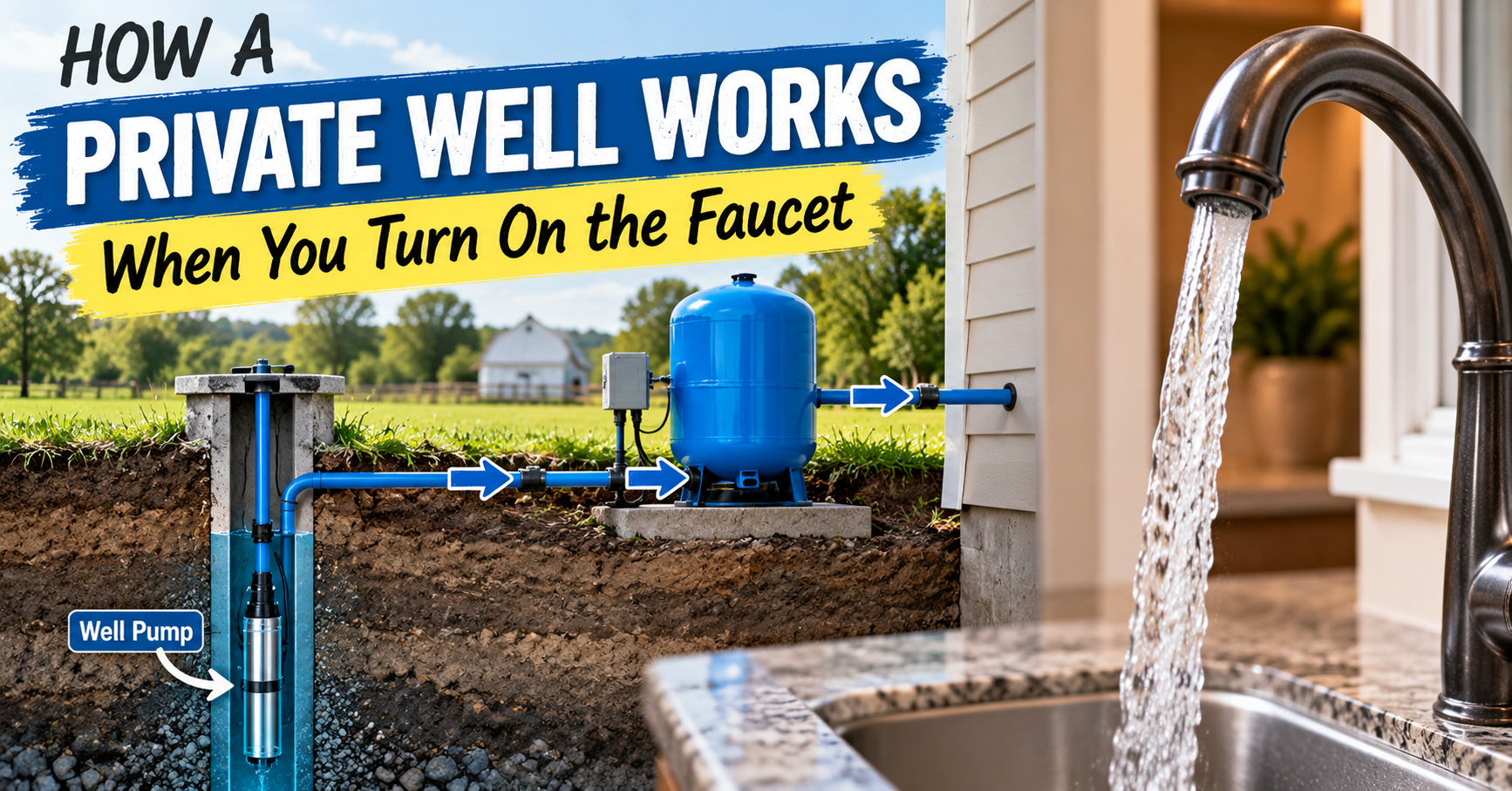
A private well makes that happen with a surprisingly small collection of equipment. The well provides access to groundwater, the pump moves it, the pressure tank stores some of it under pressure, and the pressure switch tells the pump when to run.
That is how a private well water system works in the simplest terms.
The system only starts feeling complicated when the water pressure drops, the pump keeps clicking, or the water suddenly changes color. Once I know what each part is supposed to do, those symptoms stop feeling quite so mysterious.
What Happens When I Turn On a Faucet?
The first thing that surprised me about a well system was learning that the pump does not necessarily start the instant I turn on a faucet.
At least, it should not.
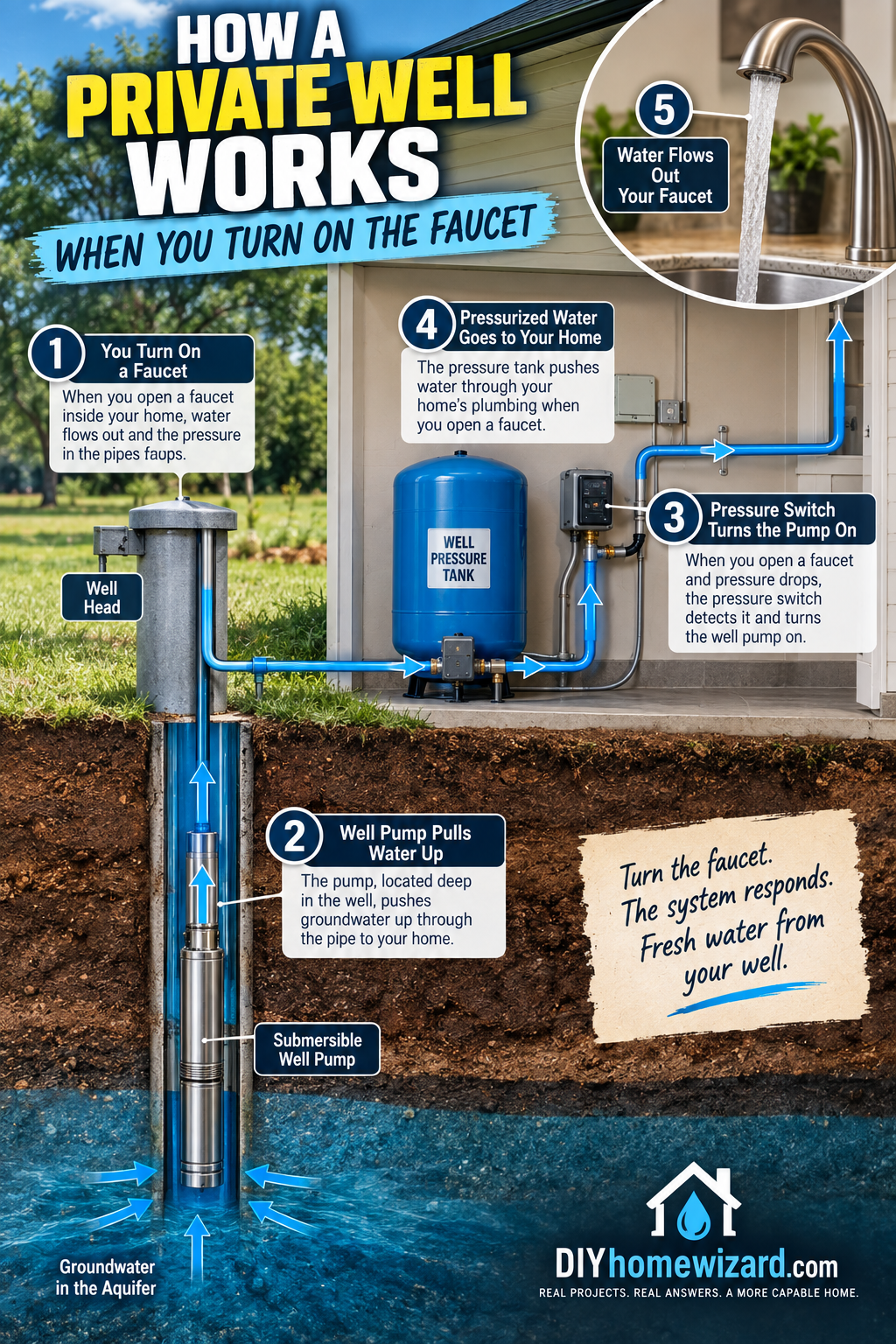
Water stored under pressure inside the pressure tank normally supplies the faucet first. As water leaves the tank, the pressure inside the system begins to fall.
Once the pressure reaches the pressure switch’s lower setting, the switch turns on the well pump. The pump sends more water toward the house and begins refilling the pressure tank.
When the system reaches the upper pressure setting, the switch shuts the pump off again.
The basic cycle works like this:
- I open a faucet.
- Water leaves the pressure tank.
- System pressure falls.
- The pressure switch turns on the pump.
- The pump supplies water and refills the tank.
- Pressure reaches the shutoff setting.
- The pressure switch turns the pump off.
That little cycle repeats every day while people shower, wash clothes, flush toilets, water gardens, and stand in front of an open refrigerator wondering what they came into the kitchen for.


Where Does Well Water Actually Come From?
Private well water comes from groundwater beneath the property. That groundwater collects in spaces between soil, sand, gravel, and rock.
People sometimes picture an underground lake sitting beneath the house. That can happen in certain geological settings, but most groundwater is not waiting in one giant open cavern.
It usually occupies tiny spaces and fractures underground. A water-bearing formation that can supply usable amounts of groundwater is called an aquifer.
The well creates a controlled path down to that water. Groundwater enters the lower portion of the well, and the pump moves it toward the house.
Well depth can vary tremendously. One neighbor may have a productive well at a relatively shallow depth, while another property may require a much deeper well.
Depth alone also does not tell me whether the water will be hard, contain iron, smell like sulfur, or produce sediment. Those characteristics depend on the geology, well construction, groundwater conditions, and surrounding land.


The Well Casing Is More Than a Pipe Sticking Out of the Yard
The visible pipe above the ground is usually the top of the well casing. It may not look impressive, but it is one of the most important parts of the entire water system.
The casing forms the body of the well. It helps hold the opening in place and separates the water supply from loose soil and shallow surface material.
I want to see the casing extending above the surrounding ground with a secure cap on top. I also want the ground around it to slope away so rainwater does not collect there.
That matters because rainwater can pick up bacteria, fertilizer, fuel, pesticides, animal waste, and other unwanted material from the surface. Water pooling around a damaged or poorly sealed well creates a possible path for that material to enter.
The EPA’s information about private well construction recommends locating and maintaining a well so surface water drains away from it.
A well casing is not a decorative yard pipe that should be hidden under a fake rock, buried in mulch, or surrounded by a miniature flower garden. It needs to remain visible and accessible for inspection and service.
What Does the Well Cap Do?
The well cap covers the top of an above-ground casing. It helps keep insects, rodents, debris, and surface water out of the well.
I check it from the outside for cracks, loose sections, damaged wiring connections, or anything that looks disturbed. I do not remove it just to satisfy my curiosity.
A proper sanitary cap may also include a screened vent. The screen allows the system to vent while helping prevent insects from crawling inside.
A loose cap deserves attention. So does a cap that appears damaged after mowing, construction, landscaping, or a storm.
If the water changes shortly after heavy rain, I would look around the well before assuming the problem is inside the house. Standing water, disturbed soil, a damaged cap, or a casing problem may be an important clue.
That does not prove contamination. It does mean I would arrange appropriate water testing instead of tasting the water repeatedly and hoping my tongue suddenly becomes a laboratory.


How Does Water Leave the Well?
Many modern drilled wells use a pitless adapter to move water through the side of the casing below ground.
The name “pitless adapter” makes it sound like something designed by a plumber who had already used all the normal names. Its job is actually straightforward.
The adapter creates a sealed connection between the pipe inside the well and the buried water line leading to the house. Because this connection sits below the local frost line, it helps protect the water line from freezing.
Older systems sometimes used a well pit. A pitless adapter eliminates the need for that arrangement while creating a more sanitary connection.
The National Ground Water Association’s well-component guide explains how a pitless adapter directs water through the casing while maintaining a frost-resistant seal.
From the adapter, a buried line carries water toward the house, pressure tank, and treatment equipment.
What Does the Well Pump Do?
The well pump provides the force needed to move groundwater into the household system.
Most homes use either a submersible pump or a jet pump. Both move water, but they do it from different locations.
Submersible Well Pump
A submersible pump sits down inside the well below the water level. It pushes water upward through a pipe and toward the house.
This is a common setup for drilled wells, especially deeper ones.
Because the pump is underground, I cannot walk into the basement and look at it. Pulling a submersible pump can require special equipment, particularly when it is hanging far below the surface.
That is not the kind of repair where I want to say, “How hard could it be?” Those words have started many expensive weekends.
Jet Pump
A jet pump is installed above ground. It may be located in a basement, crawl space, utility room, or separate well house.
Instead of pushing water from below, it creates suction that draws water from the well. Shallow-well jet pumps generally work with shallower water sources, while deep-well jet systems use a different two-pipe or ejector arrangement.
An above-ground pump is easier to see and hear. That makes leaks and unusual noises easier to notice, but it does not automatically make electrical or internal pump work a safe homeowner project.



Why Doesn’t the Pump Run Every Time I Use Water?
Starting a well pump creates heat and mechanical stress. If it started every time I washed my hands or filled a drinking glass, it could cycle hundreds of times a day.
The pressure tank prevents that.
The tank stores a usable amount of water under pressure. Small water demands can be supplied by the tank without immediately starting the pump.
Once enough water leaves and pressure reaches the lower switch setting, the pump starts. It then runs long enough to supply the house and refill the tank.
A healthy system gives the pump reasonably controlled run times and rest periods. A pump that starts, stops, and starts again within seconds is short cycling.
Short cycling is not just annoying. Repeated starts can shorten pump life.
When I hear rapid clicking, I would investigate the pressure tank, pressure switch, possible leaks, and other causes before assuming the pump itself needs to be replaced.
What Is Inside a Well Pressure Tank?
Most modern well systems use a pressure tank containing water and compressed air separated by a flexible bladder or diaphragm.
The air is what makes the tank work.
As the pump pushes water into the tank, the water compresses the trapped air. When I open a faucet, that compressed air pushes water out of the tank and into the plumbing.
The tank is not supposed to fill completely with water. It needs an air cushion to maintain pressure and provide usable drawdown.
Drawdown is the amount of water the tank can deliver between the pump shutting off and turning back on. It is much less than the tank’s advertised total volume.
A pressure tank labeled as a 40-gallon tank does not normally give me 40 gallons of water before the pump starts. Part of that internal space is occupied by compressed air.
This catches many new well owners off guard. The tank looks enormous, yet the usable water between cycles may be only a fraction of its total size.



What Happens When the Pressure Tank Goes Bad?
A failing pressure tank can lose much of its usable drawdown. The pump may then turn on after only a small amount of water is used.
Rapid pump cycling is one of the classic warning signs, but it is not the only possible symptom.
I might also notice:
- Pressure surging during a shower.
- The pump starting whenever a toilet finishes filling.
- Repeated clicking near the pressure switch.
- Large swings on the pressure gauge.
- Water coming from the tank’s air valve.
- The pump cycling much more often than it used to.
Water coming from a bladder tank’s air valve is a strong indication that the internal bladder has failed. However, I would not start pressing valves and adjusting air pressure without understanding the correct procedure.
Tank air pressure must be checked with the pump power off, the water pressure completely drained, and the system safely depressurized. Measuring it while the tank is still full of pressurized water will not provide the correct precharge reading.
The correct air charge also depends on the pressure-switch setting. Guessing can make the system behave worse.
How Does the Pressure Switch Control the Pump?
The pressure switch watches system pressure and controls electrical power to the pump.
A small pipe or fitting allows water pressure to act on the switch. When pressure falls to the cut-in setting, the switch closes its contacts and starts the pump.
When pressure reaches the cut-out setting, the contacts open and stop the pump.
Two common residential pressure ranges are 30/50 PSI and 40/60 PSI.
A 40/60 system generally works like this:
- Pressure falls to approximately 40 PSI.
- The pressure switch starts the pump.
- The pump adds water to the system.
- Pressure climbs toward 60 PSI.
- The pressure switch stops the pump.
Not every house should use the same settings. The pump, pressure tank, switch, plumbing, fixtures, and treatment equipment all need to work together.
The switch also contains live electrical contacts. I do not recommend removing its cover and poking around while the power is on.
Water and exposed electricity are both useful. They are considerably less charming when introduced to each other.


What Can the Pressure Gauge Tell Me?
The pressure gauge is one of the most useful diagnostic parts of a well system. It shows what the system is doing instead of making me guess based only on how the shower feels.
When no water is running, the gauge should normally remain steady.
When I open a faucet, I should see the pressure gradually fall. The pump should start near the cut-in setting, and the pressure should rise again while the pump runs.
A gauge can help me determine:
- When the pump starts.
- When the pump stops.
- How quickly pressure falls.
- Whether pressure drops when no water is being used.
- Whether the pump reaches its shutoff pressure.
- Whether pressure rises and falls unusually fast.
We already have a practical explanation of how to perform a water-pressure gauge test at home. That guide is a useful next step when the system feels weak, uneven, or unpredictable.
The gauge itself can fail or become clogged with sediment. If its needle never moves, I would not automatically assume the entire well system is maintaining perfect pressure.
Sometimes the messenger is the part that broke.
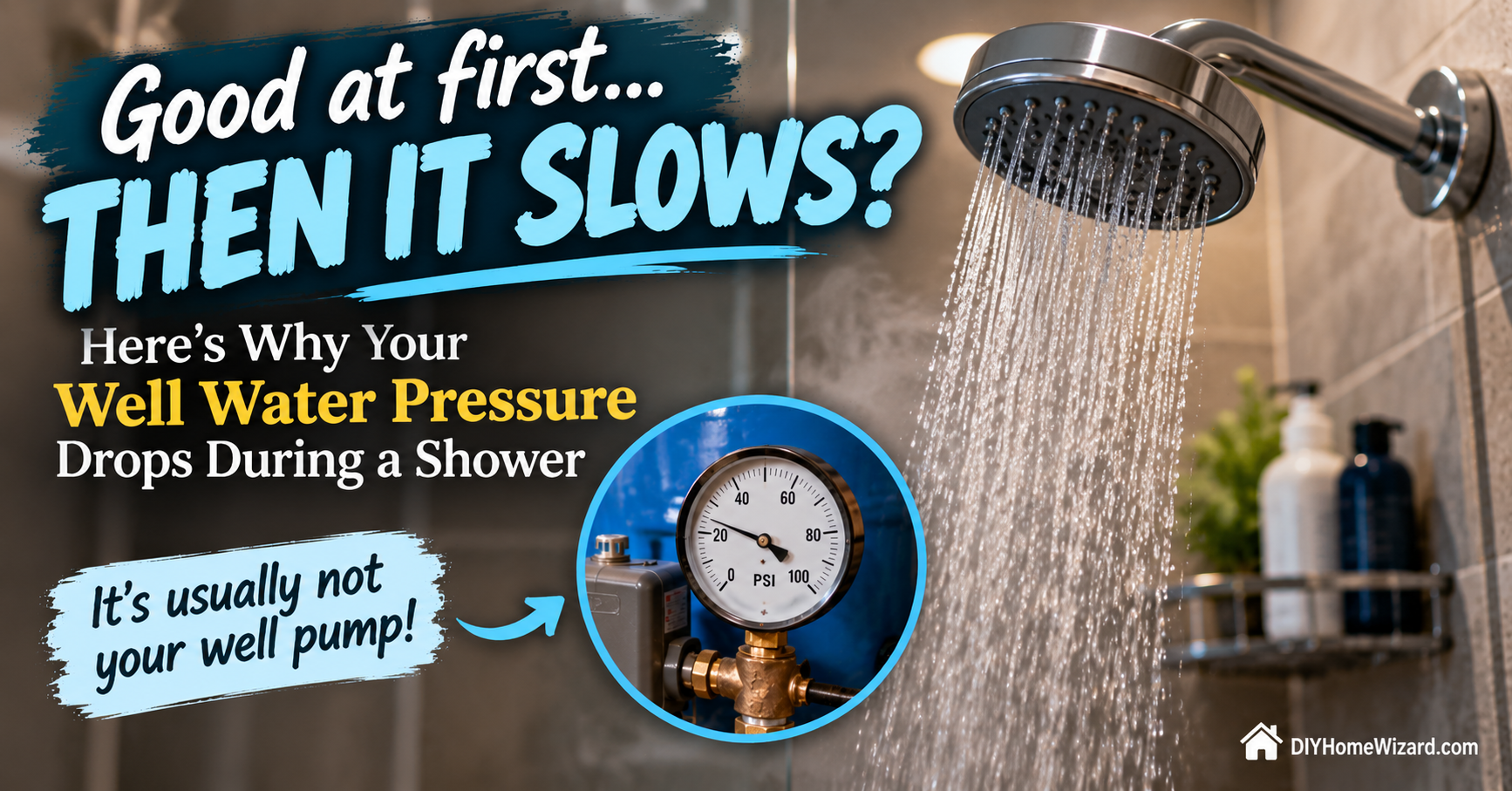
Why Does My Water Pressure Drop During a Shower?
A well system must keep up with the amount of water being used.
When I take a shower, water leaves the pressure tank. The pump eventually starts and begins replacing that water.
If another person starts the washing machine, flushes a toilet, or opens an outside faucet, the total demand increases. Pressure may fall if the pump, well, filter, or plumbing cannot maintain the required flow.
Low pressure during a shower can come from several places:
- A clogged showerhead.
- A partially closed valve.
- A loaded sediment filter.
- A failing pressure tank.
- An incorrect pressure-switch setting.
- A weak or worn pump.
- A plumbing restriction.
- A low-yield well.
- Too many fixtures running at once.
- A leak somewhere in the system.
I always want to know whether the problem affects one fixture or the entire house.
One weak shower usually points me toward the showerhead, valve, or nearby plumbing. Every fixture becoming weak at the same time moves the investigation toward the filter, pressure equipment, pump, water line, or well.

Our guide to improving water pressure throughout the entire house explains why replacing pipes or adding a booster pump should not be the first move.
Pressure and Flow Are Not the Same Thing
Pressure is the force pushing water through the system. It is normally measured in pounds per square inch, or PSI.
Flow is the amount of water moving during a certain period. Residential water flow is commonly measured in gallons per minute.
A house can have decent static pressure and still produce disappointing flow.
For example, the pressure gauge may show 60 PSI while every fixture is closed. Once I open a shower, a clogged sediment filter may restrict the amount of water that can pass through it.
The pressure then drops under actual demand.
This is why checking only the gauge while no water is running can miss the problem. I want to see how the system behaves with one or more fixtures open.
A pressure tank does not create an unlimited water supply, either. It provides stored pressure between pump cycles. The pump and well still need to produce enough water to meet ongoing demand.
Where Does a Sediment Filter Go?
A sediment filter is commonly installed after the pressure tank. This allows the pump and pressure controls to operate without an overly restrictive filter sitting between the pump and tank.
However, not every system is arranged exactly the same way. Treatment order depends on the equipment, water chemistry, plumbing design, and manufacturer instructions.
A basic arrangement might be:
Well → Pump → Pressure Tank and Controls → Sediment Filter → Additional Treatment → House
Additional treatment could include an iron filter, neutralizer, activated-carbon system, water softener, ultraviolet unit, or another device.
A clogged filter can reduce household flow dramatically. If the water pressure suddenly becomes weak, I check when the cartridge was last replaced and whether the problem began gradually or all at once.
I also pay attention to how quickly a replacement filter changes color. A brown filter proves that it caught brown material. It does not, by itself, identify whether that material is iron, clay, rust, silt, or something else.
Is a Water Softener the Same as a Well-Water Filter?
A water softener and a water filter are not interchangeable.
A traditional water softener primarily removes hardness minerals through ion exchange. Those minerals are commonly calcium and magnesium.
Hard water can leave white spots, create scale, make soap harder to rinse, and shorten the life of certain appliances. A softener is designed to address those problems.
Some softeners can handle limited amounts of certain forms of iron. That does not mean a softener is the correct treatment for every iron problem.
A softener is generally not the answer for:
- Sand or grit.
- Bacteria.
- Nitrates.
- Arsenic.
- Every type or concentration of iron.
- Every sulfur odor.
- Fuel or pesticide contamination.
- A damaged well casing.
- A failing pump.
- A clogged pressure switch.
The water should be tested before expensive treatment equipment is selected. Otherwise, it is easy to spend several thousand dollars solving the wrong problem beautifully.
Why Does Well Water Sometimes Smell Like Rotten Eggs?
A rotten-egg odor is commonly associated with hydrogen sulfide gas or sulfur-related bacteria. However, where and when the smell appears matters.
If I smell it from both hot and cold water throughout the house, I look toward the well, incoming water, or shared treatment system.
If I smell it only from hot water, the water heater becomes a stronger suspect. Reactions involving the anode rod, warm water, bacteria, and accumulated sediment can create odor inside the tank.
I test this by comparing water from the same faucet.
First, I run cold water into a clean glass. Then I use a second clean glass for hot water. I move away from the sink before smelling each sample because drain odors can fool me into blaming the water.
If only the hot sample smells, I would investigate the heater before buying a whole-house sulfur system.

Water-heater sediment can also create popping and rumbling sounds. Our article about what causes a water heater to make popping noises explains what may be happening inside the tank.
Why Does Well Water Turn Brown or Orange?
Brown, yellow, or orange well water can have several possible causes. Iron is common, but it is not the only answer.
Other possibilities include sediment, disturbed material inside the well, pipe corrosion, treatment-equipment problems, or work recently performed on the system.
I narrow it down by asking practical questions:
- Is the color present in hot and cold water?
- Does it affect every fixture?
- Did it appear after heavy rain?
- Was the pump, pressure tank, or plumbing recently serviced?
- Does the water come out colored immediately?
- Does clear water change color after sitting?
- Does material settle at the bottom of a glass?
- Are orange stains appearing in toilets, sinks, or tubs?
Water that comes out clear and develops orange or brown color after sitting may contain dissolved iron that oxidizes after exposure to air.
Grit that settles at the bottom is a different clue. It may point toward sand, silt, corrosion, or another type of sediment.
Neither observation confirms that the water is safe. It simply helps determine which testing and professional evaluation may be appropriate.
Is Clear Well Water Safe to Drink?
Clear water is not proof of safe water.
Some health-related contaminants have no visible color, noticeable smell, or obvious taste. Looking into a clear glass cannot reveal bacteria, nitrates, arsenic, lead, PFAS, or many other substances.
Private well owners are generally responsible for monitoring their own water. A municipal water department is not routinely sampling and treating the private well.
According to the EPA’s private drinking-water well information, private wells are not regulated under the federal Safe Drinking Water Act in the same way as public water systems.
That does not mean every private well is contaminated. It means I cannot assume someone else is checking it for me.
I also do not assume that a filter removes every possible contaminant. Treatment equipment should be matched to actual test results and, when relevant, certified for the particular contaminant being treated.
How Often Should I Test Private Well Water?
The EPA recommends testing private well water every year for total coliform bacteria, nitrates, total dissolved solids, and pH.
Local conditions may call for additional tests. County health departments, state environmental agencies, and certified laboratories can help identify contaminants associated with the local geology and surrounding land use.
I would also consider testing after:
- Flooding near the well.
- Damage to the casing or cap.
- A noticeable change in taste, odor, or color.
- Repairs to the well system.
- Nearby fuel or chemical spills.
- Changes in surrounding farming or construction.
- An unexplained household illness.
- Purchasing a home with a private well.
- A neighboring well testing positive for contamination.
- Long periods without any documented testing.
The EPA’s current recommendations for protecting household well water provide a good national starting point.
Home test strips can help screen certain characteristics, but I do not treat them as a complete substitute for certified laboratory testing when a health concern is involved.
What Maintenance Can I Safely Handle?
I do not have to take anything apart to notice that a well system is changing.
A simple monthly walk-through can tell me quite a bit. I listen, look, and compare the system with how it normally behaves.
I watch for:
- A pump cycling more frequently than before.
- Pressure that surges during ordinary water use.
- A gauge that no longer moves normally.
- Water around the pressure tank or visible fittings.
- Corrosion or damaged pipes.
- A loose or cracked well cap.
- Standing water around the casing.
- Filters clogging unusually fast.
- New sounds from the pump or pressure switch.
- A new color, smell, taste, or gritty texture in the water.
I also keep records. Pump model numbers, tank size, pressure settings, filter dimensions, service dates, water-test results, and treatment-equipment manuals are much easier to find before the basement is wet and the house has no water.
The National Ground Water Association’s well maintenance information explains what a professional inspection may include, such as testing system output and evaluating the pump, pressure tank, switch, wiring, and visible components.
Which Well Repairs Should I Leave Alone?
I am comfortable observing the pressure gauge, checking for leaks, comparing fixtures, and replacing ordinary filter cartridges according to their instructions.
I draw a hard line at repairs involving live electrical components, deep wells, confined spaces, or unknown chemicals.
I would call a qualified professional for:
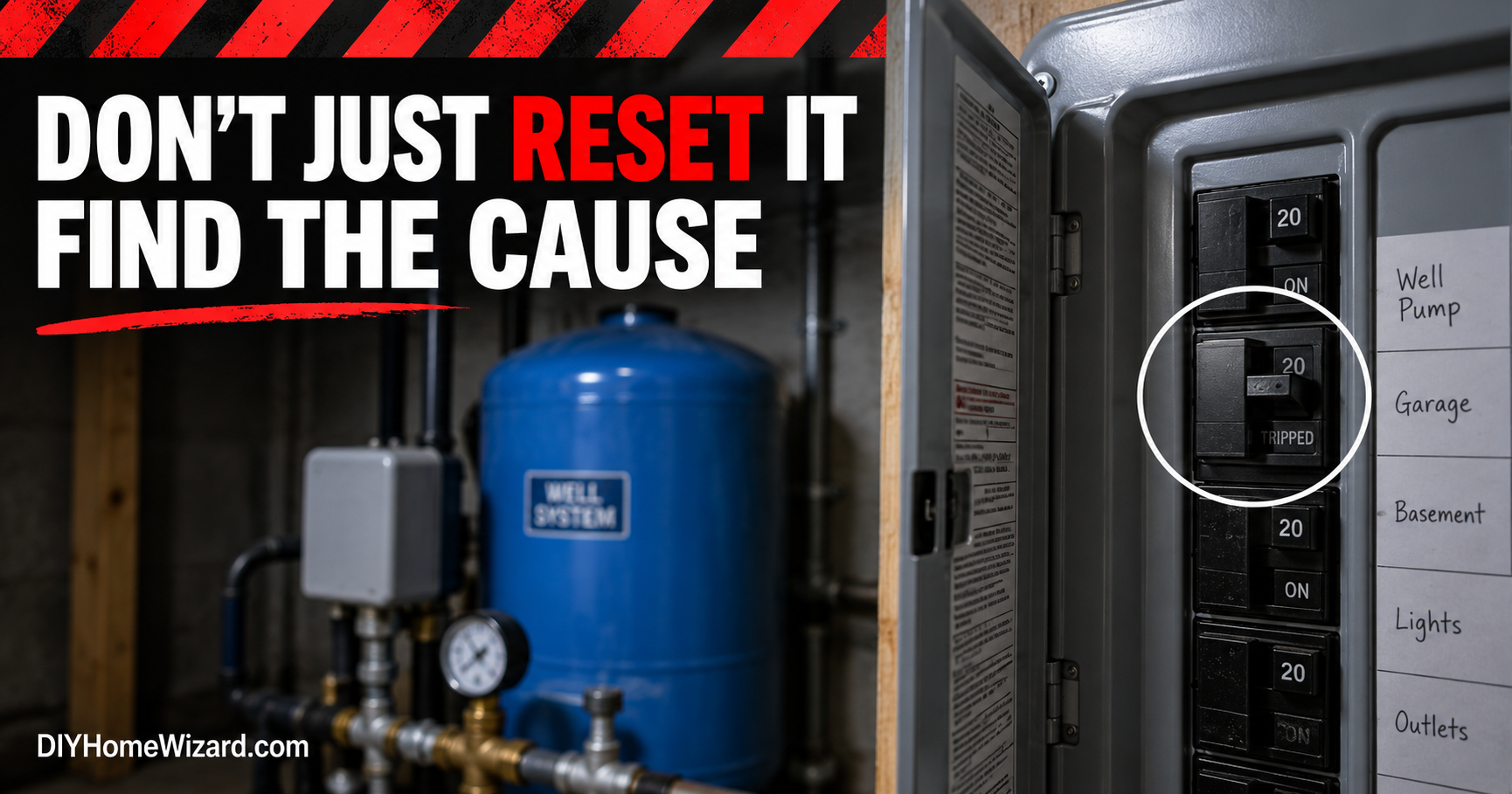
- A pump that repeatedly trips the breaker.
- Exposed or burned electrical wiring.
- Pulling a submersible pump.
- Repairing a well casing.
- Entering a well pit, cistern, or confined space.
- A pump that cannot build shutoff pressure.
- Suspected surface-water contamination.
- Water testing positive for harmful contamination.
- Chemical well treatment when the correct procedure is unknown.
- Pressure that may exceed the system’s rated limit.
I would never bypass a pressure switch, breaker, relief valve, or other safety control to force the pump to run.
I also would not mix treatment chemicals or pour something into the well because a stranger online said it worked for his cousin’s neighbor. A private well supplies water to the entire household. It is not the right place for experimental chemistry.
How I Narrow Down a Well Problem
When something changes, I start with four questions.
Is the Problem at One Fixture or Everywhere?
One affected faucet points toward the fixture, aerator, cartridge, valve, or nearby plumbing.
Every fixture being affected points farther upstream toward the filter, pressure equipment, pump, main water line, or well.
Does It Affect Hot Water, Cold Water, or Both?
Hot-water-only trouble usually moves the water heater higher on my list.
A problem affecting hot and cold water throughout the house probably begins before the water divides into separate hot and cold lines.
Did It Begin Suddenly or Gradually?
A gradual pressure decline can come from a clogging filter, mineral buildup, or worn equipment.
A sudden change may follow a failed part, broken line, electrical problem, storm, repair, or major change in the well.
What Changed Before the Problem Started?
I think back to recent filter replacements, plumbing repairs, power outages, heavy rain, freezing temperatures, landscaping, well work, or unusually high water use.
The event immediately before the symptom is not always the cause, but it often provides the best clue.
What Should I Learn After Buying a House With a Well?
I would not wait until the house has no water to locate the pressure tank and pump breaker.
Soon after moving in, I identify:
- The well casing.
- The well cap.
- The pump breaker or disconnect.
- The pressure tank.
- The pressure switch.
- The pressure gauge.
- The main water shutoff.
- The filter housings.
- Any treatment bypass valves.
- The water softener and other treatment equipment.
I photograph equipment labels and model numbers while they are still readable. I also save the latest laboratory report and any records showing the well depth, pump installation, previous repairs, and treatment equipment.
It is worth learning which local company services wells, too. A regular plumber may handle household plumbing, pressure tanks, and some controls but may not pull a deep-well pump or repair a casing.
That is useful information to have at noon on a Tuesday. It is far less enjoyable to research at 10 p.m. when everyone needs a shower and the faucets are producing nothing but disappointment.
The Easy Way I Remember How a Private Well Works
I reduce the entire well system to four main jobs.
The well gives me access to groundwater. The pump moves the water. The pressure tank stores usable water under pressure. The pressure switch decides when the pump starts and stops.
The remaining parts protect, carry, measure, or treat the water.
Once I understand those four jobs, the symptoms make more sense. Rapid clicking can point toward the tank or switch. Falling pressure can involve the filter, pump, plumbing, or well supply. Strange hot water can lead me toward the water heater. Changes throughout the entire house point me farther upstream.
Understanding how a private well water system works does not turn me into a well contractor. It does help me describe the problem accurately, perform sensible checks, avoid replacing random parts, and recognize when it is time to bring in someone with the right equipment.
Calder Voss writes for DIY Home Wizard with a practical focus on private wells, household water systems, pressure problems, and helping homeowners understand their equipment without making everything sound harder than it is.