
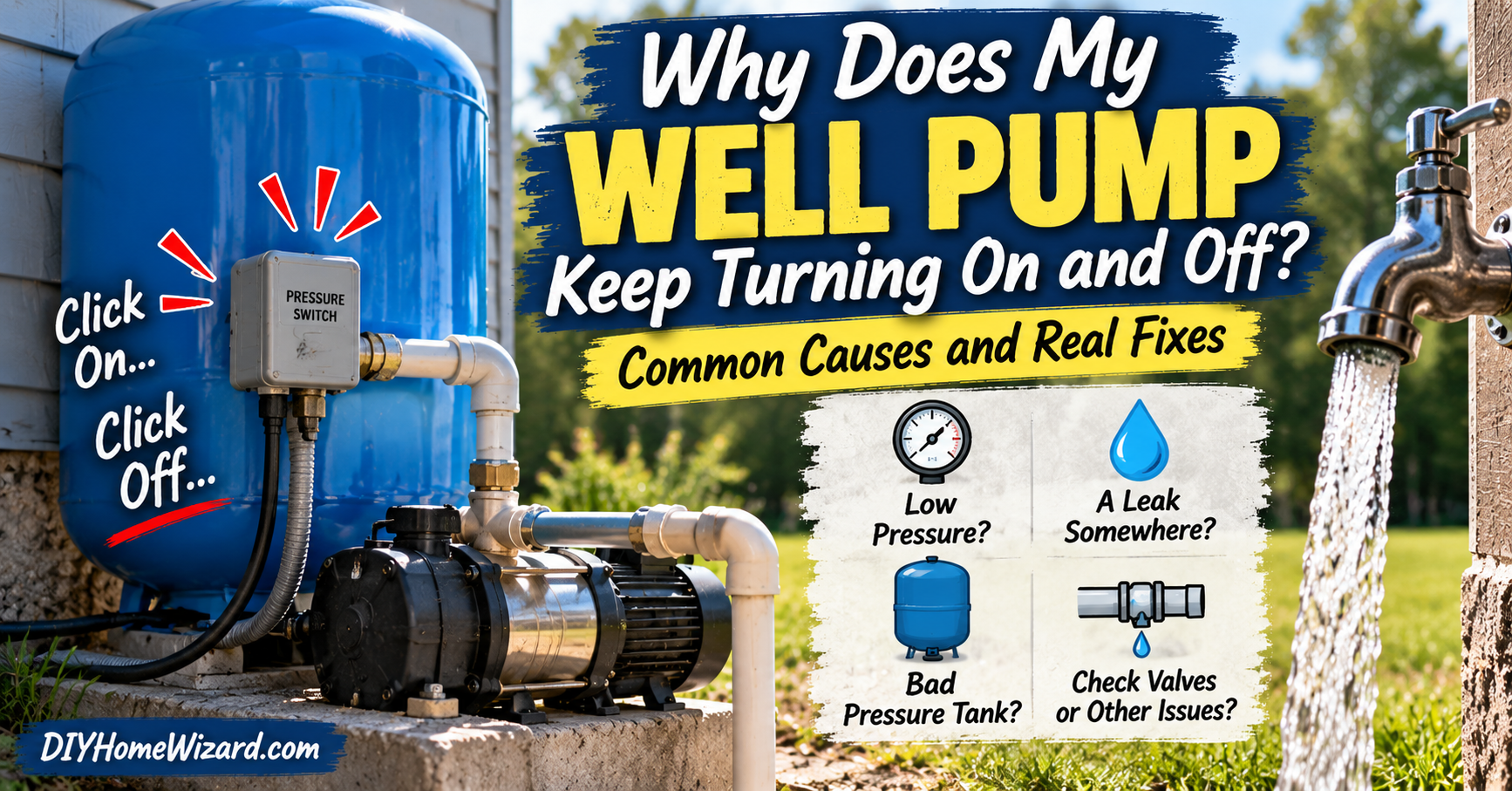
A well pump that keeps turning on and off every few seconds is usually short cycling. The most common cause is a pressure tank that has lost its air charge or has a failed internal bladder, but leaks, a clogged pressure-switch connection, incorrect settings, and pump problems can cause it too.
I never ignore rapid well-pump cycling. The house may still have water, so it is tempting to call it an annoying noise and move on. Unfortunately, every click can represent another pump start, and repeated starts are hard on the motor.
The good news is that the pump itself is not always the failed part. Quite often, another component is making a perfectly capable pump behave badly.
How Often Should a Well Pump Normally Turn On?
There is no single perfect number of pump cycles per day. A family of five will obviously use more water than one person living alone. Laundry day also gives a well system a much busier schedule than a quiet Tuesday afternoon.
What matters more is how long the pump runs and how much water is used between cycles.
On a traditional pressure-tank system, the pump should not start every time I briefly open a faucet. The pressure tank should supply a usable amount of water before system pressure falls enough to start the pump.
If I rinse my hands and immediately hear the pressure switch click, I pay attention.
If the pump starts and stops several times while one faucet runs continuously, that is another warning sign. A properly operating system should usually produce a more orderly pattern.
The exact minimum recommended run time depends on the pump and motor. However, repeated cycles lasting only a few seconds are not normal for a traditional pressure-tank system.
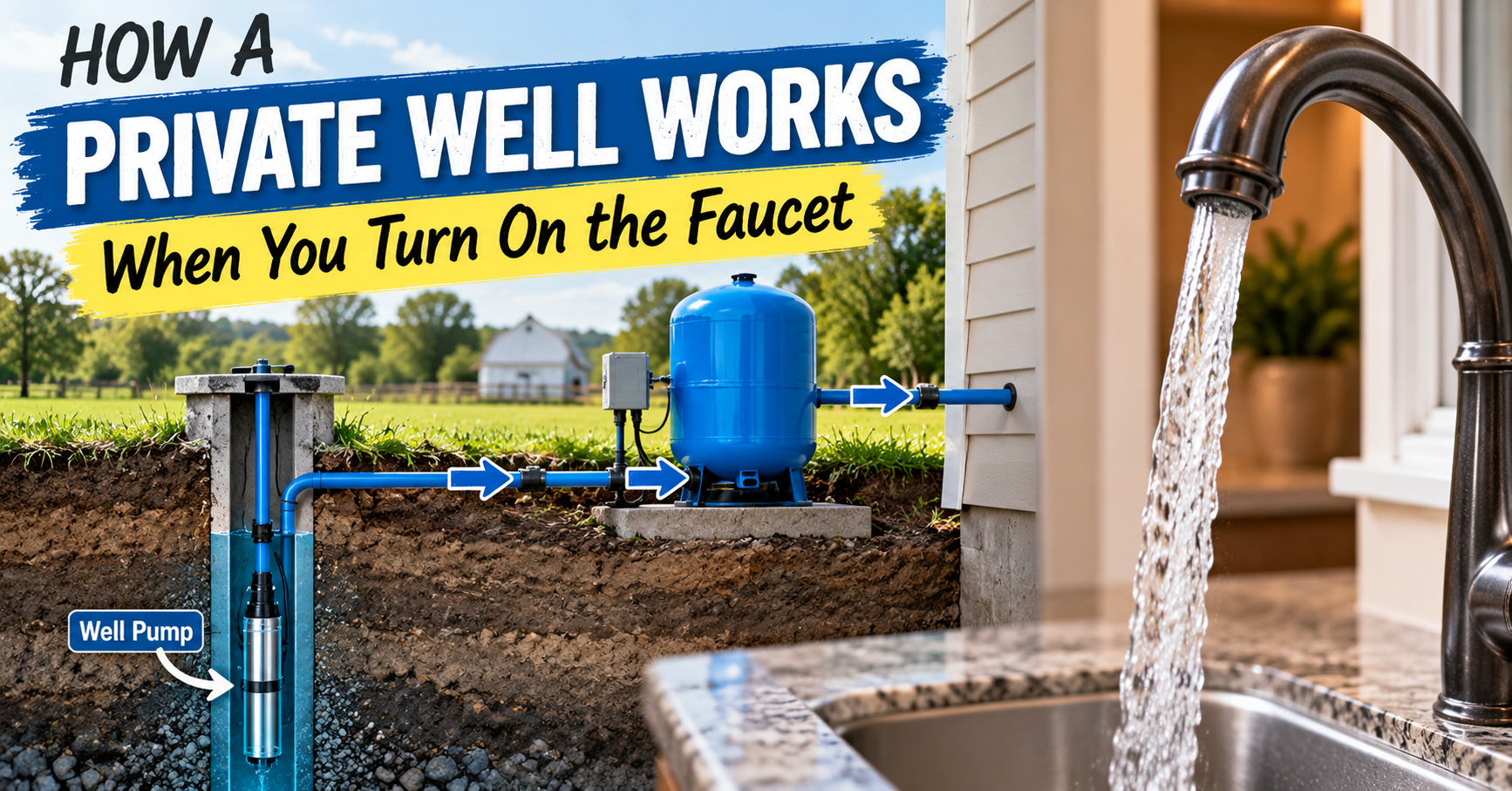
Before diagnosing the problem, it helps to understand what happens inside a private well system when a faucet opens. The pressure tank supplies water first, the pressure switch senses the drop, and the pump starts when pressure reaches the cut-in setting.



What Does Short Cycling Actually Look and Sound Like?
Short cycling means the pump starts and stops more frequently than it should.
I may hear a distinct click near the pressure switch, followed by the sound or vibration of the pump running. A few seconds later, the switch clicks again and the pump stops.
Then it happens again.
Click. Run. Stop. Click. Run. Stop.
It can sound like the well system is trying to send a message in Morse code. Unfortunately, the message is usually “Please check me before something expensive happens.”
Other signs of short cycling include:
- The shower pressure repeatedly becomes stronger and weaker.
- The pressure-gauge needle moves rapidly between two readings.
- The pump starts after only a small amount of water is used.
- Lights briefly dim each time the pump starts.
- The pressure switch chatters instead of making one clean click.
- Water pressure surges while a faucet remains open.
- The pump runs for only a few seconds at a time.
I make sure the cycling is actually abnormal before assuming something has failed. A large water demand can cause normal cycling, especially if the pressure tank is small.
The important clue is whether the pump is making full, controlled cycles or bouncing on and off rapidly.



The Pressure Tank Is the First Place I Suspect
When a traditional well pump suddenly starts cycling too often, the pressure tank is one of the first components I consider.
The pressure tank stores water and compressed air. That compressed air pushes water into the household plumbing while the pump is off.
As water leaves the tank, system pressure falls. The pressure switch eventually starts the pump, and the pump refills the tank.
If the tank loses its air cushion, it cannot provide much usable water between pump cycles. Pressure falls almost immediately when a fixture opens, so the pump starts.
The pump then adds a small amount of water, pressure shoots back up, and the switch shuts it off. A few seconds later, the process repeats.
The pump may be doing exactly what the pressure switch tells it to do. The tank simply is not giving the system enough breathing room.
Manufacturers design residential well tanks specifically to control pump cycling. Amtrol, for example, describes this as one of the primary jobs of its residential pressure tanks.
Has the Pressure Tank Lost Its Air Charge?
A bladder-style pressure tank needs the correct air precharge to work properly.
The precharge is the air pressure inside the empty tank before the system adds water. It is normally set in relation to the pressure switch’s cut-in setting.
A commonly used guideline is approximately 2 PSI below the pump’s cut-in pressure. For example, a system with a 40 PSI cut-in setting may require approximately 38 PSI of tank precharge.
That is only a general guideline. I always check the tank manufacturer’s instructions and verify the actual pressure-switch setting before making changes.
The tank must also be checked correctly.
To obtain an accurate precharge reading, the pump power must be off and all water pressure must be drained from the system. Checking the air valve while the tank is still holding pressurized water does not tell me the true empty-tank precharge.
I do not guess at this or add air until the tank “feels about right.” Too little or too much air can both create problems.
If I am not certain how to isolate, depressurize, and safely restart the system, I call someone who works on wells. Water pressure and electricity are not where I like learning through trial and error.



Has the Bladder Inside the Tank Failed?
Many modern pressure tanks contain a flexible bladder or diaphragm that keeps the water separate from the compressed air.
That internal barrier can eventually fail.
When it ruptures, water may enter the air side of the tank. The tank becomes waterlogged and loses much of its usable drawdown.
One possible clue is water coming from the tank’s air valve. If I briefly check the valve according to the manufacturer’s procedure and water appears, the internal bladder has probably failed.
That generally means the tank needs replacement.
Other possible signs include extremely frequent pump cycling, a tank that feels unusually full of water, pressure surging, or a noticeable loss of drawdown.
The old “knock on the tank and listen” method can provide a clue, but I do not treat it as a reliable diagnosis. Tank construction, location, water level, and even how hard I knock can change the sound.
I would rather confirm the pressure behavior and precharge than stand in the basement tapping on a steel tank like I am choosing a watermelon.
Could the Pressure Tank Be Too Small?
A pressure tank can be working properly and still be too small for the pump or household demand.
A small tank provides less drawdown. That means the pump starts after less water is used.
Tank sizing depends on the pump’s flow rate, motor size, pressure-switch settings, and required minimum run time. It is not determined only by the number of bathrooms in the house.
The number printed on the tank is also its total internal volume, not the amount of water it delivers between cycles. A tank labeled as 40 gallons does not normally provide 40 gallons of drawdown.
This misunderstanding can lead someone to buy a much smaller tank than the system really needs.
If short cycling has happened since the system was installed, undersizing becomes more likely. If the pump operated normally for years and suddenly began cycling rapidly, I would look harder for a failed bladder, lost air charge, leak, restriction, or control problem.


A Household Water Leak Can Keep Starting the Pump
A leak lowers system pressure even when nobody is intentionally using water. Once the pressure reaches the cut-in setting, the pump starts and restores it.
This can create intermittent cycling instead of the rapid on-and-off pattern caused by a waterlogged tank.
The house may be completely quiet, yet the pump still starts every few minutes. That is when I begin looking for water that is going somewhere it should not.
Common possibilities include:
- A toilet that continues running quietly.
- A dripping outside faucet.
- A leaking livestock waterer.
- An irrigation valve that does not close completely.
- A leaking water heater.
- A dripping filter housing or drain connection.
- A malfunctioning water softener.
- A leak in the buried water line.
- A failed check valve.
- A leak inside the well.
Toilets are especially sneaky. A worn flapper can allow water to leak into the bowl without making much noise. The tank refills periodically, which can start the well pump.
I turn off obvious fixtures and watch the pressure gauge. If pressure continues falling while everything is supposed to be closed, water is probably escaping somewhere or flowing backward.
Could a Bad Check Valve Cause Repeated Pump Cycling?
A check valve allows water to move in one direction while preventing it from flowing backward toward the well.
If it leaks, pressure can slowly fall after the pump stops. The pressure switch eventually reaches its cut-in setting and starts the pump again, even though nobody used water.
This pattern is often different from pressure-tank short cycling.
A waterlogged tank may cause the pump to start and stop within seconds while water is running. A leaking check valve may cause the pump to restart periodically while the house is quiet.
I might notice the pump running every few minutes during the night or when nobody is using water.
A buried line leak can create similar behavior, so pressure loss by itself does not prove the check valve is bad.
Diagnosing a check valve may require inspecting equipment inside the well or monitoring different parts of the system. That is a good point to involve a qualified well professional instead of replacing random parts until the clicking stops.



Can a Clogged Pressure-Switch Connection Cause Cycling?
The pressure switch needs to sense the system’s actual water pressure. It usually does this through a small pipe, tube, nipple, or fitting.
Sediment, iron, corrosion, and mineral deposits can clog that narrow passage.
When the connection is restricted, the switch may receive delayed or inaccurate pressure changes. The pump can start late, stop late, chatter, or behave unpredictably.
Possible signs include:
- The pressure gauge and switch appear to disagree.
- The switch chatters rapidly.
- The pump continues running past its expected shutoff pressure.
- The pump starts at inconsistent pressure readings.
- Visible rust or mineral buildup surrounds the switch connection.
- The system has a history of heavy sediment or iron.
The pressure switch contains live electrical contacts. I can inspect the outside for corrosion, moisture, or a burned smell, but I do not remove the cover while the circuit is energized.
I also do not push the contacts together with a screwdriver. That may make the pump run, but it skips the part where I figure out why the controls were not behaving safely.
Can Incorrect Pressure-Switch Settings Cause Short Cycling?
The pressure switch and pressure tank must be set up to work together.
If the tank precharge is too close to or higher than the switch’s cut-in pressure, water delivery may become uneven. Pressure can drop abruptly before the pump starts.
If the cut-in and cut-out settings are too close together, the pump may cycle more frequently because the system has very little pressure range to work with.
Someone may also replace a 30/50 switch with a 40/60 switch without adjusting the tank precharge. The new parts may both be functional but poorly matched.
I never assume a pressure switch is still at its original setting. Previous owners and repair attempts have a way of leaving little surprises behind.
Before adjusting anything, I identify:
- The switch’s intended pressure range.
- The actual cut-in pressure.
- The actual cut-out pressure.
- The pressure tank’s recommended precharge.
- The pump’s ability to reach the proposed cut-out pressure.
- The pressure ratings of the tank and plumbing components.
Increasing the settings is not a free upgrade. A weak pump may struggle to reach the higher cut-out pressure, and older plumbing may not appreciate the extra stress.


Why Is the Pressure-Switch Lever Clicking Rapidly?
Rapid clicking or chattering at the pressure switch can indicate unstable pressure, a clogged sensing connection, damaged contacts, low water conditions, or another control problem.
This is different from one clean click when the pump starts and another clean click when it stops.
If the switch chatters, I shut off power and arrange an inspection. Repeated electrical arcing can damage the contacts and create heat.
A burned smell, discoloration, melted plastic, or visible sparking means I stop using the system until it is checked.
Replacing the switch without cleaning or replacing a clogged pressure connection may not solve the problem. The new switch can end up receiving the same bad pressure signal as the old one.
The switch might be the part making noise, but it may only be reacting to a pressure-tank, water-supply, wiring, or pump problem elsewhere.
Can a Clogged Water Filter Make the Pump Cycle?
A clogged whole-house filter can reduce water flow and create confusing pressure symptoms.
Most conventional well systems place the main pressure tank and controls before the household filtration equipment. In that arrangement, a clogged filter usually creates poor flow inside the house rather than directly causing classic pump short cycling.
However, plumbing arrangements vary. An incorrectly placed restriction, a clogged line, or complicated treatment equipment can affect how pressure moves through the system.
A clogged filter may also make the homeowner think the pump is failing because the shower becomes weak whenever another fixture runs.
I check whether the pressure problem is present before and after the filter. If an outside faucet branches off before the treatment equipment and has strong flow while indoor fixtures are weak, the restriction is probably somewhere after that branch.
I follow the filter manufacturer’s instructions when using a bypass. I do not open a pressurized filter housing without shutting off water and safely relieving the pressure first.
Those housings are remarkably stubborn when I want them open and remarkably enthusiastic about leaking when I want them sealed.
Can a Bad Well Pump Cause Frequent Cycling?
A worn or damaged pump can contribute to unusual cycling, but I do not make it my first assumption.
A weak pump may struggle to build pressure. It may run much longer than normal, fail to reach the cut-out setting, or provide poor flow during heavy use.
That is not always the same as short cycling.
However, damaged pump components, an improperly sized pump, motor-control trouble, or a variable-speed system fault can produce irregular operation.
Possible pump-related warning signs include:
- The pump runs but pressure rises very slowly.
- The pump cannot reach the cut-out pressure.
- Water pressure remains weak throughout the house.
- The breaker trips repeatedly.
- The pump makes a new grinding or humming noise.
- The water contains air or becomes cloudy after heavy use.
- Flow decreases as water use continues.
- The system loses water completely and later recovers.
A professional can measure pump output, motor amperage, voltage, and the well’s pumping water level. Those tests reveal much more than swapping a pressure switch and hoping for the best.
Is the Well Running Low on Water?
A well with a declining water level can cause the pump to behave strangely.
During heavy use, the pump may lower the water level faster than groundwater can refill the well. The pump can begin drawing air, lose output, or activate a protective control.
The house may experience sputtering faucets, cloudy water caused by air bubbles, reduced flow, sediment, or periods of no water.
A low-producing well is more likely during drought, heavy irrigation, filling a swimming pool, or several large water demands happening together.
I pay attention to whether the trouble appears only after sustained use. If normal pressure returns after the well rests, the available water supply may be part of the problem.
I would not repeatedly restart a pump that may be running dry. Water helps cool many submersible pump motors, and dry operation can cause damage.
A well professional can perform a flow test and compare the static and pumping water levels. That helps distinguish a low-yield well from a pressure-tank or pump problem.
Is Rapid Cycling Bad for a Well Pump?
Yes, repeated short cycling can shorten the life of the well pump and motor.
Starting the motor creates heat and electrical stress. Pumps are designed to cycle, but they are not intended to start every few seconds all day.
Short cycling can also wear pressure-switch contacts, motor controls, and other system components.
The National Ground Water Association’s maintenance guidance lists frequent pump cycling as a warning sign that deserves professional evaluation.
The exact amount of damage depends on how often the pump starts, how long the problem has continued, and what type of pump and controls are installed.
I would not panic over one unusual cycle. I would take action if the pattern keeps repeating during ordinary water use.
The longer short cycling continues, the greater the chance that an affordable tank or control problem turns into a pump replacement too.
My Simple Test for Confirming Short Cycling
I can learn quite a bit by watching the pressure gauge while running one steady fixture.
I choose a faucet or hose that provides a consistent flow. Then I observe the gauge and listen for the pump.
I write down:
- The pressure when the pump starts.
- The pressure when the pump stops.
- How long the pump runs.
- How long it remains off.
- Whether the pressure drops smoothly.
- Whether the gauge needle jumps or sticks.
- Whether water pressure at the fixture surges.
- Whether the pump starts again within seconds.
I do not touch the pressure-switch contacts or exposed wiring during this observation. I am only watching the system operate.
If the gauge races from the cut-in pressure to the cut-out pressure in a few seconds and immediately falls again while the faucet remains open, the pressure tank becomes a strong suspect.
If pressure slowly falls while every fixture is closed, I begin looking for a leak, backward flow, or another source of pressure loss.
What I Check Before Calling a Well Professional
I want to give the contractor useful information rather than saying, “The water thing keeps clicking.”
Before calling, I safely check:
- Whether the problem affects the entire house.
- Whether it happens only during water use.
- Whether the pump cycles while nobody is using water.
- The approximate cut-in and cut-out readings.
- How long each pump cycle lasts.
- Whether the pressure gauge moves normally.
- Whether a toilet or faucet is leaking.
- Whether the filter is overdue for replacement.
- Whether the tank or visible plumbing is leaking.
- Whether the pump breaker has tripped.
- Whether recent weather or heavy water use may be involved.
- Whether the system recently received new equipment.
These details can help separate a pressure-tank problem from a leak, check valve, control issue, weak pump, or low-water condition.
I also locate model numbers for the pressure tank, pump controls, and any visible equipment. A clear photograph is often easier than trying to read a faded label over the phone.
When I Shut the Pump Off
Some symptoms are more serious than ordinary short cycling.
I shut off power and call for professional help when I notice:
- A burned electrical smell.
- Smoke or visible sparking.
- A pressure switch chattering violently.
- Water spraying near electrical equipment.
- The pump repeatedly tripping the breaker.
- Pressure climbing beyond the normal cut-out point.
- The pump running continuously without building pressure.
- Grinding or severe mechanical noise.
- Evidence that the pump is running dry.
- A badly leaking pressure tank or pipe.
I do not keep resetting a breaker to see whether it “holds this time.” A breaker that repeatedly trips is reporting a problem, not asking for encouragement.
I also never bypass the pressure switch or safety controls. Forcing the pump to run can damage the pump, overpressurize the system, or create an electrical hazard.
Can I Keep Using Water While the Pump Is Short Cycling?
I would limit water use until I understand how severe the problem is.
If the pump cycles every few seconds, continuing to run showers, laundry, irrigation, and other high-demand fixtures adds even more starts. That is the exact stress I am trying to prevent.
A minor issue will not always destroy a pump immediately. The problem is that I cannot know how much damage has already occurred or whether the cycling is being caused by a failing electrical component.
If I see leaks, smell burned wiring, hear switch chatter, or notice the breaker tripping, I stop using the system and shut off power.
If the cycling is mild and there are no electrical or pressure hazards, I still arrange diagnosis promptly rather than letting it run that way for weeks.
Why I Diagnose the Tank Before Blaming the Pump
When a well pump keeps turning on and off, it is easy to assume the most expensive component has failed.
I start with the system’s behavior instead.
Rapid cycling during steady water use points me toward lost tank drawdown, incorrect precharge, a failed bladder, or poorly matched pressure settings.
Cycling while nobody uses water makes me think about leaks, toilets, underground lines, and check valves.
Chattering at the switch raises concerns about the pressure-sensing connection, unstable pressure, damaged contacts, or electrical trouble.
Long run times with pressure that barely rises move the pump, water line, well yield, and restrictions higher on the list.
That distinction matters. A pump can be the loudest and most obvious part of the problem while another component is actually causing it.
If my well pump keeps turning on and off every few seconds, I do not wait for the house to lose water completely. I record the pressure behavior, reduce unnecessary water use, check for obvious leaks, and have the pressure tank and controls tested before rapid cycling turns into a much larger repair.
Calder Voss writes for DIY Home Wizard with a practical focus on private wells, pressure tanks, pump problems, and helping homeowners figure out what their water system is trying to tell them.