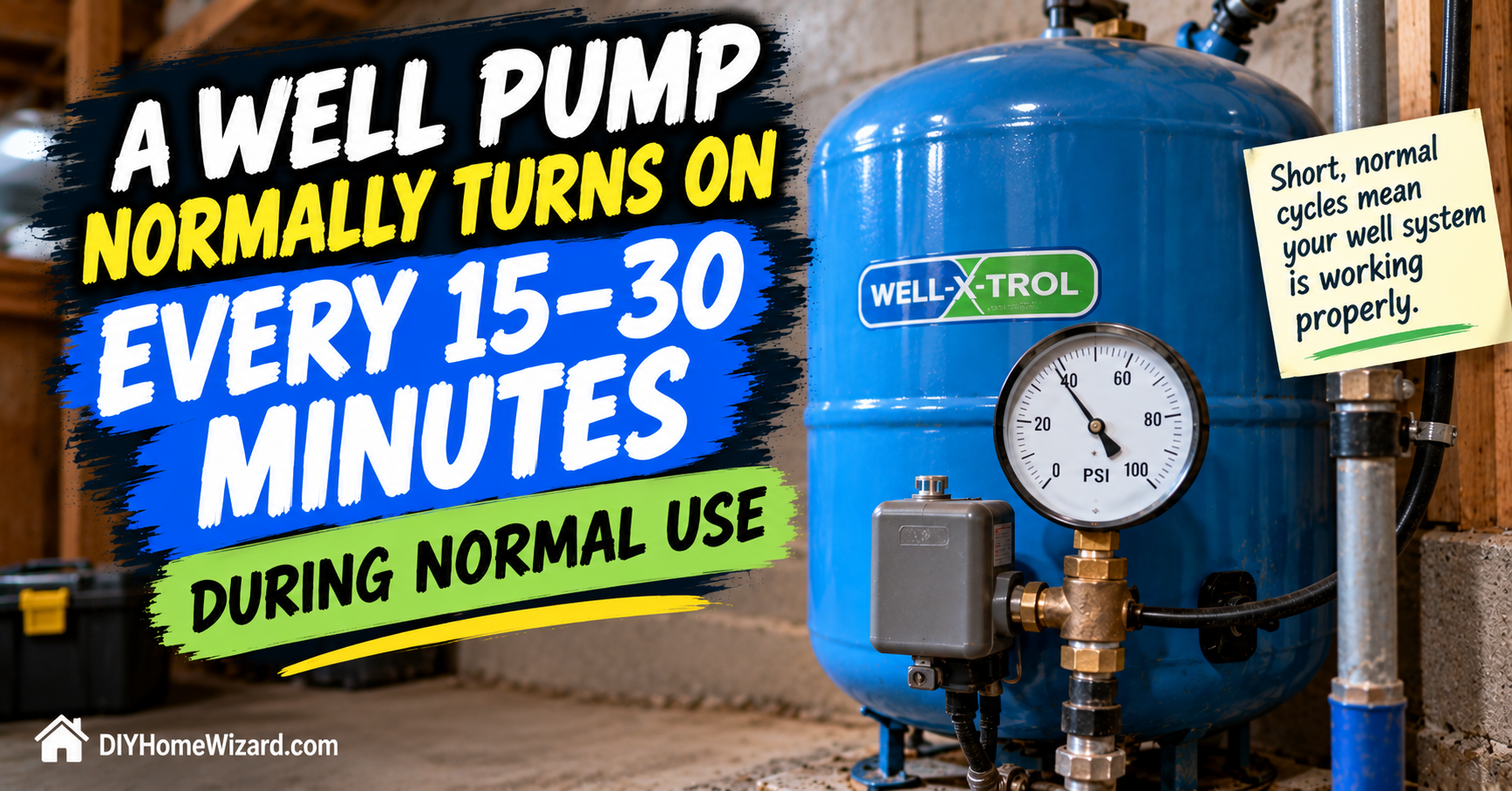
A well pump may turn on several times throughout the day, and that is completely normal. What I do not want is a pump starting and stopping every few seconds or kicking on after someone uses only a tiny amount of water.
There is no magic number of daily cycles that fits every home. A family doing laundry, taking showers, watering animals, and running a dishwasher will naturally start the pump more often than someone who lives alone.
I pay more attention to how long the pump runs, how quickly it starts again, and whether the cycle matches the amount of water being used. A healthy system should produce steady, predictable cycles instead of sounding like someone is flipping the pump switch for entertainment.
The Short Answer on Normal Well-Pump Cycling
A traditional well pump should generally run long enough to refill the pressure tank instead of starting and stopping within a few seconds.
Many residential systems are designed around a minimum pump run time of approximately one minute. Larger pump motors may need closer to two minutes or another manufacturer-specified minimum.
That does not mean every cycle will last exactly 60 seconds. Water may still be running inside the house while the pump operates, which changes how quickly the pressure tank refills.
The pump might run for several minutes during a long shower, garden watering, or laundry cycle. That can be completely normal.
The behaviors that concern me are:
- The pump starts and stops every few seconds.
- It starts after using only a cup or two of water.
- It repeatedly cycles during one steady shower.
- It turns on while nobody is using water.
- It runs continuously but cannot reach shutoff pressure.
- The pressure switch chatters rapidly.
- The time between cycles suddenly becomes much shorter.
A good cycle is not defined only by a stopwatch. I also need to know what water is being used and what the pressure gauge is doing.


Why There Is No Perfect Number of Cycles Per Day
People often want a simple answer such as “the pump should run six times per day.” I understand why. One number would make this much easier.
Unfortunately, the pump has no idea what a normal day looks like in my house.
One day may include several loads of laundry, two showers, a dishwasher cycle, and an hour of watering outside. The next day may involve little more than flushing toilets and making coffee.
Tank size changes the cycle count too. A larger pressure tank generally provides more usable water between pump starts. A small tank reaches the cut-in pressure sooner.
Other factors include:
- The number of people living in the house.
- The pump’s flow rate.
- The pressure tank’s drawdown.
- Pressure-switch settings.
- Plumbing leaks.
- Irrigation use.
- Water-treatment equipment.
- Well recovery rate.
- The number of fixtures running together.
- Whether the home uses a conventional or variable-speed pump system.
Instead of counting every cycle from sunrise to bedtime, I first determine whether the system is cycling appropriately for the water being used.



What Happens During a Normal Pump Cycle?
When no fixtures are running, a conventional well system should remain pressurized with the pump off.
When I open a faucet, the pressure tank supplies water first. The compressed air inside the tank pushes stored water into the plumbing.
As water leaves, system pressure falls.
Once it reaches the pressure switch’s cut-in setting, the switch starts the pump. The pump supplies the fixture and begins restoring water to the pressure tank.
When pressure reaches the cut-out setting, the pump stops.
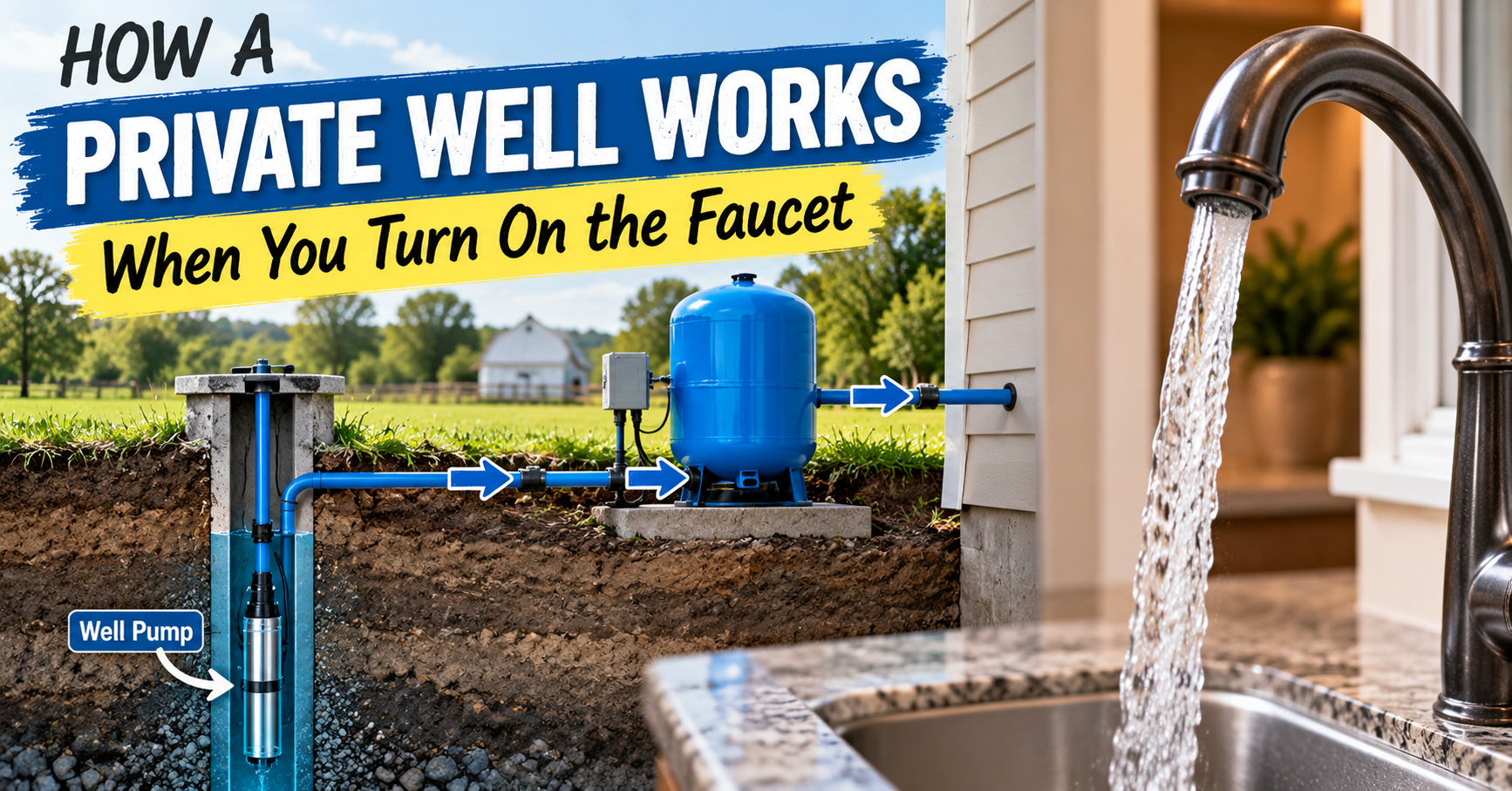
Our complete guide to how a private well responds when a faucet opens explains each component involved in this cycle.
On a 40/60 system, the pump normally starts near 40 PSI and stops near 60 PSI. On a 30/50 system, it normally starts near 30 PSI and stops near 50 PSI.
The pump should move through this range in an orderly way. If it races from one setting to the other in seconds, the pressure tank may not be providing enough drawdown.
How Long Should a Well Pump Run Each Time?
A common residential goal is at least one minute of pump run time. Systems with larger motors may require two minutes or more.
The correct minimum depends on the pump motor, controls, tank sizing, and manufacturer instructions. I do not use one general recommendation to override the specifications for the equipment actually installed.
Amtrol’s current residential well-tank sizing information separates systems into approximately one-minute and two-minute minimum run-time groups based partly on pump horsepower. Its sizing guidance emphasizes that a larger tank provides more drawdown and reduces pump starts.
That makes sense when I look at what happens during startup.
Every time the pump motor starts, it experiences an electrical and heat load. Longer, controlled cycles are normally easier on the motor than dozens of tiny cycles.
However, longer is not always better.
A pump that runs for 20 minutes because it cannot reach cut-out pressure may have a leak, clogged line, low water level, weak pump, or pressure-switch problem. That is not a healthy long cycle. It is a pump asking why nobody has turned it off yet.



Is a 30-Second Pump Cycle Too Short?
A 30-second cycle may be shorter than ideal for many conventional residential systems, especially if it happens repeatedly.
I would not diagnose a failed tank from one 30-second cycle. The duration can change depending on whether water is still being used and how much pressure had fallen.
If every cycle lasts around 20 or 30 seconds during ordinary use, I begin checking:
- Pressure-tank drawdown.
- Tank air precharge.
- Tank size.
- Pump flow rate.
- Cut-in and cut-out settings.
- Plumbing leaks.
- Check-valve operation.
- Pressure-gauge accuracy.
A strong pump paired with a small tank can refill it very quickly. The tank may not be broken, but it may be undersized for the pump.
If the cycle time suddenly dropped from more than a minute to only a few seconds, I become more suspicious of a lost air charge or failed tank bladder.
Is It Normal for a Well Pump to Run for Several Minutes?
Yes. A pump can run for several minutes during ongoing water use without anything being wrong.
Imagine the pump produces 10 gallons per minute while an outside faucet uses 5 gallons per minute. The remaining capacity can gradually refill the pressure tank while the faucet remains open.
If the fixture uses nearly as much water as the pump produces, pressure may rise slowly. The pump can stay on for the entire shower, watering session, or appliance fill cycle.
That may actually create fewer motor starts than repeatedly turning the pump on and off.
I watch whether the pump eventually reaches cut-out pressure after the water demand ends. If it does, the longer run may be normal.
If the pump continues running after every fixture is closed and the gauge never reaches cut-out pressure, something is wrong.
A pump should not run forever simply because it enjoys the sound of its own motor.



How Many Times Should a Well Pump Cycle During a Shower?
There is no exact number because shower flow, tank drawdown, pump output, and shower length vary.
A short shower with a large pressure tank may start the pump once. A long shower with a smaller tank may cause several normal cycles.
The important part is the length and regularity of those cycles.
If the pump runs for a reasonable period, shuts off, stays off while stored water is used, and then starts again, the system may be operating normally.
If it starts and stops every 5 or 10 seconds, that is not normal cycling.
I also pay attention to what I feel at the showerhead. A slight change between 40 and 60 PSI can be expected in a conventional system.
A dramatic strong-weak-strong-weak pattern every few seconds points toward short cycling, a failing pressure tank, or another pressure-control problem.
Should the Pump Start Every Time I Flush a Toilet?
It might, but it should not always have to.
A toilet commonly uses somewhere around 1.28 to 1.6 gallons per flush in newer homes, while older toilets may use more. Whether that starts the pump depends on how much drawdown remains in the pressure tank.
If the system is already near its cut-in pressure, one flush may start the pump. That can be normal.
If the tank is near cut-out pressure and every single toilet flush immediately starts the pump, I question how much usable drawdown the tank is providing.
The same applies when washing hands or filling a drinking glass. A healthy pressure tank should normally handle small demands without requiring an immediate pump start every time.
I do not judge the system based on one flush. I watch the pattern over several cycles.
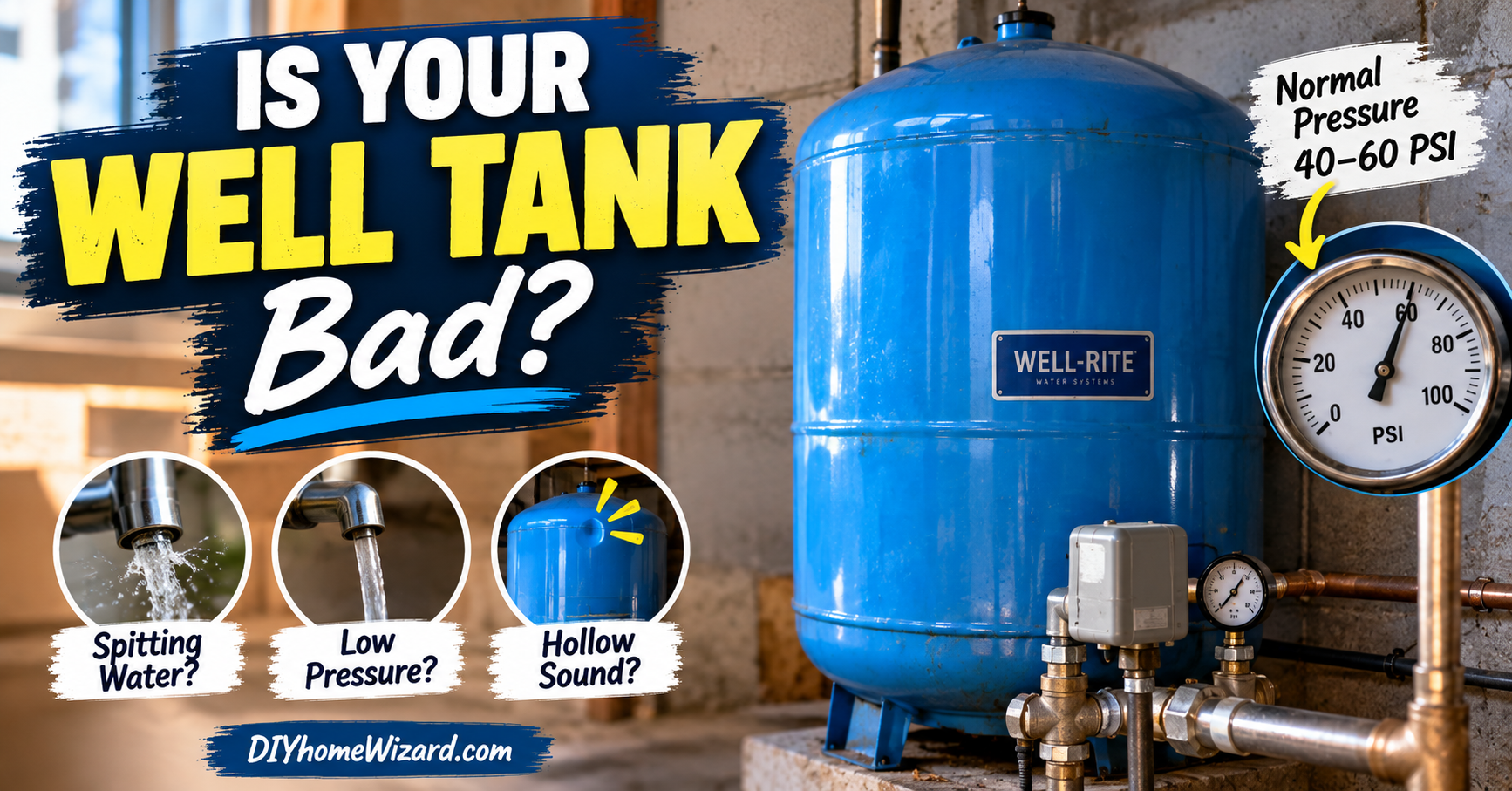
If every tiny use starts the pump, our guide on recognizing a bad well pressure tank covers the checks I make before replacing it.
Is It Normal for the Pump to Run Through an Entire Shower?
It can be normal, especially if the shower uses water at a rate close to the pump’s effective output.
A running pump is not automatically an unhappy pump. Pumps are built to move water.
Constant starting is often harder on the motor than one longer run.
I become concerned if the pump:
- Cannot build pressure after the shower ends.
- Runs when every fixture is closed.
- Produces less water as the shower continues.
- Begins pulling air into the plumbing.
- Makes a new grinding or humming sound.
- Causes the breaker to trip.
- Runs unusually hot on an above-ground setup.
- Never reaches its normal cut-out pressure.
A long run during high water demand can be expected. A long run with no water demand is a different story.
The pressure gauge helps separate the two.
How I Time a Well-Pump Cycle
I do not need to open the pressure-switch cover or touch electrical equipment to observe a basic cycle.
I start with no water running and allow the pump to reach its normal cut-out pressure. Then I open one faucet at a steady rate.
I watch the pressure gauge and record:
- The pressure where the pump starts.
- The time when the pump starts.
- The pressure where the pump stops.
- The time when the pump stops.
- How long the pump remained off.
- Whether the faucet stayed open during the test.
- Whether pressure rose smoothly.
- Whether the water flow surged.
I repeat the observation because one cycle can be misleading.
If the faucet is still running, part of the pump’s output is going directly to that fixture. The rest is refilling the tank. This can make the pump run longer than it would with the faucet closed.
For a cleaner refill-time check, I can close the faucet after the pump starts and time how long the pump takes to reach cut-out pressure. I stay nearby and watch the gauge.
If pressure climbs beyond the normal cut-out setting, I shut off power and call a professional.



Why Does Tank Drawdown Matter So Much?
Drawdown is the amount of water the pressure tank can provide between pump cycles.
A larger drawdown means more water can be used before the pump starts. That usually reduces the total number of pump activations.
Tank size, precharge, and pressure-switch settings all affect drawdown.
The total volume printed on the tank label is not its usable drawdown. A tank labeled for 40 gallons may provide far less than 40 gallons between pump cycles because much of its internal space is occupied by compressed air.
Amtrol’s pressure-tank installation information explains that larger tank capacity provides more drawdown, reduces pump cycles, and can help extend pump life.
If my pump cycles too often, I want to know how much water actually leaves the tank before the pump starts. The tank’s physical size alone does not answer that question.
How Can I Estimate My Tank’s Drawdown?
I begin with the system fully pressurized and the pump off.
Then I collect water from one fixture until the pressure reaches cut-in and the pump starts. The amount collected is an estimate of the tank’s available drawdown at that moment.
I can use a marked bucket or another container with known volume.
This is not a perfect laboratory measurement. Fixtures may flow unevenly, and other appliances must remain off during the test.
Still, it can reveal a major problem.
If a large pressure tank provides only a cup or two before the pump starts, it is not offering meaningful drawdown.
I compare the result with the tank manufacturer’s drawdown chart for the exact model and pressure range.
I do not compare it with the tank’s total gallon rating. Those are two different numbers, even though product labels sometimes make that about as obvious as the fine print on a phone bill.
Can Incorrect Tank PSI Make the Pump Run Too Often?
Yes. The tank’s air precharge must match the pressure switch’s cut-in setting.
For many bladder-style tanks, the empty-tank precharge is set approximately 2 PSI below cut-in pressure.
A 30/50 system commonly uses about 28 PSI. A 40/60 system commonly uses about 38 PSI.
The pressure must be measured with pump power off and all water pressure drained from the system. Checking it while the tank contains pressurized water does not reveal the true precharge.
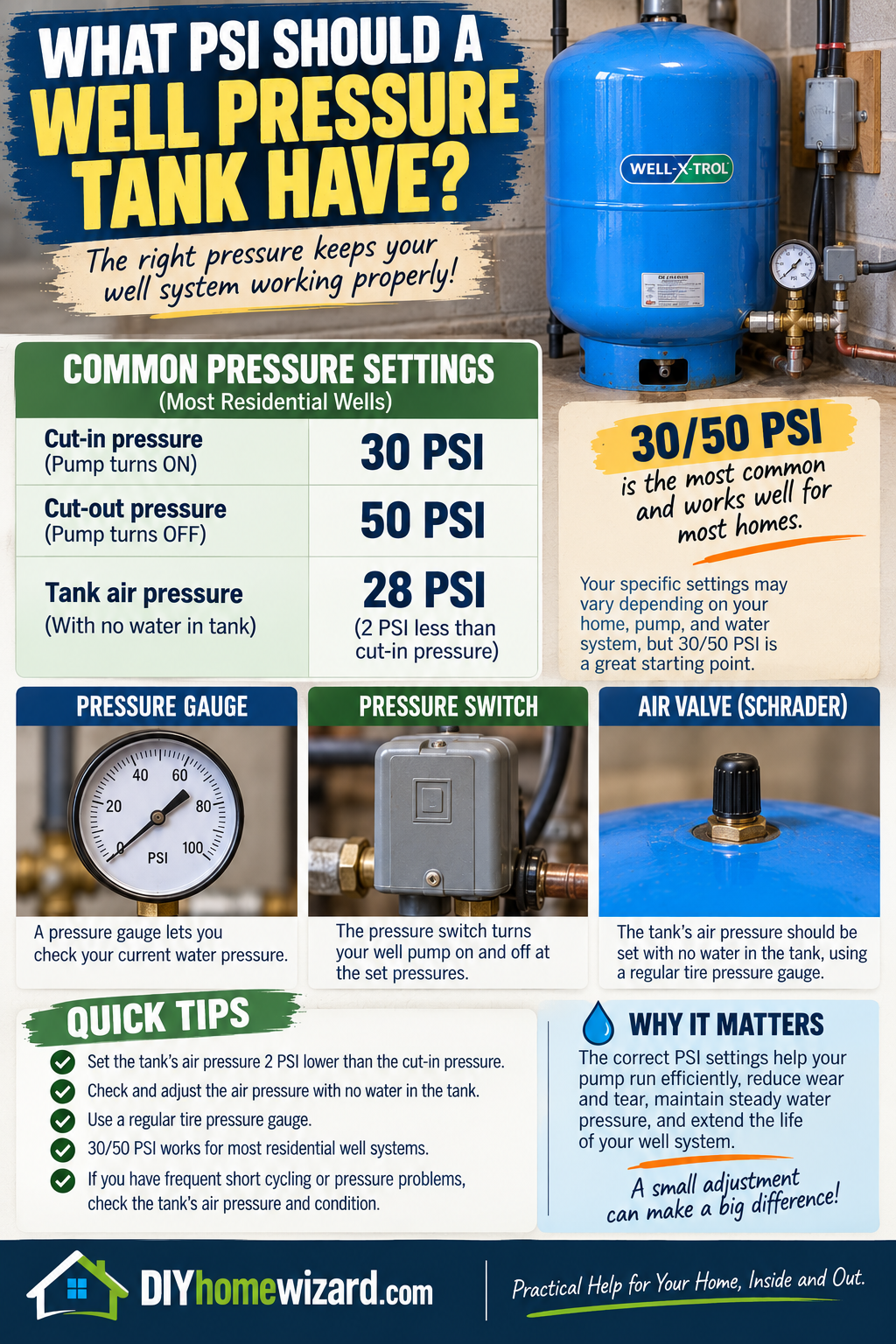
Our guide explaining what PSI a well pressure tank should have includes the complete checking procedure and common settings.
Too little air can reduce proper drawdown and stress the bladder. Too much air can cause the tank to run out of water before the pump starts.
Either problem can make the pressure feel strange and affect cycling.
Can a Small Pressure Tank Make the Pump Cycle Too Much?
Yes. A pressure tank may be functioning exactly as designed but still be too small for the pump.
A high-output pump can refill a small tank quickly. That creates short run times and more frequent starts.
This mismatch may have existed since installation. The pump cycles often, but the problem does not suddenly get worse until another component ages or household demand increases.
Tank sizing should consider:
- Pump flow in gallons per minute.
- Pump horsepower.
- Desired minimum run time.
- Pressure-switch settings.
- Required drawdown.
- Household water demand.
- Any peak-use periods.
Adding tank capacity can reduce pump starts in some systems. However, I do not buy another tank based only on the existing tank’s outside dimensions.
I identify the pump output and calculate the required drawdown first. Tank manufacturers provide sizing charts and tools for this purpose.
Why Does My Pump Run Every Few Minutes When No Water Is On?
A pump that starts while the house is quiet may be responding to pressure loss.
Somewhere, water may be leaving the pressurized system or flowing backward toward the well.
Common possibilities include:
- A leaking toilet flapper.
- A dripping faucet.
- An outside hydrant that does not close completely.
- A livestock waterer.
- An irrigation-system leak.
- A water-softener problem.
- A leaking underground pipe.
- A failed check valve.
- A leak inside the well.
- A leaking filter or treatment connection.
I shut off every fixture and watch the pressure gauge.
If pressure gradually falls without any intended water use, I do not blame the pressure tank immediately. A healthy tank cannot maintain pressure when water is escaping elsewhere.
The timing helps too. A failed tank often causes extremely fast cycling during water use. A hidden leak may start the pump every few minutes while nobody is using anything.
Can a Running Toilet Really Start the Well Pump?
Absolutely. Toilets are one of the first things I check when a pump starts unexpectedly.
A worn flapper can allow water to leak silently from the toilet tank into the bowl. The fill valve opens periodically to replace it.
That small refill lowers well-system pressure. Eventually, the well pump starts.
The homeowner hears the pump in the basement and assumes something expensive has failed. Meanwhile, the toilet is quietly wasting water and trying to keep a straight face.
I add a few drops of food coloring to the toilet tank and wait without flushing. If color appears in the bowl, water is leaking past the flapper.
I test toilets one at a time so I know which one is responsible.
Fixing the toilet may stop the mysterious pump cycles without touching the well equipment.
What If the Pump Cycles Only When the Water Softener Runs?
A water softener uses water during regeneration. Depending on the model and settings, the process can last for an extended period and cause multiple pump cycles.
This may happen late at night when the house is otherwise quiet.
If I hear the pump running around the same time on certain nights, I check the softener’s programmed regeneration schedule.
Normal regeneration creates intentional water use. However, a softener that regenerates too frequently, becomes stuck in a cycle, or sends water continuously to the drain can make the pump run far more than expected.
I inspect the drain line for ongoing flow after regeneration should have ended. I also check the display for error codes and review the manufacturer’s instructions.
The well pump may be responding normally to a treatment appliance that is using water abnormally.
Does a Larger Pressure Tank Make the Pump Run Less?
A larger tank can reduce the number of pump starts by providing more drawdown.
It does not necessarily reduce the total volume of water the pump must move. If the household uses 300 gallons, the pump still needs to replace approximately 300 gallons.
The difference is how that work is divided.
A small tank may cause many short cycles. A larger tank can allow fewer, longer cycles.
That is generally better for a traditional pump motor, assuming the tank is sized and installed correctly.
Amtrol’s current tank-sizing materials state the relationship simply: larger tank capacity produces fewer cycles and can support longer pump life.
More tank capacity is not a cure for every cycling problem, though. It will not fix a plumbing leak, failed check valve, clogged switch connection, or damaged pump.
I diagnose the cause before solving every problem with a larger blue tank.
What About Constant-Pressure Well Systems?
A variable-speed or constant-pressure well system behaves differently from a traditional fixed-speed pump and large pressure tank.
Instead of running only at full speed, a variable-frequency drive can adjust pump speed to match water demand.
The pump may run continuously during a shower or watering session while maintaining relatively steady pressure. These systems often use a much smaller pressure tank.
That longer run is not necessarily a problem. It may be exactly how the system was designed to operate.
I do not judge a constant-pressure system by conventional pressure-tank cycling rules. I identify the controller and follow its manufacturer specifications.
Warning signs can include frequent fault codes, failure to enter standby, unstable pressure, or a pump that continues running after water demand ends.
Programming and electrical diagnosis should be handled by someone trained to service that particular drive.
Why Does My Pump Run Longer Than It Used To?
A noticeable increase in run time can mean the pump is moving less water or the system is losing water somewhere.
Possible causes include:
- A clogged sediment filter.
- A partially closed valve.
- A plumbing leak.
- A damaged underground water line.
- Falling water level in the well.
- A worn pump.
- A clogged pump intake or well screen.
- A check-valve problem.
- Increased household demand.
- Higher pressure-switch settings.
I compare the current pressure rise with the system’s previous behavior.
If the pump once moved from 40 to 60 PSI in one minute and now takes four minutes with no water running, something has changed.
A longer cycle is not automatically harmful, but a sudden change deserves investigation.
If the well has been under heavy use or local drought conditions, I also consider whether the pump has less available water to work with.
Why Does My Pump Shut Off Almost Immediately?
A pump that shuts off within seconds may be filling very little usable tank volume.
The most common reasons include a waterlogged tank, failed bladder, incorrect air precharge, undersized tank, or pressure switch with too narrow an operating range.
A high-output pump can also refill a small tank extremely quickly.
I watch the gauge.
If pressure jumps from cut-in to cut-out almost instantly, I inspect the tank’s drawdown and precharge.
If the gauge barely moves but the switch clicks off, the gauge or pressure-switch sensing connection may be unreliable.
If the switch chatters rather than making one clean click, I shut off power. Worn electrical contacts or unstable pressure can create heat and arcing.
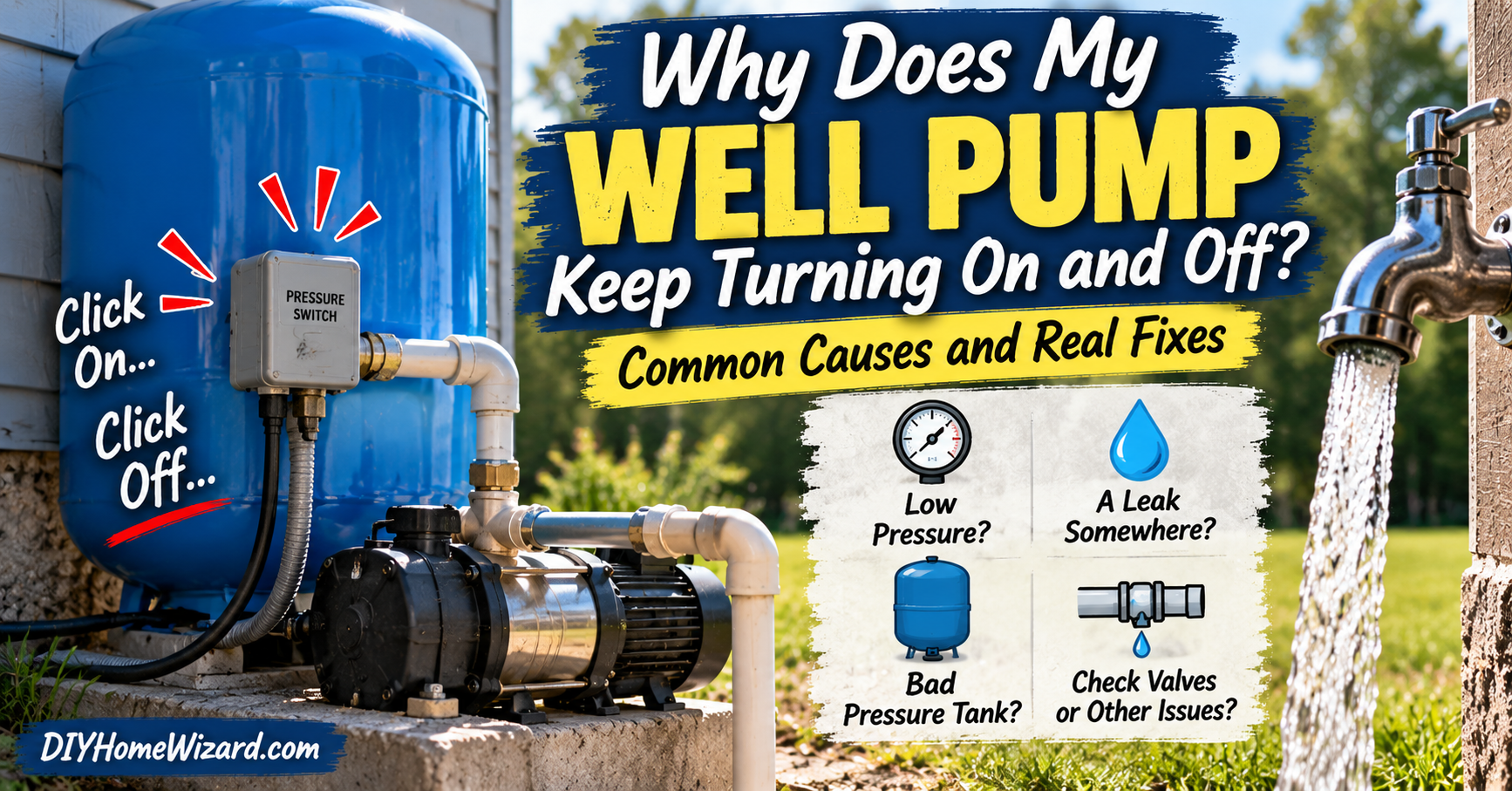
Our detailed guide to why a well pump repeatedly turns on and off covers the full short-cycling diagnosis.
Can Too Many Pump Starts Damage the Motor?
Yes. Repeated motor starts create heat and electrical stress.
The pump is designed to start and stop, but it should do so within the equipment manufacturer’s limits.
The acceptable number of starts per hour varies by motor size and design. I do not use one universal internet number for every pump.
The motor manufacturer’s documentation is the correct place to find its starting limit.
Pressure-tank manufacturers focus heavily on minimum run time because proper tank drawdown reduces unnecessary starts. A correctly sized tank allows the pump to do more useful work each time it turns on.
The National Ground Water Association’s well maintenance guidance lists frequent cycling as a sign that the system needs attention.
One busy laundry day is not likely to ruin a healthy pump. Short cycling every few seconds for weeks is another matter.
When Pump Cycling Means I Should Call Someone
I can safely observe the pressure gauge, listen to cycle timing, check toilets, and look for visible plumbing leaks.
I call a well professional when I notice:
- The pump starts and stops every few seconds.
- It runs continuously without reaching cut-out pressure.
- The breaker repeatedly trips.
- The pressure switch chatters, sparks, or smells burned.
- Pressure rises beyond the normal shutoff setting.
- Water pressure disappears during ordinary use.
- Air repeatedly spits from several fixtures.
- The pump makes grinding or severe mechanical noises.
- Water leaks near electrical components.
- The well may be running low or dry.
I never hold the pressure-switch contacts closed or bypass a safety control to force the pump to run.
If the breaker trips again after being reset, I stop resetting it. A breaker is a safety device, not a stubborn button that needs to be taught who is boss.
The Pump-Cycling Pattern I Want to See
I want my well pump to remain off while the pressure tank supplies small amounts of water.
When pressure reaches the cut-in setting, I want one clean click from the switch and a steady pump run.
I want pressure to rise smoothly toward the cut-out setting. Then I want one clean shutoff and a reasonable amount of stored water before the next start.
The pump may cycle several times during heavy water use. That alone is not a problem.
What matters is that it does not start every few seconds, run when no water is being used, or struggle endlessly to build pressure.
There is no exact answer for how many times a well pump should turn on each day. Normal well-pump cycling depends on water use, tank drawdown, pump output, and system design. Steady runs of roughly a minute or longer are commonly preferred on traditional systems, while rapid starts every few seconds tell me it is time to investigate.
Calder Voss writes for DIY Home Wizard about private wells, pump cycling, pressure tanks, and the practical warning signs that help homeowners catch water-system trouble early.