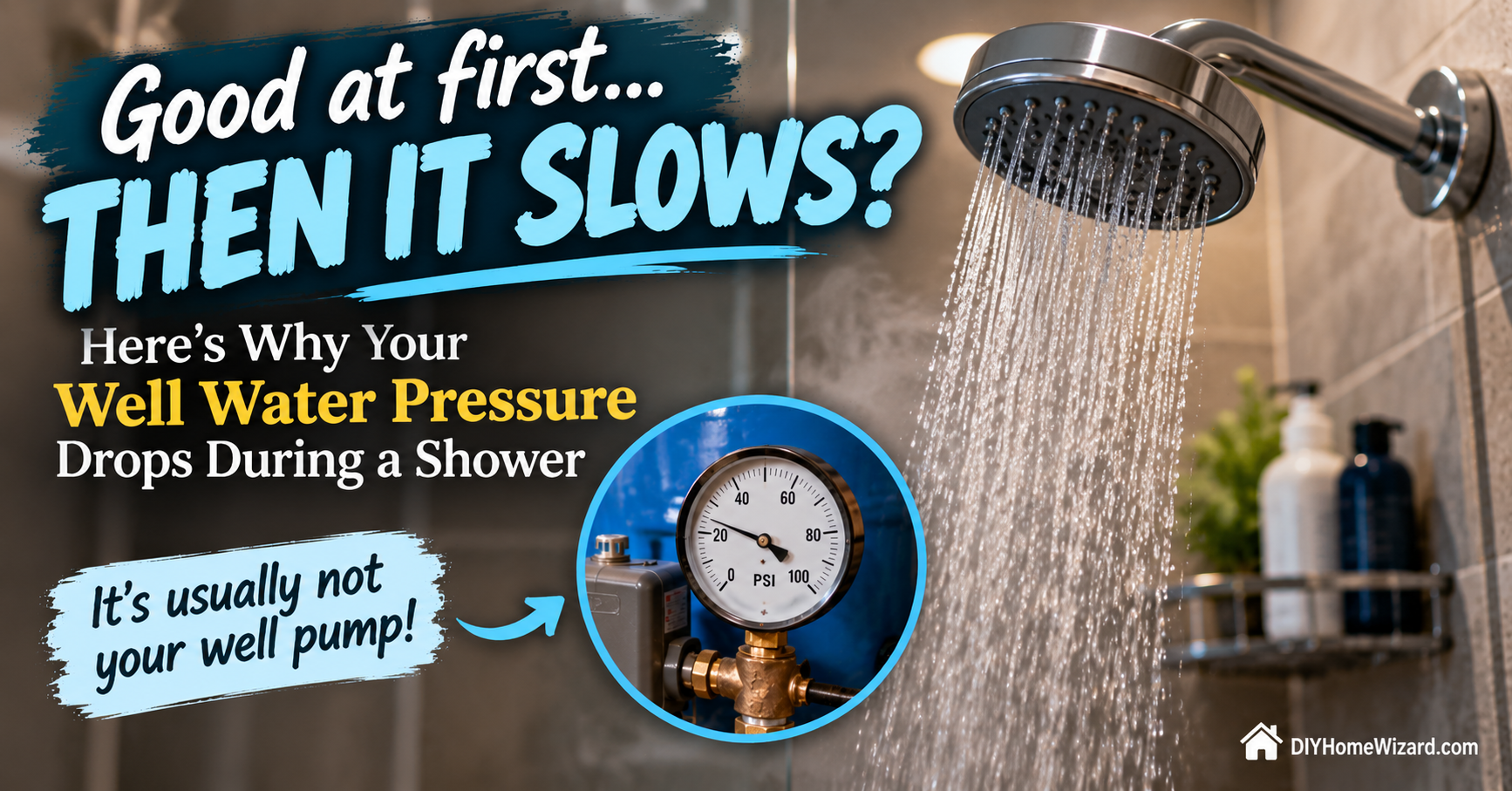
When well water pressure drops during a shower, the most common causes are a clogged showerhead or filter, an improperly charged pressure tank, a weak pump, too many fixtures using water, or a well that cannot recover fast enough.
I start by figuring out whether the pressure drop affects only the shower or the whole house. That one detail can save a lot of time and prevent me from blaming a perfectly good well pump for a $20 showerhead problem.
If the bathroom sink stays strong while the shower fades, I look near the shower. If every faucet becomes weak at the same time, I work backward toward the filters, pressure tank, pump, and well.
First Check Whether It Is Only the Shower
I turn on the shower and let it run until the pressure drops.
While the shower is still running, I check another faucet. I usually pick a nearby bathroom sink first, then a kitchen or outside faucet.
What happens next tells me where to look.
If the bathroom sink has strong pressure while the shower remains weak, the problem is likely inside the showerhead, shower valve, or nearby plumbing.
If every fixture becomes weak, the problem is probably affecting the entire well-water system.
I also remove the showerhead briefly and test the flow from the shower arm, provided the manufacturer’s instructions allow it and I can do so without damaging the finish.
Strong flow without the showerhead points toward a clogged or restrictive showerhead. Weak flow from the open shower arm moves the problem farther upstream.


A Clogged Showerhead Can Feel Like a Well Problem
Well water often contains hardness minerals, iron, sediment, or other material that can clog the small openings in a showerhead.
The pressure tank may be working perfectly. The pump may be building normal pressure. The showerhead simply cannot pass enough water.
I inspect it for:
- White mineral crust.
- Orange or brown staining.
- Uneven spray patterns.
- Individual nozzles that do not spray.
- Grit inside the inlet screen.
- Flow that improved after removing the showerhead.
If only the shower is weak, I clean the showerhead according to its manufacturer’s instructions. Some can be soaked in vinegar, but I check the finish and care directions first because certain coatings are easily damaged.
A showerhead marketed as “high pressure” can improve the feel of a low-flow shower, but it cannot repair a failing pump or clogged whole-house filter.
That distinction matters. I do not want to buy a new showerhead and then discover the kitchen faucet is weak for the exact same reason.


Check Whether the Shower Valve Is Restricting Flow
The mixing valve behind the shower controls how much hot and cold water reaches the showerhead.
Mineral buildup, debris, a worn cartridge, or a partially closed service stop can restrict flow through the valve.
This is more likely when:
- Only one shower is affected.
- The showerhead has been cleaned or removed.
- Other fixtures have normal pressure.
- The problem began after plumbing work.
- Hot and cold flow behave differently.
- The handle no longer moves or adjusts normally.
Pressure-balancing valves can also reduce one side when the other side loses pressure. That is a safety feature designed to help prevent sudden temperature changes.
If the cold-water supply weakens when a toilet flushes, the valve may reduce hot-water flow too. The shower becomes weaker, but it may be protecting the person inside from getting blasted with much hotter water.
I leave internal valve work to a plumber when replacement requires opening the wall or shutting down unfamiliar plumbing.
Does the Pressure Drop When a Toilet Flushes?
A noticeable pressure drop when a toilet flushes usually means the shower and toilet are competing for available flow.
The toilet’s fill valve opens after each flush and uses cold water. If the well system, pipe, filter, or pressure tank cannot keep up, less flow reaches the shower.
This can be more obvious in homes with small supply pipes or bathrooms where multiple fixtures share the same branch.
I test the shower by itself first.
Then I flush the toilet and watch what happens. I repeat the test with another fixture, such as the bathroom sink or washing machine.
If the shower is strong by itself but weak whenever another fixture runs, the house may have a whole-system flow limitation.
Common causes include:
- A clogged whole-house filter.
- Small or restricted plumbing.
- A weak pump.
- Low pressure-switch settings.
- Limited well yield.
- An undersized treatment system.
- Several fixtures demanding more water than the pump supplies.
This is different from a shower that slowly loses pressure even when nothing else is running.



Watch the Well Pressure Gauge During the Shower
The pressure gauge can show whether the well system is behaving normally while the shower runs.
On a traditional 40/60 system, pressure normally falls from around 60 PSI toward 40 PSI. The pressure switch then starts the pump.
The pressure should begin rising again if the pump supplies more water than the shower uses.
On a 30/50 system, the same cycle occurs between approximately 30 and 50 PSI.
I watch for a few specific patterns:
- Pressure falls normally, the pump starts, and pressure recovers.
- Pressure falls and never recovers while the shower runs.
- The gauge races up and down every few seconds.
- Pressure remains normal at the gauge while the shower is weak.
- The gauge barely moves or appears stuck.
A normal gauge reading with a weak shower points toward a restriction after the gauge, such as a filter, softener, pipe, valve, or showerhead.
Low pressure throughout the system moves the investigation toward the tank, pump, switch, well, or buried line.
Our water-pressure gauge test explains how I read those changes without opening the pressure switch or touching electrical components.
Some Pressure Change Is Normal on a Well
A conventional well system does not maintain one exact pressure all the time.
If the pressure switch is set to 40/60, the shower begins stronger when the system is near 60 PSI. The pressure gradually decreases as water leaves the tank.
The pump starts near 40 PSI and raises the pressure again.
I may feel a modest change at the showerhead as the system moves through that range. That alone does not mean anything is broken.
What I do not want is a severe drop that makes the shower barely usable. I also do not want pressure surging from weak to strong every few seconds.
A small, gradual change is common. A dramatic roller coaster usually means the system needs attention.
If I want city-like pressure that remains steadier, a constant-pressure well system is one possible option. It is not the first repair I make without checking the existing equipment, though.



Pressure and Flow Are Two Different Things
Pressure is the force pushing water through the plumbing. It is measured in pounds per square inch, or PSI.
Flow is the amount of water moving through the plumbing, usually measured in gallons per minute.
A gauge may show 50 PSI while a clogged filter allows very little water to pass.
That is why static pressure can look fine when every fixture is closed, yet the shower becomes weak as soon as water starts moving.
I think of it like a garden hose with a kink.
The water behind the kink may be under pressure. There still is not much coming out the other end.
When diagnosing a weak shower on well water, I check both the pressure reading and the actual flow under demand.
A Dirty Whole-House Filter Is One of My First Suspects
A sediment filter can slowly collect sand, silt, rust, iron particles, and other material.
As the cartridge loads up, it becomes harder for water to pass through. The shower may start strong and then weaken as demand continues.
Several fixtures running together make the restriction even more noticeable.
I look for:
- A cartridge that is overdue for replacement.
- Dark brown, orange, black, or gray material.
- Pressure that is stronger before the filter than after it.
- Flow that improves when the filter is safely bypassed.
- A problem that gradually worsened.
- Pressure dropping throughout the house during water use.
I follow the filter manufacturer’s procedure for bypassing or replacing the cartridge. I shut off water and relieve housing pressure before opening it.
A pressurized filter housing can spray water with impressive commitment. The basement floor does not need that kind of deep cleaning.
If a new filter clogs unusually fast, I do not keep buying cartridges without investigating why so much material is entering the system.


Water Softeners Can Restrict Shower Flow Too
A water softener contains resin through which household water must pass.
Resin fouling, a clogged distributor, a valve problem, incorrect sizing, or accumulated iron can restrict flow.
I become suspicious of the softener when:
- Pressure is weak at every treated fixture.
- An untreated outside faucet remains strong.
- The problem improves when the softener is correctly bypassed.
- Iron or hardness has recently become worse.
- The softener is regenerating abnormally.
- The unit is old or has received little maintenance.
A softener may pass enough water for one sink but struggle when a shower and another fixture run together.
I use the proper bypass procedure for the actual unit. I do not force old plastic valves that have not moved in 15 years. That is how a pressure problem becomes a plumbing emergency.
The Pressure Tank May Have Lost Its Air Charge
The pressure tank stores water under pressure and keeps the pump from starting every time I use a small amount of water.
A bladder-style tank needs the correct air precharge to provide useful drawdown.
When the air charge is too low or the internal bladder fails, the tank may provide very little water between pump cycles.
The shower pressure can surge as the pump repeatedly starts and stops.
Common warning signs include:
- Rapid changes on the pressure gauge.
- The pump starting every few seconds.
- Pressure becoming strong when the pump starts, then quickly weakening.
- Very little water being used between cycles.
- Water coming from the tank’s air valve.
- The tank repeatedly losing its air charge.
Water at the air valve strongly suggests a failed bladder. That normally means the tank needs replacement.
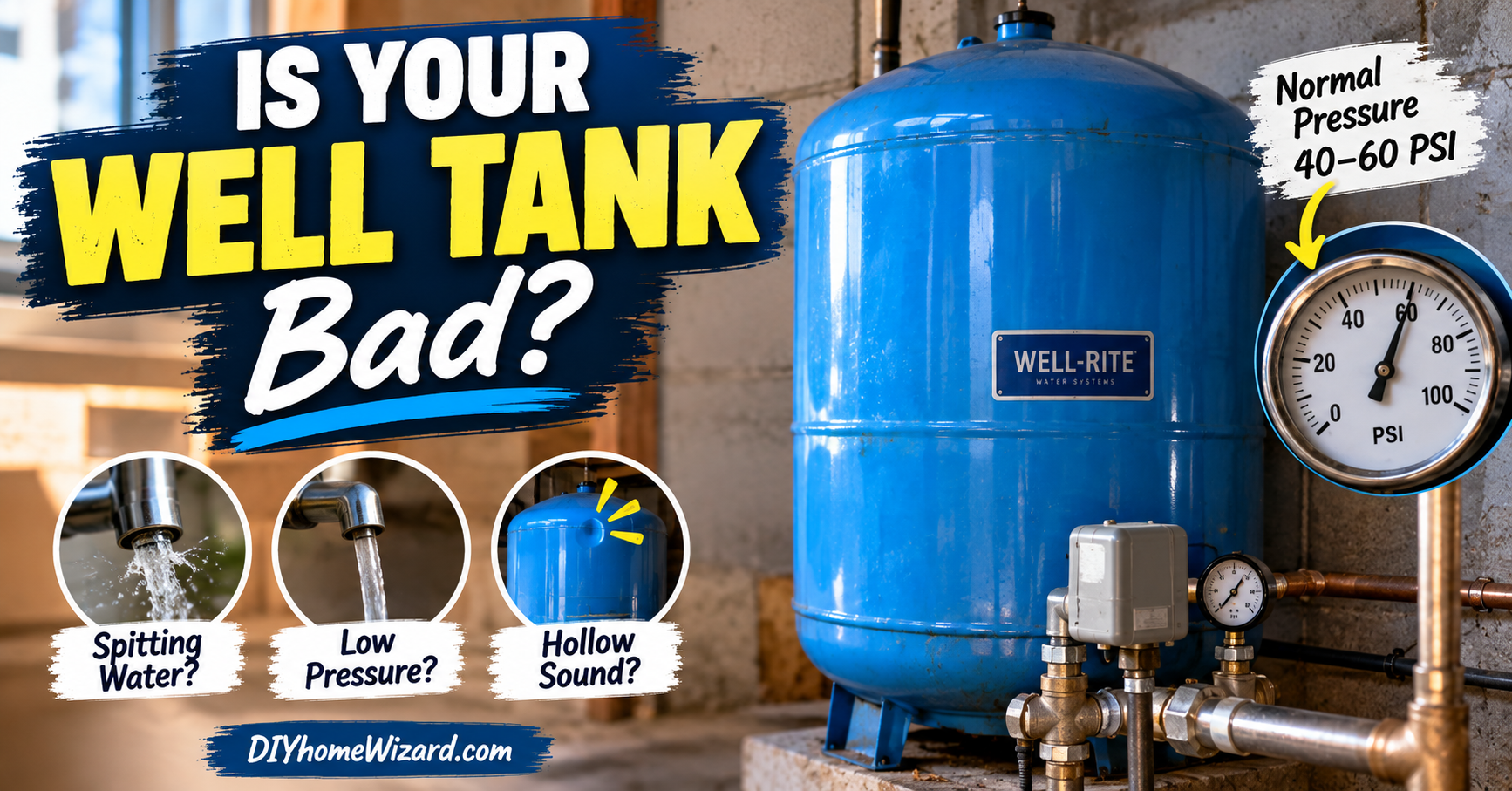
Our guide to telling whether a well pressure tank is bad covers the checks I trust more than simply knocking on the side of the tank.
The Tank’s Air Pressure May Be Set Wrong
For many bladder-style tanks, the empty-tank precharge should be approximately 2 PSI below the pressure switch’s cut-in setting.
A 30/50 system commonly uses about 28 PSI.
A 40/60 system commonly uses about 38 PSI.
The measurement must be taken with pump power off and all water pressure drained from the system. Checking the tank while it still contains pressurized water does not reveal its true precharge.
Too little air can reduce proper drawdown and contribute to poor cycling.
Too much air can cause the tank to run out of water before the pump starts. That may create a noticeable hesitation or sudden pressure dip.
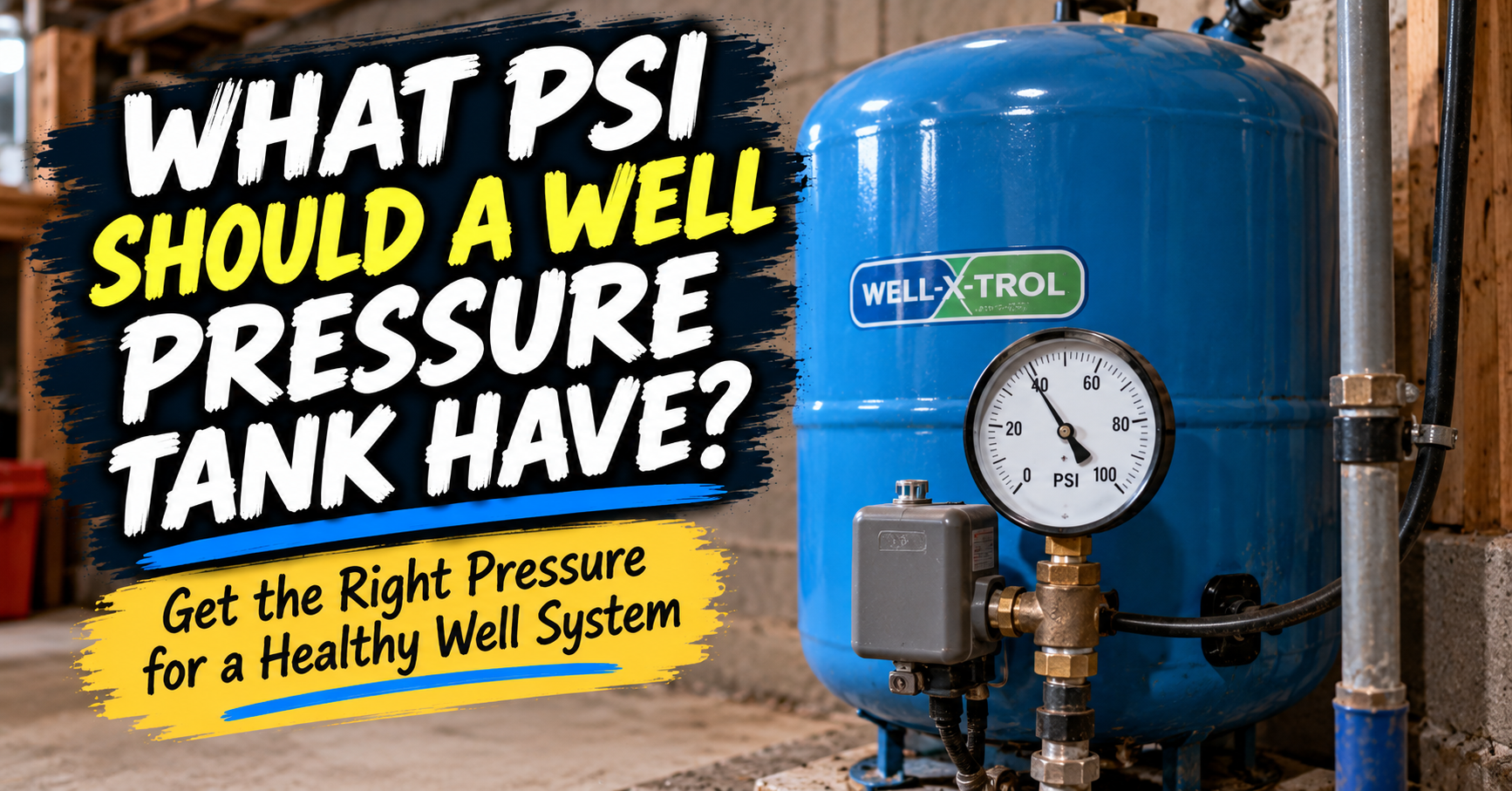
Our guide covering the correct well pressure tank PSI explains the complete checking procedure.
I never add air simply because the shower feels weak. Air pressure is one part of the diagnosis, not a universal cure.
Why Does the Shower Pressure Keep Going Up and Down?
Repeated pressure surging is often connected to the pump cycle.
The pressure tank supplies water, pressure falls, and the pump starts. If the tank has little drawdown, the pump may bring pressure back up very quickly.
The pump shuts off, pressure immediately falls, and the cycle repeats.
At the shower, I feel strong water followed by weak water over and over.
This pattern is commonly associated with:
- A waterlogged pressure tank.
- A failed tank bladder.
- Incorrect tank precharge.
- A pressure tank that is too small.
- Incorrect switch settings.
- A clogged pressure-switch connection.
- A pump and tank that are poorly matched.
If the pump starts and stops every few seconds, I do not keep running the shower to see whether it eventually works itself out. Short cycling places unnecessary stress on the pump motor.
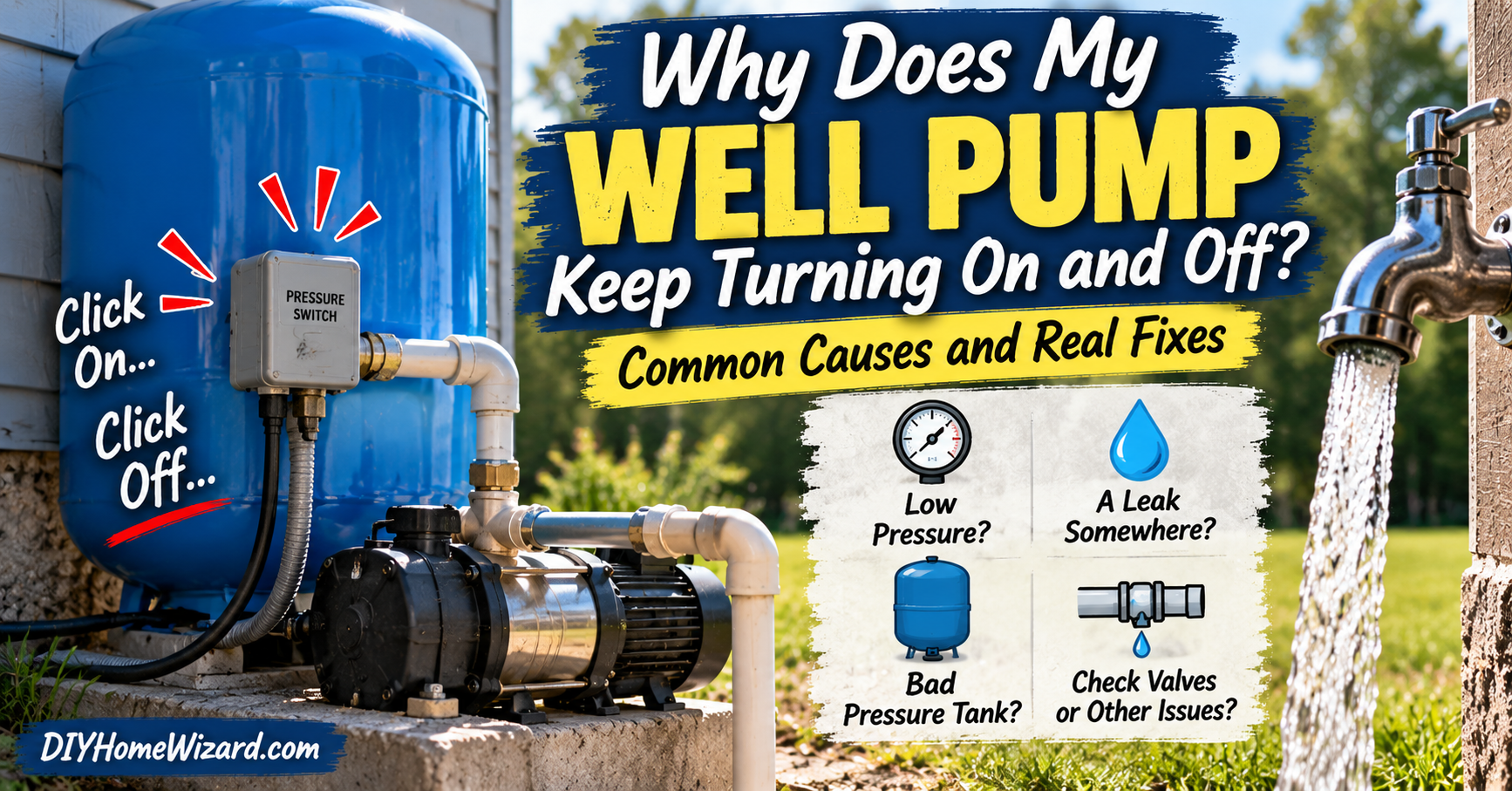
Our article explaining why a well pump repeatedly turns on and off goes deeper into that particular pattern.
The Well Pump May Not Produce Enough Flow
A worn or undersized pump may build acceptable pressure while no water is running but struggle under actual demand.
The shower begins with water stored in the pressure tank. Once that stored water is used, the pump must carry the load.
If the pump cannot supply enough flow, the pressure continues dropping.
Possible pump-related clues include:
- Weak pressure at every fixture.
- Slow recovery after water use.
- The pump running for a long time.
- Pressure failing to reach cut-out.
- The problem gradually worsening.
- Reduced flow during sustained use.
- A history of pumping sand or sediment.
- An older pump that has short cycled for a long time.
I do not replace the pump based only on weak shower pressure. A clogged filter, low water level, restricted pipe, or leak can make a good pump look weak.
A well professional can measure pump output, motor amperage, voltage, and the well’s pumping water level. Those numbers are much more useful than guessing from the sound of the motor.
The Pump May Be Running but Still Losing Ground
Sometimes the pump starts normally during a shower but pressure continues falling.
That usually means household demand is greater than the water reaching the pressure tank.
The cause could be:
- The shower and other fixtures are using too much water together.
- The pump is worn.
- The water level has fallen.
- The well has limited yield.
- A line is leaking.
- A valve is partly closed.
- A filter or pipe is restricted.
- The pump intake is clogged.
I stop other water use and watch whether the pressure begins recovering.
If it does, the system may be hitting its capacity during peak demand.
If pressure remains low with only one modest-flow fixture running, a mechanical or water-supply problem becomes more likely.
A well pump should not have to lose a tug-of-war against one ordinary shower.
The Well May Not Recover Fast Enough
Well yield is the amount of water a well can supply over time.
A well can have plenty of water when nobody is using it but recover too slowly during extended demand.
The pressure tank may provide a strong beginning to the shower. Once the stored water is gone, the pump begins drawing from the well.
If the water level falls faster than the well recovers, flow and pressure may weaken.
Clues include:
- The shower starts strong and slowly fades.
- Water pressure returns after the well rests.
- Problems are worse during dry weather.
- Irrigation or pool filling causes water loss.
- Faucets begin sputtering.
- Sediment appears after heavy use.
- Several loads of laundry trigger the problem.
- Short water use causes no trouble.
The National Ground Water Association explains that groundwater levels can change with drought, seasonal conditions, and pumping demand. A well does not necessarily recover after one quick rainfall.
A professional flow test can measure well yield and water-level drawdown. I would want those results before installing a larger pump.
Could the Well Be Running Dry?
A well does not need to be completely dry to create pressure problems.
The pumping water level may fall close to or below the pump intake during extended use. The pump begins drawing air or cannot move enough water.
I may notice sputtering faucets, cloudy water caused by air bubbles, sediment, or water that stops and later returns.
I shut down heavy water use when those symptoms appear.
I do not repeatedly restart the pump and hope it finds more water. Many submersible motors depend on surrounding water for cooling.
Running without adequate water can damage the pump.
Franklin Electric lists falling water levels, over-pumping, blocked flow, and worn pump components among conditions that can reduce well-pump output.
If the problem appears mainly during drought or prolonged use, I have the well’s static and pumping water levels checked.
An Underground Leak Can Steal Pressure
The buried line between the well and house can crack, freeze, separate, or develop a leaking fitting.
The pump may be moving plenty of water, but some of it escapes into the ground before reaching the pressure tank.
I look for:
- Unexplained wet ground.
- A soft or sunken area along the pipe route.
- Unusually green grass over one spot.
- Pressure that never fully recovers.
- A pump that runs when no water is being used.
- A problem that began after digging or freezing weather.
- Air or sediment appearing in the plumbing.
A buried leak may not show at the surface, especially in porous or disturbed soil.
If pressure drops even when the household plumbing is isolated, the buried line or well equipment becomes more suspicious.
I leave system isolation and underground leak testing to someone who understands the piping arrangement. Closing the wrong valve while the pump is running can overpressurize part of the system.
Low Pressure-Switch Settings May Be Noticeable in the Shower
A 30/50 system provides lower operating pressure than a 40/60 system.
That does not mean 30/50 is wrong. Many homes operate perfectly well at those settings.
However, the difference may be more noticeable in a second-story shower, through restrictive treatment equipment, or when several fixtures run together.
I verify the actual cut-in and cut-out readings before changing anything.
Raising the switch setting is not automatically the right fix. The pump must be capable of reaching the higher cut-out pressure, and the tank precharge must be adjusted to match.
Plumbing, filter housings, appliances, and the pressure tank must also be rated for the higher pressure.
If the pump already struggles to reach 50 PSI, asking it to reach 60 PSI will not make it stronger. It will just make it run longer while questioning my decision.
A Clogged Pressure-Switch Connection Can Cause Odd Pressure
The pressure switch senses water pressure through a small tube, nipple, or fitting.
Iron, sediment, rust, and mineral buildup can clog this narrow opening.
The switch may start late, stop late, chatter, or respond inconsistently.
I become suspicious when:
- The gauge and switch do not seem to agree.
- The pump starts at a different pressure each time.
- The switch chatters rapidly.
- Pressure drops far below the expected cut-in setting.
- The pump continues past the expected cut-out pressure.
- Corrosion surrounds the switch connection.
The switch contains live electrical contacts. I do not remove its cover or clean the connection while the circuit is energized.
If pressure rises beyond the normal cut-out point, I shut off the pump and call a professional. A clogged switch connection can be more than an inconvenience when the pump no longer receives a proper stop signal.
Small or Restricted Pipes Can Limit Shower Flow
Older homes may have galvanized steel plumbing with significant internal corrosion.
The pipe can look normal from the outside while years of buildup leave only a small opening inside.
Small-diameter plumbing can also struggle when multiple fixtures share the same branch.
I suspect a plumbing restriction when:
- The well-system gauge shows normal pressure.
- Flow is strong near the pressure tank.
- Fixtures farther away are weak.
- One side of the house has worse pressure.
- Several fixtures on the same branch affect each other.
- The home contains old galvanized piping.
A booster pump will not remove rust buildup from the inside of a pipe.
Before spending money on well equipment, I compare flow at fixtures located at different points in the plumbing system.
DIYHomeWizard.com already has a guide covering what causes low pressure at a single faucet, which is useful when the issue does not affect the entire house.
Does a High-Pressure Showerhead Fix Well Pressure?
A high-pressure showerhead may improve the feel of the spray by concentrating a limited amount of water through smaller openings.
That can be helpful when the plumbing supplies adequate pressure but the existing showerhead has a weak or inefficient spray pattern.
It will not repair:
- A failed pressure tank.
- A clogged whole-house filter.
- A worn well pump.
- A low-yield well.
- An underground leak.
- Restricted supply plumbing.
- A faulty pressure switch.
- Incorrect tank precharge.
If the problem is isolated to the shower and the plumbing flow is otherwise healthy, changing the showerhead may be a reasonable solution.
The high-pressure showerhead combination we use for bathroom upgrades is one existing option from our DIY Home Wizard product list. I would only consider it after confirming the well system is delivering normal pressure to the shower valve.
A new showerhead should improve a shower problem, not cover up a failing water system.
My Quick Way to Narrow Down the Cause
I work through the system in a simple order.
First, I run the shower by itself.
Then I check another fixture while the shower remains on.
I watch the pressure gauge and listen for the pump.
Next, I check the whole-house filter and treatment equipment.
I note whether the pump starts, whether pressure recovers, and whether the pump eventually shuts off.
I also think about recent changes. A new filter, pressure-switch adjustment, plumbing repair, drought, freezing weather, or unusually heavy water use may point toward the cause.
The pattern usually fits one of these groups:
- Only the shower is weak, which points toward the showerhead or valve.
- Pressure drops when another fixture runs, which points toward limited system flow.
- The gauge cycles rapidly, which points toward the pressure tank or controls.
- The pump runs but pressure keeps falling, which points toward pump output, leakage, or well yield.
- Pressure remains normal before a filter but weak afterward, which points toward a restriction.
- Pressure returns after the well rests, which raises concern about well recovery.
This approach keeps me from replacing the most expensive component first.
When I Stop Testing and Call a Well Professional
I can compare fixtures, inspect a showerhead, check filter dates, and watch the pressure gauge without opening electrical equipment.
I call a professional when:
- The pump runs constantly without building pressure.
- The pump starts and stops every few seconds.
- The breaker repeatedly trips.
- The pressure switch sparks or smells burned.
- The gauge rises past normal cut-out pressure.
- Faucets spit air during ordinary use.
- Water disappears and returns after the well rests.
- I suspect an underground leak.
- The well may be running low.
- Water leaks near electrical components.
I do not repeatedly reset a tripping breaker or force pressure-switch contacts closed.
Water and electricity already have a complicated working relationship. I see no reason to stand between them holding a screwdriver.
What the Shower Is Telling Me
A shower places steady demand on a well system, which makes it a useful troubleshooting fixture.
If only the shower is weak, I look at the showerhead and valve.
If the entire house weakens when the shower runs, I check filters, pressure-tank behavior, pump output, plumbing restrictions, and well yield.
If the pressure gauge falls to cut-in, the pump starts, and pressure recovers, the well system may be operating normally.
If the pump starts but pressure continues falling, the system cannot keep up with demand.
If the gauge jumps up and down every few seconds, I suspect short cycling.
When my well water pressure drops during a shower, I do not begin by adjusting the pressure switch or replacing the pump. I follow the pressure from the showerhead backward until I find the exact point where normal flow disappears.
Calder Voss writes for DIY Home Wizard about private wells, pressure tanks, water-flow problems, and practical ways homeowners can find the real cause before replacing expensive equipment.