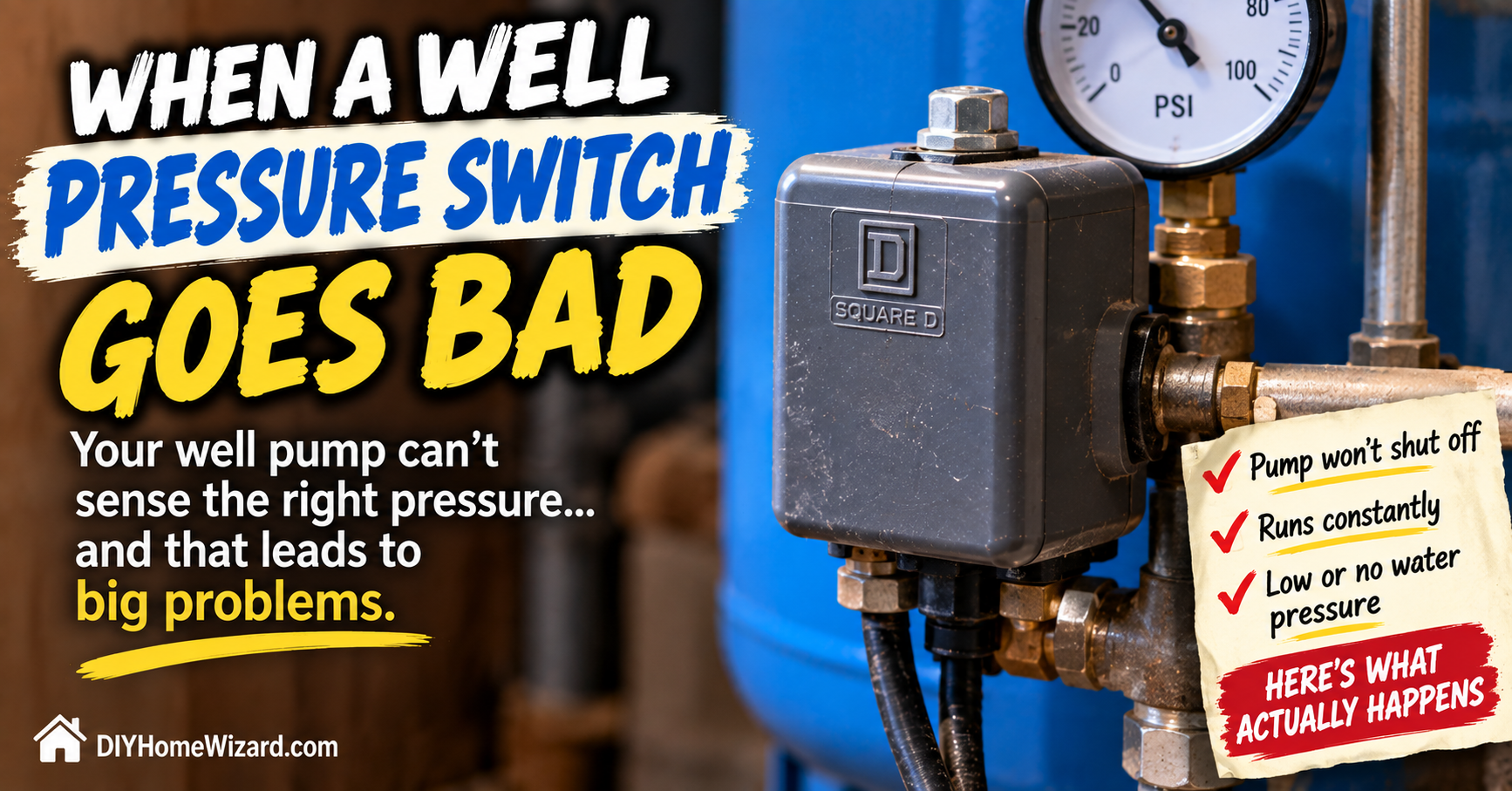
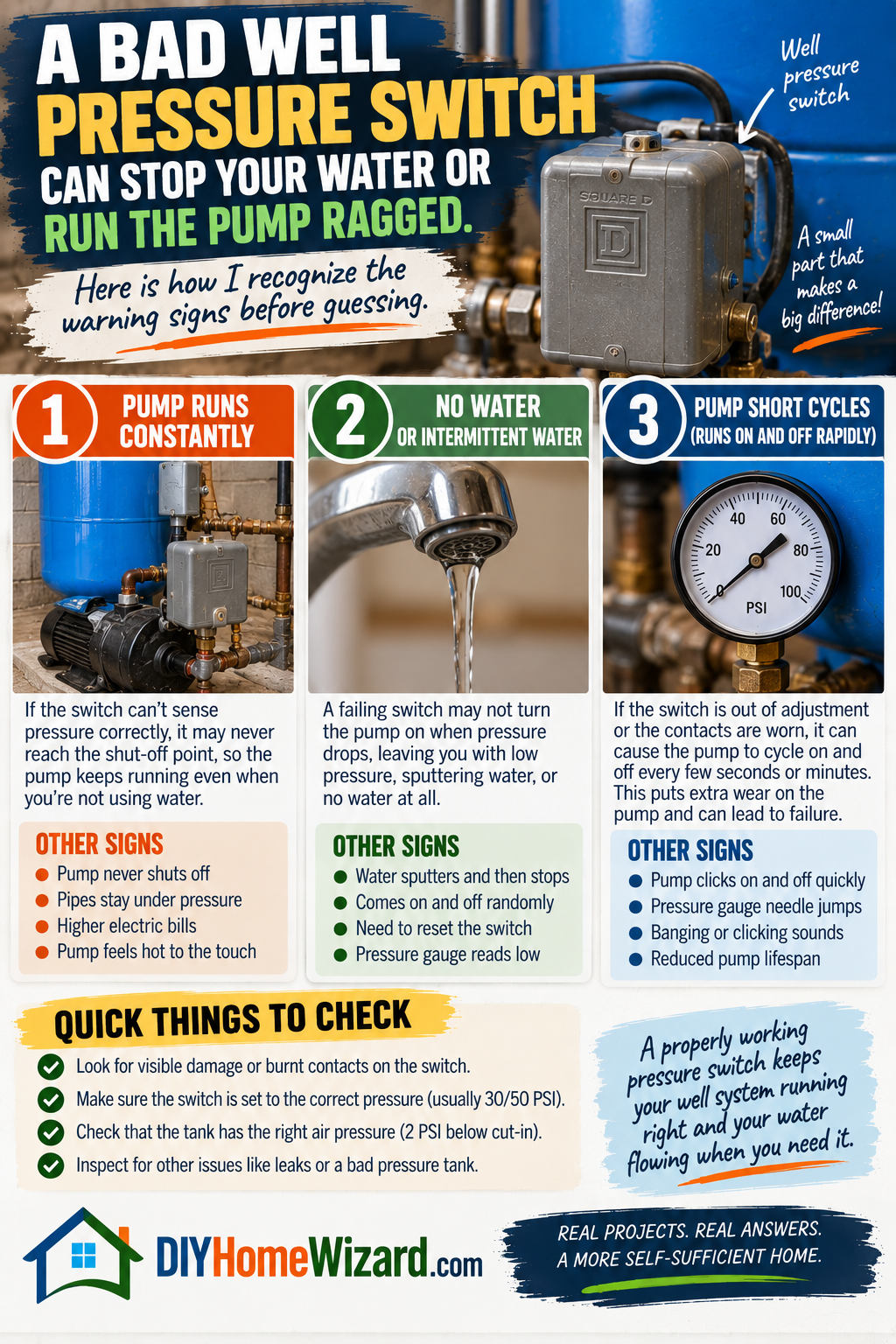
A bad well pressure switch can leave you with no water, make the pump run nonstop, or cause it to click on and off like it cannot make up its mind. You may also notice pressure that swings wildly, a pump that starts late, or electrical contacts that chatter, spark, or refuse to move.
The tricky part is that those symptoms do not always prove the pressure switch itself is bad. A clogged pressure sensing port, failed pressure tank, worn pump, plumbing leak, bad pressure gauge, or low water level can fool the switch or create nearly identical behavior. When the gauge itself may be misleading, a bad pressure gauge explains how to test the reading before replacing the switch.
That distinction matters. Replacing a pressure switch is not terribly expensive, but replacing a perfectly good one will not fix a waterlogged tank or a pump that can no longer reach its shutoff pressure.
I like to slow down, watch one complete pump cycle, and figure out what the system is actually doing before I start buying parts.
What a Well Pressure Switch Actually Does
In a traditional private well system, the pressure switch is the little traffic cop that tells the pump when to start and when to stop.
When somebody opens a faucet, water leaves the pressure tank and the system pressure falls. Once it reaches the switch’s lower setting, called the cut in pressure, the switch closes its electrical contacts and sends power to the pump.
The pump refills the tank while supplying the house. When the system reaches the upper setting, called the cut out pressure, the switch opens its contacts and turns the pump off.
A common setup operates at 30 and 50 PSI. The pump starts around 30 PSI and stops around 50 PSI. Another common setup operates at 40 and 60 PSI.
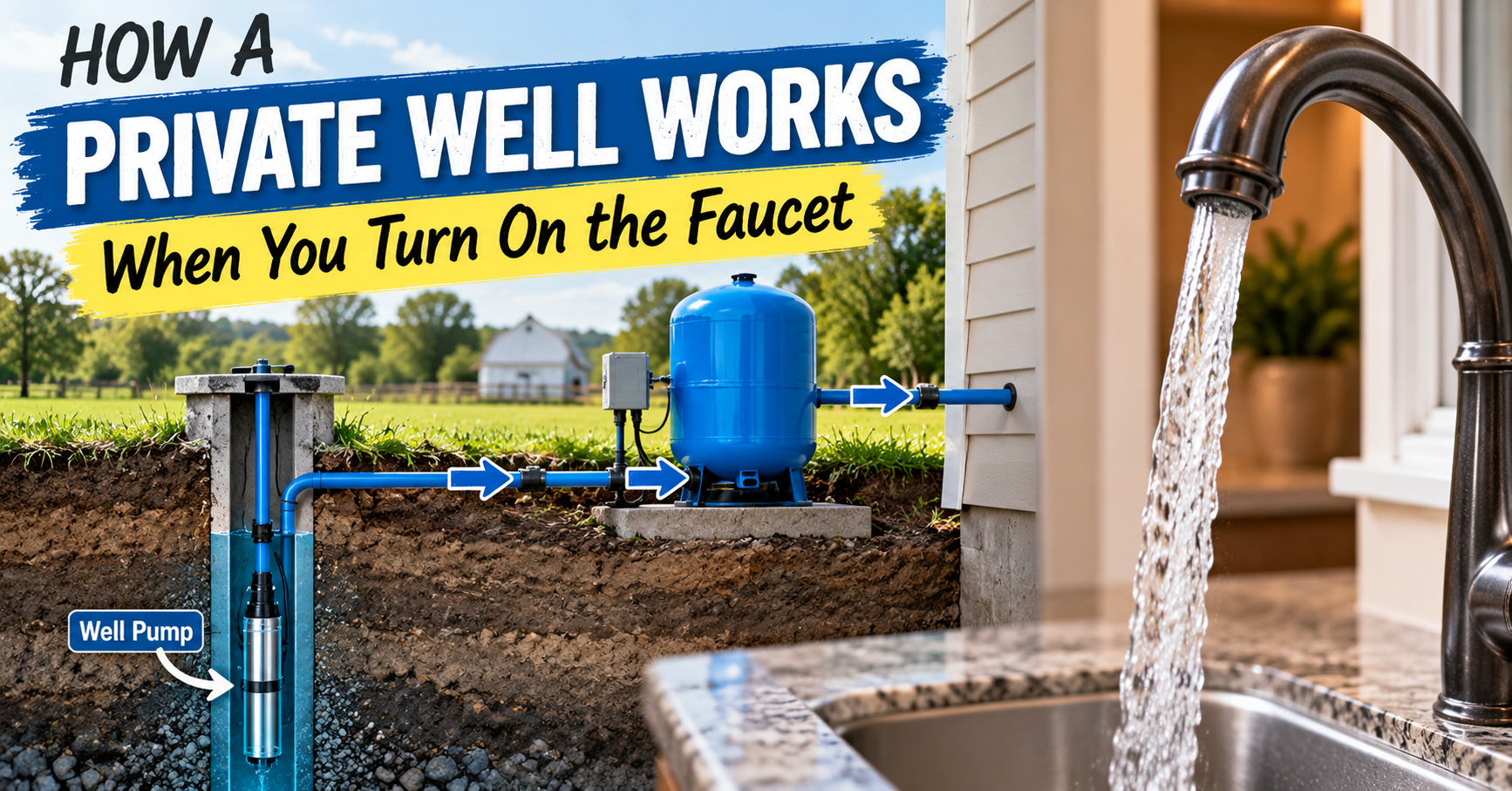
If the whole arrangement still feels mysterious, my explanation of how a private well works when you open a faucet follows the water from the well to the fixture in plain English.
The switch usually senses pressure through a small threaded opening or a narrow tube connected to the plumbing near the pressure tank. That passage is important. If rust, sediment, or mineral buildup blocks it, the switch cannot respond correctly even if its electrical parts are still perfectly usable.
That is why I never assume a strange pump cycle automatically means the switch is ruined.



The Fast Answer: Signs a Well Pressure Switch May Be Bad
The symptoms I pay the most attention to are:
- The house suddenly has no water even though the breaker has not tripped.
- The pump does not start when pressure falls below the normal cut in setting.
- The pump starts only after someone taps or nudges the switch enclosure.
- The pump reaches normal cut out pressure but continues running.
- The electrical contacts chatter rapidly instead of closing firmly.
- The contacts appear badly burned, melted, pitted, or stuck together.
- The pump starts or stops at pressures far outside the expected range.
- The switch repeatedly fails to respond even though the pressure gauge changes normally.
- The small sensing port under the switch is clogged with rust or mineral deposits.
- The switch leaks water, smells burned, or shows signs of heat damage.
Any one of these is worth investigating, but none should be considered alone. I want to know what the pressure gauge is doing, whether water is being used, and whether the pump can physically build pressure.
That little bit of observation prevents a lot of expensive guessing.



What a Bad Pressure Switch Feels Like Inside the House
Most homeowners never see the switch fail. They experience the failure at a sink, shower, washing machine, or garden hose.
The first clue might be a faucet that worked normally in the morning and produces nothing but a sad dribble that evening. Another common clue is a shower that starts strong, weakens, and then suddenly comes roaring back.
Sometimes the water stops completely when the pressure tank empties. The pump should start at that moment, but the switch does not close its contacts. The gauge drops toward zero, and the entire house goes quiet.
Other times, the opposite happens. The pump starts but does not shut off after the tank has reached its usual upper pressure. You may hear it humming in the basement, crawl space, utility room, or well house long after every faucet has been closed.
I have learned not to ignore that sound. A pump that keeps running can overheat, waste electricity, damage plumbing, or wear itself out while everyone in the house assumes somebody else left a faucet open.
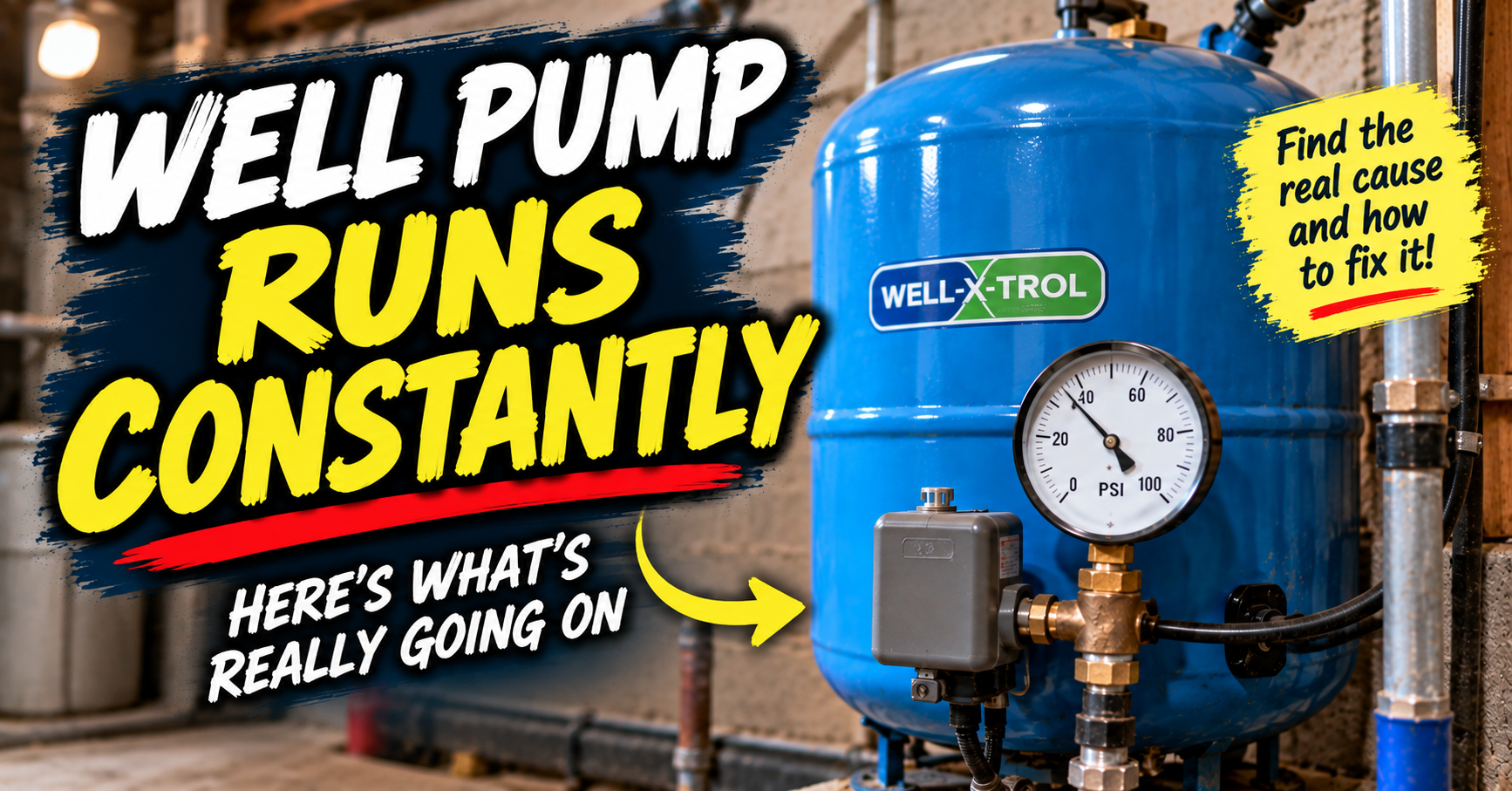
If your pump never seems to get a rest, work through the causes in my guide to a well pump that runs constantly and never shuts off. A stuck switch is on the list, but it is not the only possibility.
No Water Does Not Automatically Mean a Bad Switch
When the water stops, the pressure switch is an easy suspect because it controls power to the pump. Still, I check a few simpler possibilities before blaming it.
A tripped pump breaker can create the same no water condition. So can a failed control box, broken wire, seized pump motor, dry well, clogged intake, or damaged pipe between the pump and the house.
Start by looking at the pressure gauge.
If the gauge reads zero or sits below the normal cut in pressure, the pump should be receiving a call to start. If it is not running, the problem may involve the switch, the electrical supply, the control box, the wiring, or the pump itself.
If the gauge still reads 40 or 50 PSI while the faucets produce little or no water, the gauge could be stuck, a valve could be closed, or a restriction may exist farther into the plumbing.
I do not trust a pressure gauge merely because it has numbers printed on its face. Old gauges frequently stick. A gauge needle frozen at 50 PSI can send a troubleshooting session down the wrong rabbit hole for an entire afternoon.

That is one reason a water pressure gauge test is so useful. It gives you another reading to compare with the gauge installed at the tank.
The Most Telling Pressure Switch Test Is a Complete Pump Cycle
One of the best things you can do requires no disassembly.
Stand where you can safely see the pressure gauge and hear the pump. Then open a faucet and watch what happens.
On a 40 and 60 system, pressure should gradually fall toward 40 PSI. Around that point, the switch should call for the pump. You may hear a firm click, followed by the sound of the pump starting.
Close the faucet and keep watching. Pressure should rise toward 60 PSI. The switch should click again, and the pump should stop.
Your numbers may be different, so do not get hung up on exactly 40 and 60. You are watching for consistent behavior near the system’s established settings.
Here is what the sequence can reveal:
- Pressure drops below the usual starting point, but the pump stays off. The switch may not be closing, the sensing port may be blocked, or power may not be reaching the pump.
- The switch clicks, but the pump does not start. The problem may be beyond the switch, including wiring, a control box, or the pump motor.
- The pump starts and pressure rises normally, but it blows past the usual shutoff point. The switch may be stuck, misadjusted, clogged, or unable to open its contacts.
- The pump starts, but pressure never reaches the shutoff point. The switch may be doing exactly what it should while a leak, weak pump, clogged component, or low yielding well prevents pressure from rising.
- The switch and pump cycle every few seconds. The pressure tank is more suspicious than the switch, although a restricted sensing port can also produce strange behavior.
Watching the gauge and listening for the clicks turns a vague complaint into a pattern. That pattern is far more useful than saying, “The water pressure is acting weird.”
A Bad Pressure Tank Can Make a Good Switch Look Guilty
Rapid cycling is often blamed on the pressure switch because the switch is the part making all the noise. Click, pump on. Click, pump off. Repeat until somebody in the house threatens to move to city water.
The switch may simply be responding to rapidly changing pressure.
A properly working pressure tank stores water under pressure and provides a cushion of compressed air. That stored water lets you use a reasonable amount before the pump needs to start.
If the tank loses its air charge, develops a damaged bladder, or becomes waterlogged, pressure can fall almost immediately after a faucet opens. The switch closes, the pump starts, and pressure shoots back up. The switch opens, the pump stops, and the cycle begins again.
The clicking switch is the messenger in this situation, not the troublemaker.
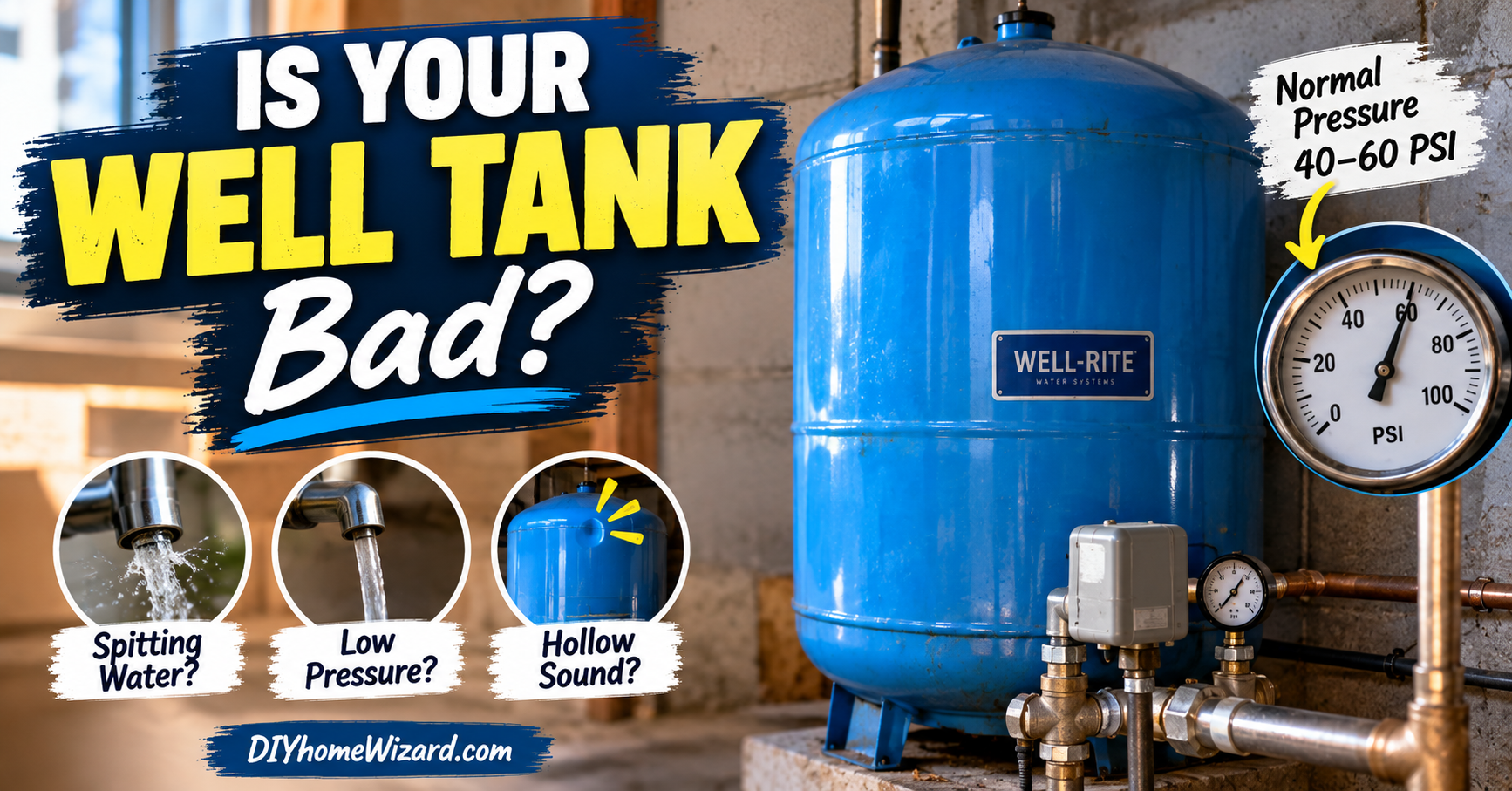
Before replacing it, check the symptoms of a failing well pressure tank. Rapid cycling, a tank that feels full of water, and very little usable water between pump cycles all point toward the tank.
I also check the tank’s air charge with the water pressure completely drained from the system. For a typical conventional setup, the tank precharge is commonly set 2 PSI below the switch’s cut in pressure.
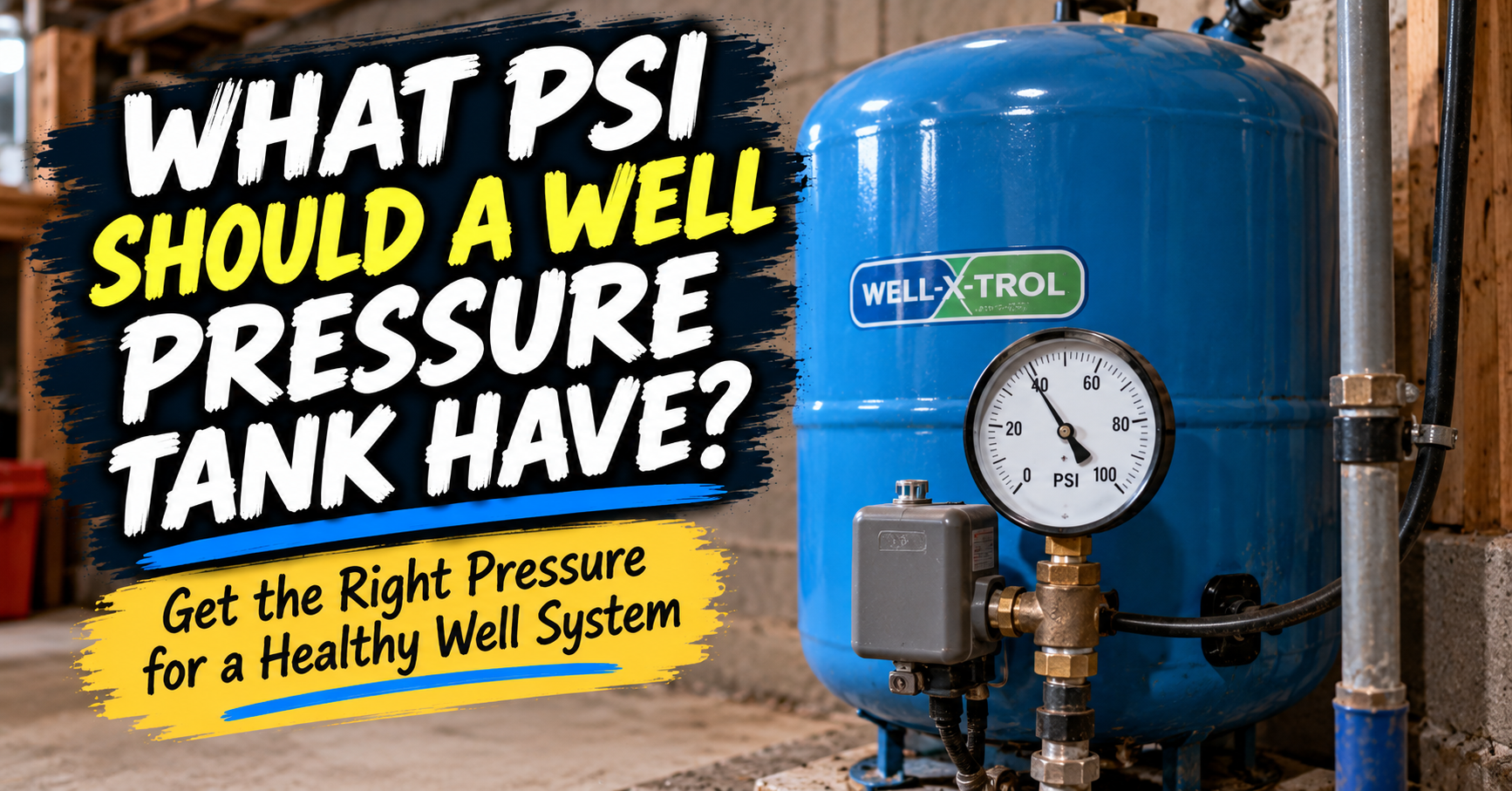
That relationship is important. My guide to the correct PSI for a well pressure tank explains how to identify the switch setting and check the tank without mixing up air pressure and water pressure.



A Clogged Sensing Port Is One of the Best Imposters
A pressure switch does not magically sense the entire plumbing system from the air around it. Water pressure has to reach a small opening beneath the switch.
That opening may be part of a short nipple, a small tube, or the tank tee assembly. Unfortunately, small passages and mineral buildup are natural enemies.
Rust flakes, iron deposits, sediment, and scale can gradually restrict the opening. The switch then reacts slowly, late, or not at all.
This can cause several confusing symptoms:
- The pressure drops far below the normal starting point before the pump comes on.
- The pump continues running above the usual shutoff pressure.
- The switch behaves inconsistently from one cycle to the next.
- The contacts seem to work when manually disturbed but not in normal operation.
- The gauge and the switch appear to disagree about the system pressure.
I think of it like trying to hear someone through a clogged drinking straw. The switch may be fine, but the pressure signal is not reaching it properly.
This is especially common on systems with iron rich water or older galvanized fittings. The outside of the nipple may look acceptable while the inside is nearly plugged.
Cleaning or replacing a clogged nipple can restore normal operation, but this job involves both pressurized water and electrical wiring. Power must be shut off, pressure must be relieved, and the wiring must be handled correctly.
If you are not comfortable confirming that the circuit is dead with a proper tester, this is an excellent place to call a well technician or licensed electrician. Water and electricity already have a difficult relationship. They do not need an overconfident homeowner acting as matchmaker.
What Burned Pressure Switch Contacts Mean
With the power safely disconnected, the condition of the electrical contacts can provide useful clues.
Healthy contacts should move cleanly and make firm contact. Older contacts may show some discoloration or light wear. That does not automatically mean the switch has failed.
Deep pitting, heavy blackening, melted material, obvious heat damage, or contacts welded together are different. Those are signs the switch may no longer carry or interrupt the pump current reliably.
A switch can also have weak mechanical movement. The contacts may hang up instead of snapping decisively from one position to the other.
One clue homeowners sometimes discover is that the pump starts after the switch enclosure is tapped. That strongly suggests sticking contacts or a mechanical problem, but tapping is not a repair.
If a tap wakes it up once, I treat that as a warning, not a new operating procedure. Nobody should have to visit the basement and smack the water system every time they want to take a shower.
Burned contacts can result from normal wear, but they can also be a symptom of a larger electrical or pump problem. Loose connections, excessive current, frequent cycling, and a struggling motor can all contribute to heat and contact damage.
Replacing the switch without addressing the reason it burned may give you a brief victory followed by the same failure.


Why the Pump May Refuse to Start at Low Pressure
Suppose the pressure gauge drops below the normal cut in setting, but the pump remains silent.
The first possibility is that the switch contacts are not closing. They may be burned, stuck, mechanically damaged, or prevented from moving by debris.
The second possibility is a clogged sensing passage. If the true plumbing pressure is 20 PSI but trapped pressure beneath the switch remains higher, the switch may not realize that the house needs water.
The third possibility is an electrical problem before or after the switch. The breaker may be tripped, a wire may be loose, a control box component may have failed, or the pump motor may have an internal problem.
Some pressure switches include a low pressure cutoff lever. These are designed to shut the pump down when system pressure falls too low, which can help protect against certain problems.
After a power outage or loss of prime, that type of switch may need to be manually held in its start position until pressure rises. Homeowners sometimes replace the entire switch because they do not realize the lever is doing its intended job.
Do not hold or manipulate anything unless you know which style of switch you have and can follow its manufacturer’s instructions safely. The terminals under the cover may carry 240 volts.
Why the Pump May Start but Never Shut Off
A pump that will not stop gets blamed on the pressure switch constantly. Sometimes that diagnosis is correct. Sometimes the switch is patiently waiting for a pressure the system never reaches.
Watch the gauge.
If pressure climbs past the normal cut out setting and the pump continues running, the switch becomes a strong suspect. The contacts may be stuck closed, the mechanism may be damaged, or the sensing port may be blocked.
If pressure rises to 42 PSI and sits there while a 40 and 60 switch is trying to reach 60, the switch may not be the problem. The pump has not satisfied its shutoff condition.
Possible causes include:
- A leaking pipe between the pump and the pressure tank
- A worn pump that cannot build enough pressure
- A low water level in the well
- A clogged pump intake or jet assembly
- A partially open faucet, hose bib, or running toilet
- A failed check valve or foot valve
- An incorrect pressure switch setting
- A pump that is undersized for the required pressure
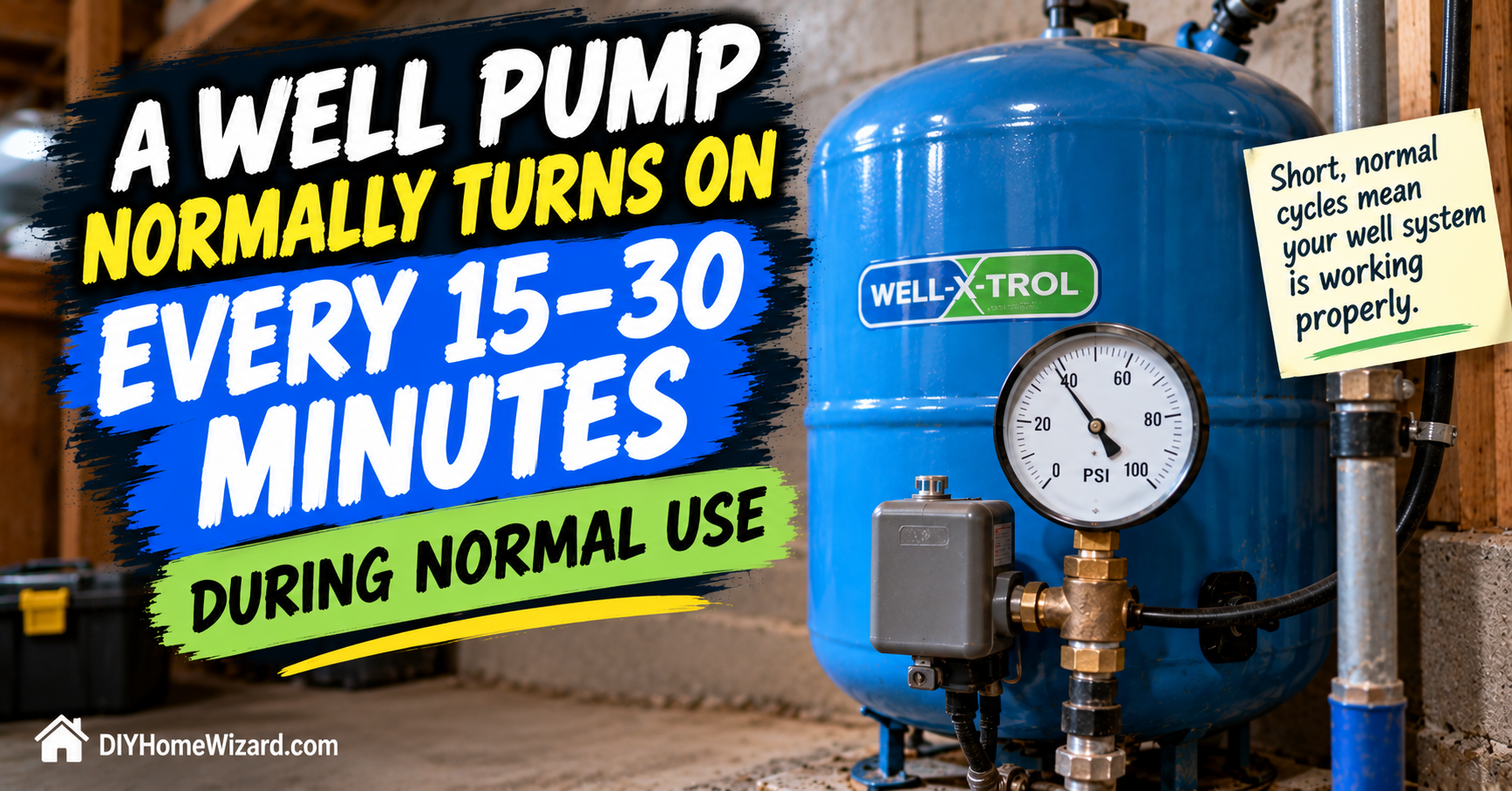
This is where knowing how often a well pump should run during normal water use becomes helpful. A pump running while water is being used can be completely normal. A pump running indefinitely after every fixture is closed is not.
If the pump is running continuously and pressure is not rising, I shut it down rather than letting it struggle while I debate the possibilities. Running a pump dry or against a serious restriction can turn a repairable problem into an expensive one.


Rapid Clicking or Chattering at the Switch
A pressure switch should normally make a clean click when it closes and another clean click when it opens.
Rapid chattering sounds different. The contacts may repeatedly open and close in a fraction of a second, sometimes producing visible arcing.
This can happen when pressure at the switch fluctuates rapidly. A clogged or poorly configured sensing line can contribute. So can a waterlogged pressure tank, loose electrical connection, weak switch mechanism, or pump system that cannot stabilize near the switching point.
I do not let a chattering switch continue operating. Repeated arcing damages the contacts and creates heat. Even if the switch was not the original cause, the chattering can eventually ruin it.
There is also a difference between rapid electrical chatter and ordinary short cycling. Short cycling may involve pump runs lasting several seconds. Chattering can sound more like a frantic buzzing or a burst of fast clicks.
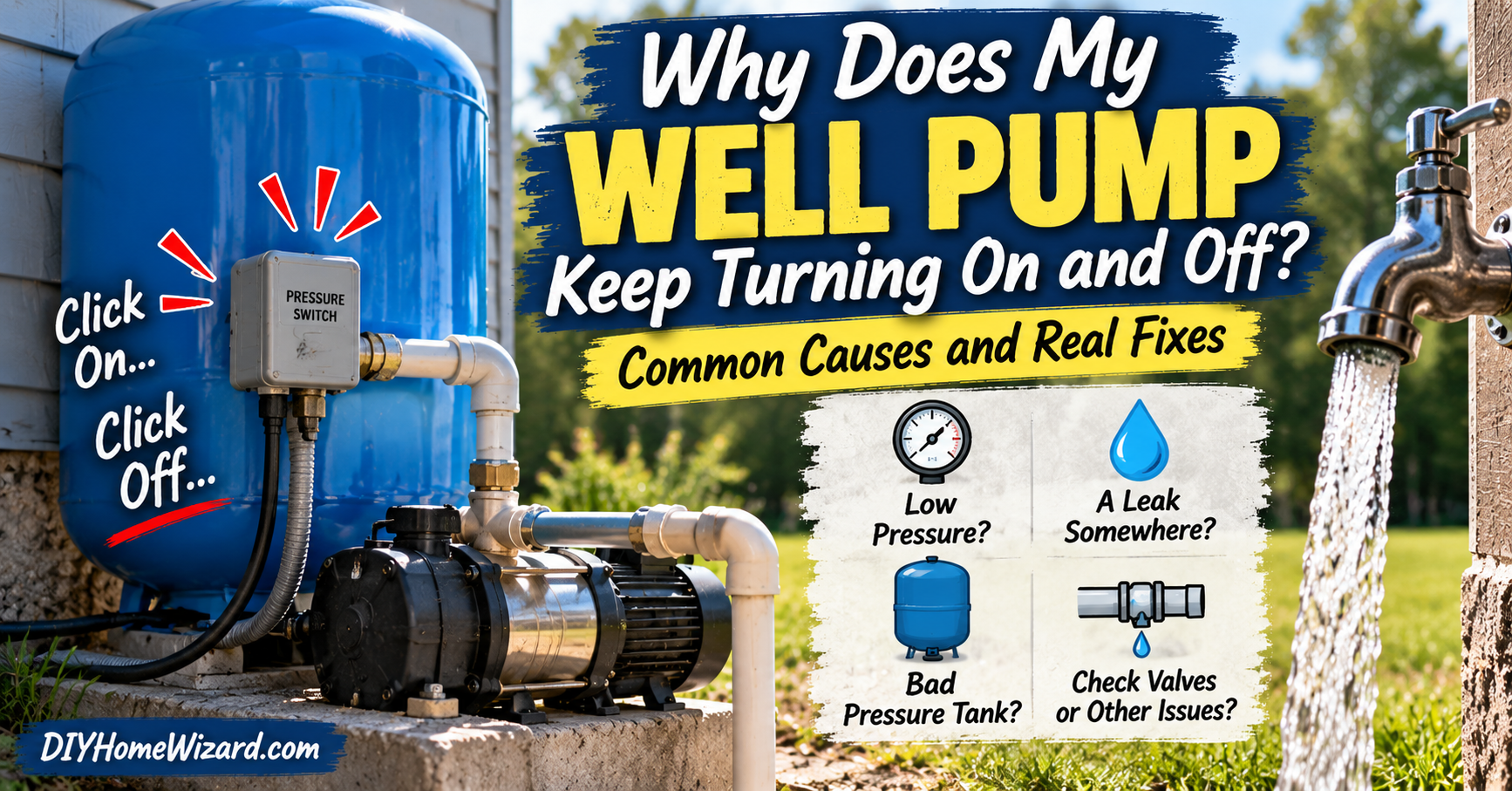
For a broader diagnosis, compare what you hear with the causes of a well pump that keeps turning on and off.
Can You Adjust a Well Pressure Switch Instead of Replacing It?
Many traditional pressure switches can be adjusted, but I do not treat adjustment as the automatic cure for bad pressure.
Adjustment changes the operating range. It does not repair burned contacts, unclog a blocked sensing port, restore a lost tank air charge, or make a worn pump stronger.
On many common switches, the larger adjustment nut moves both the cut in and cut out pressures together. A smaller adjustment may change the difference between them. The exact arrangement depends on the switch model.
Turning the wrong adjustment too far can create a system the pump cannot satisfy. For example, raising the cut out pressure sounds like an easy way to improve a weak shower. If the pump can only build 52 PSI and you ask it to shut off at 60 PSI, it may run continuously.
I record the original settings before touching anything. I also check the label or manufacturer’s instructions for that exact switch.
The pressure tank air charge must remain properly matched to the cut in setting. Changing the switch settings without checking the tank can create poor drawdown, rapid cycling, or confusing pressure behavior.
If the system used to operate correctly and suddenly does not, I look for a failure or blockage before changing the adjustment. Mechanical settings rarely wake up one morning and decide to wander off by themselves.
What I Check Before Buying a New Pressure Switch
My troubleshooting order is simple because I want evidence before parts.
- I confirm whether the house has no water, weak water, unstable pressure, or a pump that will not stop.
- I check whether a faucet, toilet, irrigation valve, or outdoor hose is using water.
- I observe the installed pressure gauge and compare it with a separate gauge if the reading seems suspicious.
- I watch one full cycle to identify the pressure where the pump starts and stops.
- I listen for a clean click, repeated chatter, or complete silence from the switch.
- I consider whether the pressure tank is causing rapid pressure changes.
- I shut off power before any close inspection of the switch, wiring, or sensing connection.
- I look for burned contacts, loose wires, corrosion, leaking water, or heat damage.
- I investigate whether the sensing port or nipple is restricted.
- I confirm that the pump can actually reach the switch’s cut out pressure.
This order separates control problems from water supply problems. It also gives a professional much better information if I decide the repair is beyond what I should handle.
Telling a technician, “The pressure falls to 28 PSI, the switch does not click, and the pump starts when the contacts finally move,” is much more useful than saying, “My well is broken.”
Is It Safe to Replace a Well Pressure Switch Yourself?
Mechanically, replacing a common pressure switch can look simple. Electrically, it deserves respect.
A well pump circuit may operate at 240 volts. Turning off a wall switch or assuming the breaker label is correct is not enough. Power must be disconnected and verified with an appropriate tester.
The plumbing side also needs attention. System pressure should be relieved before removing a switch or opening its sensing connection. Water can enter the electrical area if the job is handled carelessly.
Wire placement matters. Grounding matters. The switch’s pressure rating and current rating matter. The new switch also needs to match the intended cut in and cut out pressures.
I would consider replacement only if I could confidently do all of the following:
- Identify the correct breaker
- Verify the circuit is deenergized
- Photograph and label the existing wiring
- Match the new switch to the pump and system
- Relieve the water pressure safely
- Inspect and clear or replace the sensing nipple
- Make watertight threaded connections
- Confirm the tank precharge
- Test the full pump cycle after restoring power
If any of that sounds unfamiliar, hiring a qualified professional is the sensible choice. There is no prize for saving a service call while standing next to exposed pump wiring with wet hands.
How Much Does a New Pressure Switch Fix?
A new switch can solve the problem when the old switch has failed electrically or mechanically. It can also help when the old unit is badly corroded, leaking, or unreliable.
It will not repair:
- A ruptured pressure tank bladder
- Incorrect tank precharge
- A leaking underground pipe
- A worn or damaged well pump
- A dry or low yielding well
- A bad pressure gauge
- A failed pump control box
- Loose or damaged wiring elsewhere in the circuit
- A clogged pump intake
- Plumbing restrictions inside the house
This is worth emphasizing because a new switch may temporarily appear to help. During replacement, the clogged nipple gets disturbed, wiring gets tightened, or the system gets drained and repressurized. The behavior changes, and the new switch gets all the credit.
A few days later, the original problem returns because its actual cause was never corrected.
Pressure Switch Trouble Versus Ordinary Pressure Drop
A pressure switch controls when the pump starts and stops. It does not create the pump’s pressure or increase the well’s water supply.
If water pressure falls mainly when two or more fixtures operate at once, the switch may be working normally. The house could be demanding water faster than the pump, plumbing, filters, or treatment equipment can provide it.
If the pressure drops during every shower but recovers when other fixtures stop, investigate household demand, clogged filters, pipe restrictions, showerhead buildup, and pump capacity.
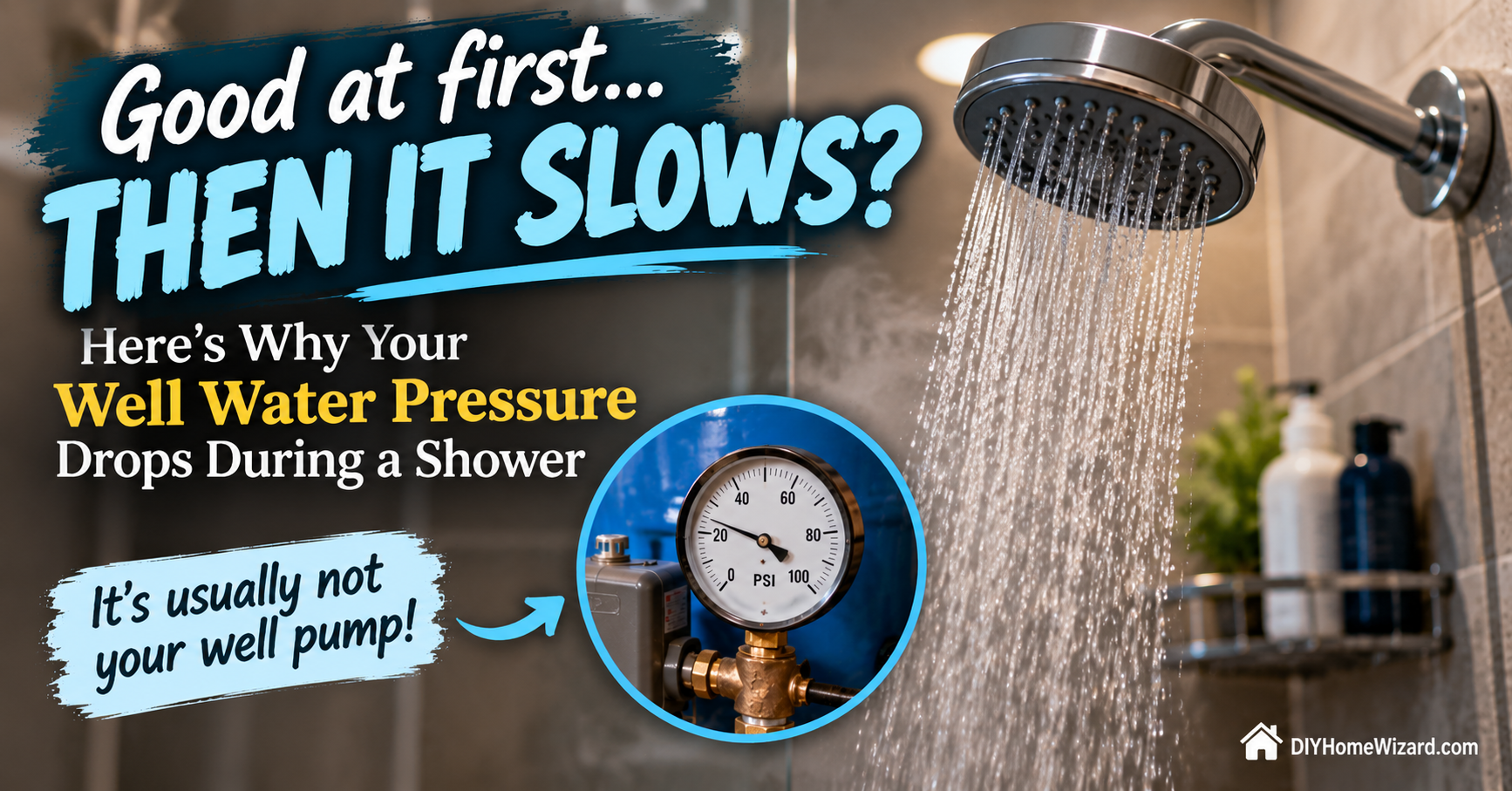
My guide to well water pressure dropping during a shower breaks that problem down without assuming the pressure switch is guilty.
A switch problem usually shows up at the pump’s starting or stopping points. A flow restriction tends to show up while water is moving through a particular part of the system.
That is not a perfect rule, but it is a useful way to begin separating the two.
When I Would Shut the System Down Immediately
Some symptoms move the problem out of the “watch it for a while” category.
I shut off the pump breaker and call for help if I notice:
- Smoke or a strong burned electrical smell
- Melted insulation or a scorched switch enclosure
- Water leaking directly onto electrical components
- Violent contact chattering or repeated arcing
- A pump that continues running with pressure above its normal shutoff point
- A breaker that repeatedly trips when the pump tries to start
- Wiring that is loose, damaged, or too hot to touch safely
- A pump running while the well appears to be out of water
I also shut the pump down if it cannot build pressure and no water is being used. Letting it run all night will not encourage it to try harder. Pumps are dependable machines, but motivational speeches are largely wasted on them.
How Long Does a Well Pressure Switch Last?
There is no dependable expiration date because operating conditions vary so much.
A switch in a clean, dry environment with a healthy pressure tank may operate for many years. A switch exposed to moisture, corrosion, rapid cycling, loose wiring, insects, mineral buildup, or excessive motor current can fail much sooner.
Frequent cycling is especially hard on the contacts. Every start and stop creates mechanical movement and electrical wear. If a failing pressure tank causes hundreds of unnecessary cycles, the switch and pump motor both pay the price.
I focus less on the calendar and more on condition. Corrosion, unreliable switching, serious contact damage, heat discoloration, and repeated sticking tell me more than the installation date alone.
How I Help a New Pressure Switch Last Longer
Once the system works properly, a few habits can reduce future trouble.
Keep the pressure tank correctly charged. A healthy tank reduces unnecessary starts and protects more than just the switch.
Fix leaks instead of letting the pump cycle for small, constant water losses. A dripping outdoor hydrant or running toilet may not look dramatic, but it can add many pump cycles.
Keep the switch area dry and protected. Condensation, roof leaks, flooding, and insects do electrical equipment no favors.
Inspect the tank tee and nearby fittings for corrosion. Rust around the base of the switch can indicate a slow leak or a deteriorating fitting.
Pay attention to changes in normal operation. Once you know roughly when the pump starts, how long it runs, and when it stops, new behavior becomes much easier to recognize.
Frequently Asked Questions
Can a bad well pressure switch cause low water pressure?
Yes, but not in every case. A switch that starts the pump too late can allow pressure to fall unusually low. A clogged sensing port can also delay the switch’s response.
However, consistently weak flow may be caused by a clogged filter, restricted pipe, failing pump, low well level, or heavy household demand. The gauge and pump cycle usually help separate these possibilities.
Can a pressure switch work sometimes and fail other times?
Yes. Worn contacts can stick intermittently, corrosion can interfere with movement, and a partially blocked sensing port can produce delayed or inconsistent operation.
Intermittent problems are frustrating because everything may work normally when a technician arrives. Recording the gauge reading and pump behavior during the failure can be extremely helpful.
Will tapping the pressure switch fix it?
No. Tapping may temporarily free stuck contacts, but it does not repair them.
If tapping the enclosure changes the pump’s behavior, shut off power and have the switch and related wiring inspected. Do not turn tapping into part of the family’s morning water routine.
Can a clogged pressure switch be cleaned?
The electrical contacts are not the only concern. Often the blockage is in the small nipple or passage that carries water pressure to the switch.
That passage may be cleanable, or the corroded fitting may be better replaced. The power must be disconnected, verified, and the plumbing pressure relieved before the assembly is opened.
Why does my pressure switch click but the pump does not start?
The click indicates that the switch mechanism may be responding to pressure, but it does not prove power is reaching or starting the pump.
Possible causes include burned contacts, loose wiring, a failed control box, a tripped breaker, damaged cable, or a failed pump motor. Electrical testing is needed to narrow it down safely.
Why does my pump stop at a different pressure every time?
A small variation can be normal, especially with an old gauge. Large changes are not.
A sticking switch mechanism, clogged sensing port, faulty gauge, unstable tank pressure, or electrical chatter could cause inconsistent operation. Compare the readings with a known reliable gauge before adjusting the switch.
Should I replace the pressure gauge when replacing the switch?
If the gauge is old, rusty, damaged, or questionable, replacing it at the same time is often practical. A reliable gauge is essential for setting up and testing the system.
Without one, you are trying to diagnose pressure while the one instrument reporting it may be lying to you.
Can the wrong pressure switch damage a well pump?
An incorrect switch or improper setting can contribute to trouble.
If the cut out pressure is higher than the pump can reach, the pump may run continuously. If the tank precharge is not matched to the cut in pressure, the system may cycle poorly. The switch must also have electrical ratings appropriate for the pump circuit.
Is the pressure switch always located beside the pressure tank?
It is commonly installed on the tank tee or nearby plumbing, but not every system is arranged the same way.
Some jet pumps have the switch mounted on or near the pump. Constant pressure systems may use a pressure sensor and electronic drive instead of a traditional mechanical pressure switch.
My Bottom Line
A bad well pressure switch can cause no water, delayed pump starts, nonstop running, erratic pressure, or rapid electrical clicking. The strongest evidence is a switch that fails to open or close even though the pressure gauge has crossed its normal operating point.
Still, I would not replace it based on one symptom alone.
I watch the gauge through a complete cycle. I make sure the pump can actually build pressure. I consider the pressure tank. I question the gauge. I look for leaks and heavy water use. I also remember that a clogged sensing port can make a healthy switch behave like a bad one.
That careful approach may take ten extra minutes, but it can save hours of swapping parts and inventing new words in the basement.
Most importantly, I treat the switch as live electrical equipment until the circuit has been shut off and properly verified. Observing the system is a reasonable homeowner task. Working inside a 240 volt control circuit without the right knowledge and test equipment is not.
Calder Voss writes about private wells, household water systems, and the practical lessons that become obvious only after a repair has already interrupted dinner.