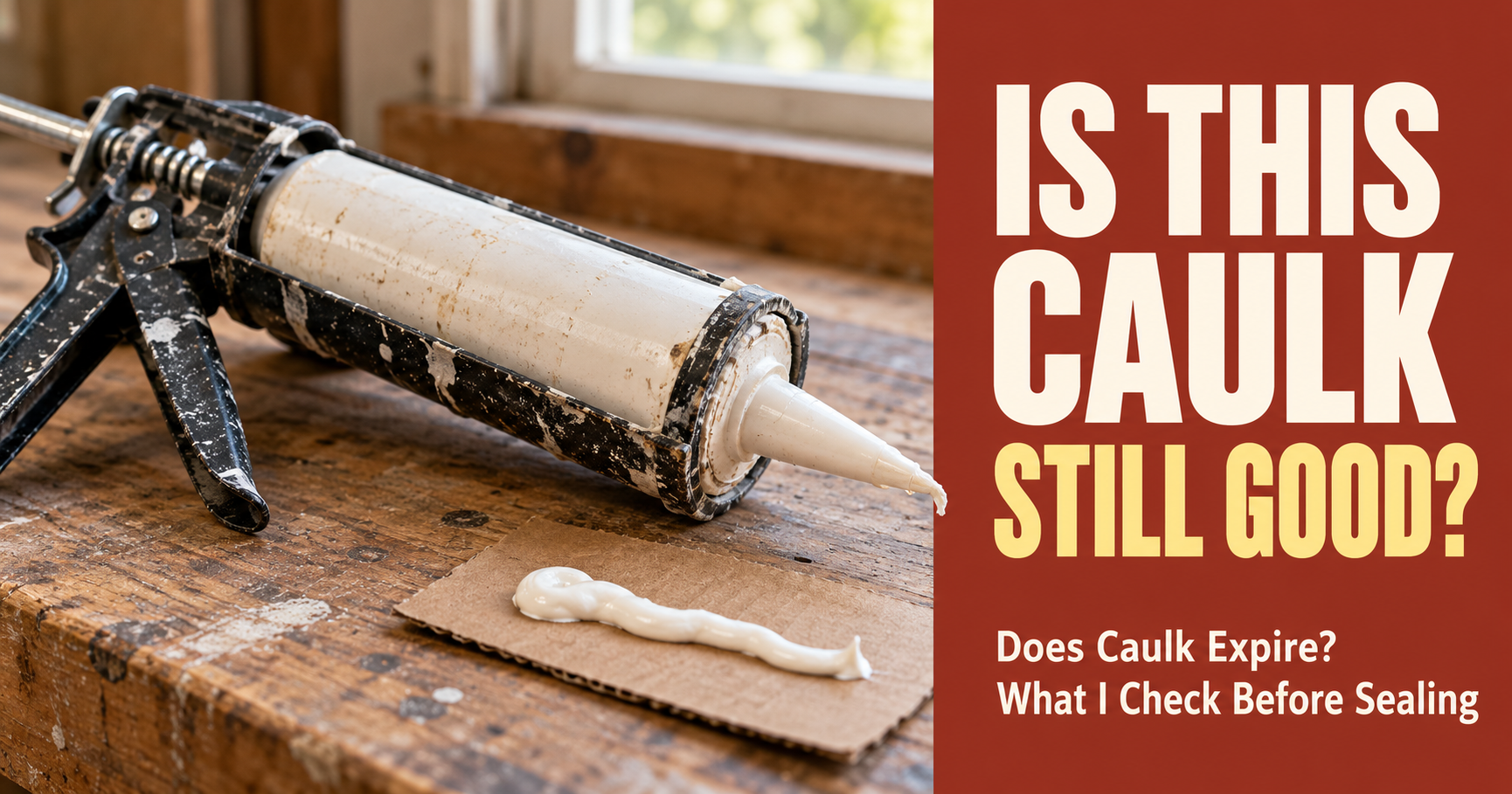
Caulk does expire. Not every old tube is automatically trash, but I have learned not to trust one just because the label looks fine and the tube still feels full.
A tube can sit in a basement or garage for years, look completely normal, and then come out in one lumpy, stringy mess. That is usually when you are balanced awkwardly next to a bathtub, naturally.
Before I seal anything I care about, I check the caulk itself, the tube, and how it comes out of the nozzle. It takes a couple of minutes and can save a lot of scraping, swearing, and doing the job twice.
How long does caulk last?
Unopened caulk usually lasts about 12 to 18 months when it has been stored somewhere dry and reasonably cool. Some tubes may last longer, but I treat the date on the package as a useful warning rather than a suggestion.
Once a tube has been opened, the clock speeds up considerably.
Even if you put a nail in the tip, wrap it in tape, and give it a little pep talk, air can still work its way inside. The nozzle may harden first while the deeper material stays usable, or the entire tube may slowly turn into a rubbery disappointment.
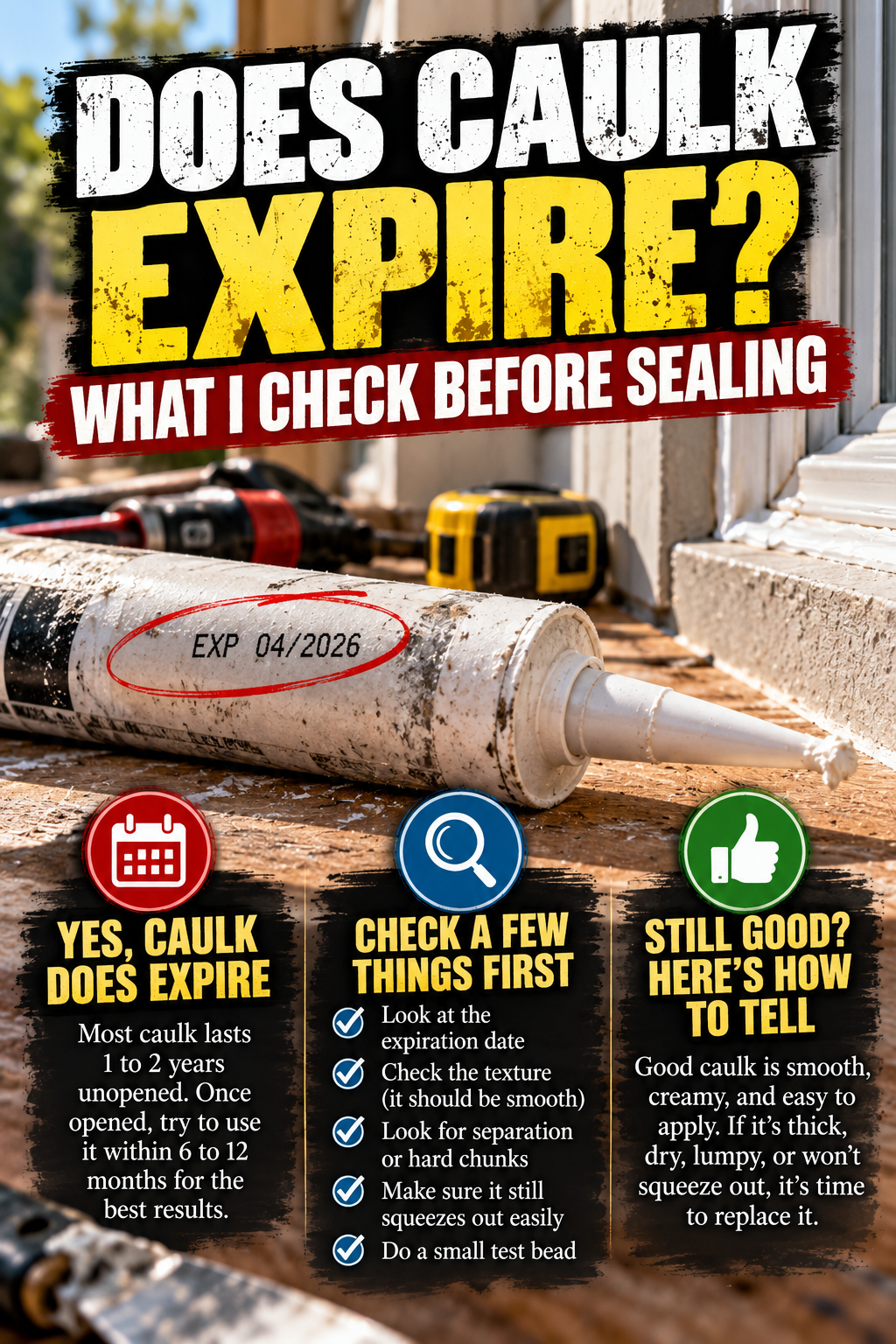
As a rough guide, I use these expectations:
- Unopened caulk: often good for 12 to 18 months
- Opened caulk stored carefully: sometimes usable for a few months
- Opened tube found in a random garage drawer: approach with healthy suspicion
- Caulk that froze or baked in summer heat: may be bad long before its date
The exact lifespan depends on whether it is acrylic latex, silicone, hybrid, or another specialty formula. Storage matters almost as much as age.


Does unopened caulk go bad?
Yes. An unopened tube can still go bad.
The seal helps, but it cannot reverse years of heat, freezing temperatures, or plain old aging. I have opened supposedly fresh-looking tubes that had a thick plug near the end, separated liquid inside, or came out with the consistency of cottage cheese. None of those are promising signs for a neat bathroom bead.
An unopened tube is more likely to be usable than an opened one, of course. Still, I check these things before trusting it:
- The expiration or manufacture date, if printed
- A swollen, damaged, or leaking tube
- A tube that feels unusually hard in spots
- Dried caulk around the cap or nozzle area
- A package that has clearly spent several summers in a hot shed
If it is well past its date, I do not use it on a shower, sink, window, or anything where a failed seal can lead to water damage. A few dollars for fresh caulk is much cheaper than repairing swollen trim later.


The fastest way to tell if caulk is still good
The honest answer is to squeeze out a small test bead before starting the actual job.
Do not test it on the tub, countertop, or freshly painted trim. A scrap of cardboard, an old piece of wood, or even the inside of a trash bag will do.
Good caulk should come out smoothly with steady pressure. It should look consistent from start to finish and hold together as a bead.
Bad caulk often tells on itself immediately.
It may:
- Come out in hard chunks
- Separate into watery liquid and thick paste
- Need an absurd amount of pressure to move
- Spit or pulse from the nozzle
- Look grainy, curdled, or full of lumps
- Break apart instead of forming one smooth bead
- Smell strange or sour compared with a new tube
A little dried plug in the tip does not always mean the whole tube is ruined. I cut the nozzle back, poke through the blockage, and test again. If the material behind it flows smoothly, I can usually keep working.
If the tube keeps producing chunks or watery goo, I toss it. Trying to force bad caulk into a good-looking joint is how a five-minute touch-up turns into a scraping project.
What good caulk should look and feel like
Fresh caulk has a uniform texture. It should not be watery, crumbly, or rubbery before it has had a chance to cure.
With acrylic latex caulk, I expect a smooth paste that spreads easily and cleans up with water. With silicone, I expect a smooth, slightly glossy bead that is thicker and stickier than latex but still consistent.
The caulk should also respond normally when I run a damp finger or caulk tool along it. It should shape into a clean line instead of dragging into little piles or tearing open.
I do not expect every tube to perform exactly the same. Different brands and formulas feel different. I am looking for consistency more than a specific texture.
If it comes out like it has already partially cured in the tube, it is done.


Signs your caulk has gone bad
Some tubes make the decision easy. Here are the signs that tell me it is time for a fresh one.
It will not come out of the tube
First, make sure the nozzle opening is actually cut and the inner seal has been punctured. It is amazing how easy it is to forget that tiny foil seal when you are in a hurry.
If the nozzle is open and the caulk gun is working, but nothing moves even with steady pressure, the caulk may have cured solid inside.
Do not keep squeezing harder until the tube bends, splits, or launches itself out of the gun. I have seen that movie. It is not a good one.
It comes out in chunks
Chunks mean the caulk has started curing or separating inside the tube. You might be able to clear the first little dried section near the nozzle, but recurring chunks are not worth fighting.
A lumpy bead will be hard to smooth, may not seal evenly, and can leave gaps where water gets in.
Watery liquid comes out first
A little separation can happen with some products, especially if they have been sitting awhile. I will sometimes squeeze out a small amount, discard it, and see whether the material behind it becomes smooth.
But if the tube keeps alternating between water and thick paste, I do not use it for a real seal. The formula is no longer mixed the way it should be.
The tube is swollen, cracked, or leaking
A swollen tube can mean the product has degraded or been exposed to bad storage conditions. A cracked or leaking tube has probably been exposed to air.
Either way, I do not gamble with it.
It has been through a hard freeze
Freezing is rough on many water-based acrylic latex caulks. A tube that froze may look fine after it thaws, but the material can become grainy, separated, or weak.
Silicone handles cold storage better in some cases, but I still test it. A garage in a northern winter is not exactly a climate-controlled spa for construction products.
Can you use caulk after the expiration date?
Sometimes, yes. The expiration date does not magically flip a switch at midnight.
If the tube was unopened, stored well, and passes a test squeeze, it may still be usable for a low-risk job. Think of a small interior trim gap, a minor crack in painted baseboard, or a spot where failure will be obvious and easy to fix.
I am much less forgiving with old caulk around:
- Showers and tubs
- Kitchen sinks
- Exterior windows
- Exterior doors
- Roof or flashing repairs
- Areas that regularly get wet
- Anything difficult to access once it fails
Those jobs need a dependable seal. Saving a few dollars with an old tube is not much of a victory if water gets behind the wall or under the counter.



Is dried caulk in the nozzle a deal breaker?
Not always.
The nozzle is where opened caulk usually starts drying first. I remove the cap, pull out what I can, and cut back the nozzle a little if needed. Then I use a long nail, stiff wire, or the built-in puncture tool on a caulk gun to clear the passage.
After that, I squeeze out a test bead.
If smooth caulk follows, great. I did not lose a perfectly usable tube.
If the blockage goes deep or the caulk comes out in dry strings and chunks, I stop there. Digging through half-cured caulk for ten minutes rarely pays off.
Does silicone caulk expire too?
Yes. Silicone caulk can expire and cure in the tube just like other caulks.
Silicone is popular around tubs, showers, sinks, and other wet spots because it stays flexible and handles moisture well once cured. But that does not mean an old tube is invincible.
Opened silicone often hardens near the nozzle. If air works farther into the tube, it can create rubbery clumps that no amount of squeezing will turn back into smooth sealant.
One thing I watch for with silicone is an uneven cure. Old silicone may look acceptable when it comes out, but it can fail to cure properly or remain tacky much longer than it should. That is not a gamble I take in a shower joint.
If the tube is old but the bead comes out smooth, I let the test bead cure on cardboard before using it for a more important job. If it sets up normally, that gives me more confidence.


Does acrylic latex caulk expire?
Absolutely. Acrylic latex caulk is especially vulnerable to freezing and long-term storage.
It is usually easier to apply and clean up than silicone, which makes it a good choice for many interior trim and paintable gaps. But when it gets old, it can separate, become grainy, or lose its ability to cure and adhere properly.
If I find a forgotten tube of paintable caulk, I test it before I load the gun. If it is smooth, it may still be fine for a small interior repair. If it is watery, chunky, or hard to smooth, it gets replaced.
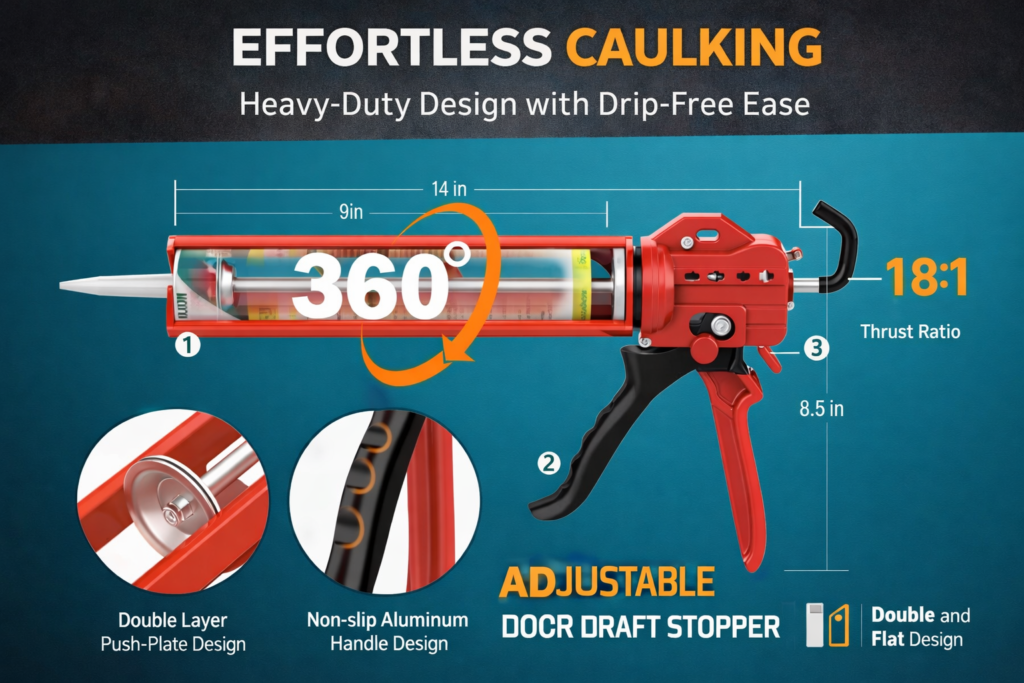
For a clean finish around trim, doors, or baseboards, good caulk makes a bigger visual difference than most people expect. The same goes for choosing the right tools. A decent drip-free caulk gun gives me far better control than a cheap gun that keeps pushing material after I release the trigger.
What happens if you use bad caulk?
The best-case scenario is an ugly bead that you notice immediately and scrape out before it cures.
The worse outcome is that it looks fine at first, then cracks, shrinks, peels away, or lets water through after you have put everything back together.
Bad caulk can lead to:
- Gaps that never seal correctly
- Poor adhesion to tile, trim, or a tub
- Cracking after the bead dries
- A sticky bead that never fully cures
- Mold-prone gaps around wet areas
- Water getting behind a sink, tub, or window
- More cleanup than the original job required
Caulk is one of those little materials that seems unimportant until it fails. Then it becomes the whole project.


How I store opened caulk so it lasts longer
No storage trick makes an opened tube last forever, but a little effort can buy useful time.
First, I clean the nozzle as well as I can. Then I put a long screw or nail into the opening and wrap the tip tightly with tape. Some people use plastic wrap before the tape, which can help create a tighter seal.
I also store the tube upright when possible, with the nozzle facing up. That keeps the material from settling into the opening and making a hard plug.
Here is what I avoid:
- Leaving it in direct sun
- Storing it in a freezing garage
- Letting it bounce around loose in a truck bed
- Keeping it near a heater or furnace
- Tossing it back in a drawer without sealing the nozzle
A basement shelf or conditioned utility area is usually a better bet than an uninsulated shed.
Can you save partially hardened caulk?
You can sometimes save a tube with a hardened nozzle. You cannot really revive caulk that has cured throughout the tube.
I have had decent luck removing the dried material from the tip, cutting the nozzle back, and clearing the opening with a nail. If the deeper caulk is smooth, the tube is still useful.
But do not add water, thinner, solvents, or mystery liquids to a caulk tube hoping to soften it. That changes the formula and can create a seal that fails when it matters.
Once it is cured inside the tube, it is finished. Accepting that early is easier than discovering it halfway through a bathroom project.
How to check an old tube before a shower or sink repair
Wet areas deserve a stricter test.
Before I use older caulk around a shower, tub, or sink, I do this:
- Check the tube date and look for damage or swelling.
- Remove any dried plug from the nozzle.
- Squeeze out a few inches onto cardboard.
- Make sure the bead is smooth and even.
- Let the test bead sit long enough to confirm it starts curing normally.
- Buy a fresh tube if anything seems questionable.
That may feel overly careful for a small tube of caulk. It is still easier than removing a failed shower bead after mildew has found the gap.
Do different kinds of caulk have different shelf lives?
They can. The label is always the best source for a specific product, but these general patterns are useful.
Acrylic latex caulk is convenient and paintable, but it dislikes freezing temperatures. It is often best for interior trim, small wall gaps, and areas that stay fairly dry.
Silicone is better for many wet locations, but it can harden in the tube once opened and is not usually paintable.
Hybrid and polyurethane sealants can be tougher and more demanding. They often have a shorter useful life after opening because they cure when exposed to moisture in the air.
Whatever the formula, I try not to buy a giant tube just because it is on sale unless I know I will use it soon. Half-used sealants have a funny way of becoming garage fossils.
When it is worth using a new tube without testing the old one
There are times I do not bother trying to rescue an older tube.
I buy fresh caulk right away when I am:
- Sealing a tub or shower
- Caulking around a kitchen sink
- Repairing an exterior window
- Sealing a door frame against weather
- Finishing a room I just painted
- Doing work for someone else
- Fixing a spot that will be difficult to reach later
For a small gap in a utility closet, I may test the old tube. For a shower wall, I start fresh and enjoy the rare feeling of making a smart decision before the mess begins.
Common questions about expired caulk
Can I use caulk that is two years old?
Maybe, if it was unopened, stored well, and comes out smooth. I would only use it after testing it first. For a wet area or exterior repair, I would choose a new tube.
Why is my caulk hard in the tube?
Air likely got into the tube after it was opened, or the caulk was stored for too long. It may also have frozen, overheated, or simply reached the end of its shelf life.
Can I use caulk that separated in the tube?
If only a tiny amount of liquid comes out first and the rest becomes smooth, it may still be usable for a minor project. If separation continues or the bead is lumpy, do not use it for sealing.
Does unopened silicone caulk go bad?
Yes. Unopened silicone usually lasts longer than an opened tube, but age and poor storage can still cause it to fail. Check the date and test a small bead before an important job.
How do I dispose of old caulk?
Let small amounts cure completely before throwing them away if local rules allow. Do not squeeze uncured material into a drain. For larger quantities or specialty products, check your local household hazardous-waste guidance.
The simple answer
Caulk does expire, and opened tubes usually do not stay reliable for long.
I do not judge a tube by its age alone. I check the date, inspect the tube, clear the nozzle if needed, and test a bead on scrap material. If it flows smoothly and cures normally, it may still have some life left.
If it is chunky, separated, stubborn, or just plain suspicious, I replace it.
Fresh caulk costs less than fixing a failed seal, and it makes the job much less likely to turn into one of those “well, I did not plan to redo the bathroom today” afternoons.
Calder Voss writes about practical home fixes, garage projects, and the everyday household questions that usually show up five minutes before a project starts.