
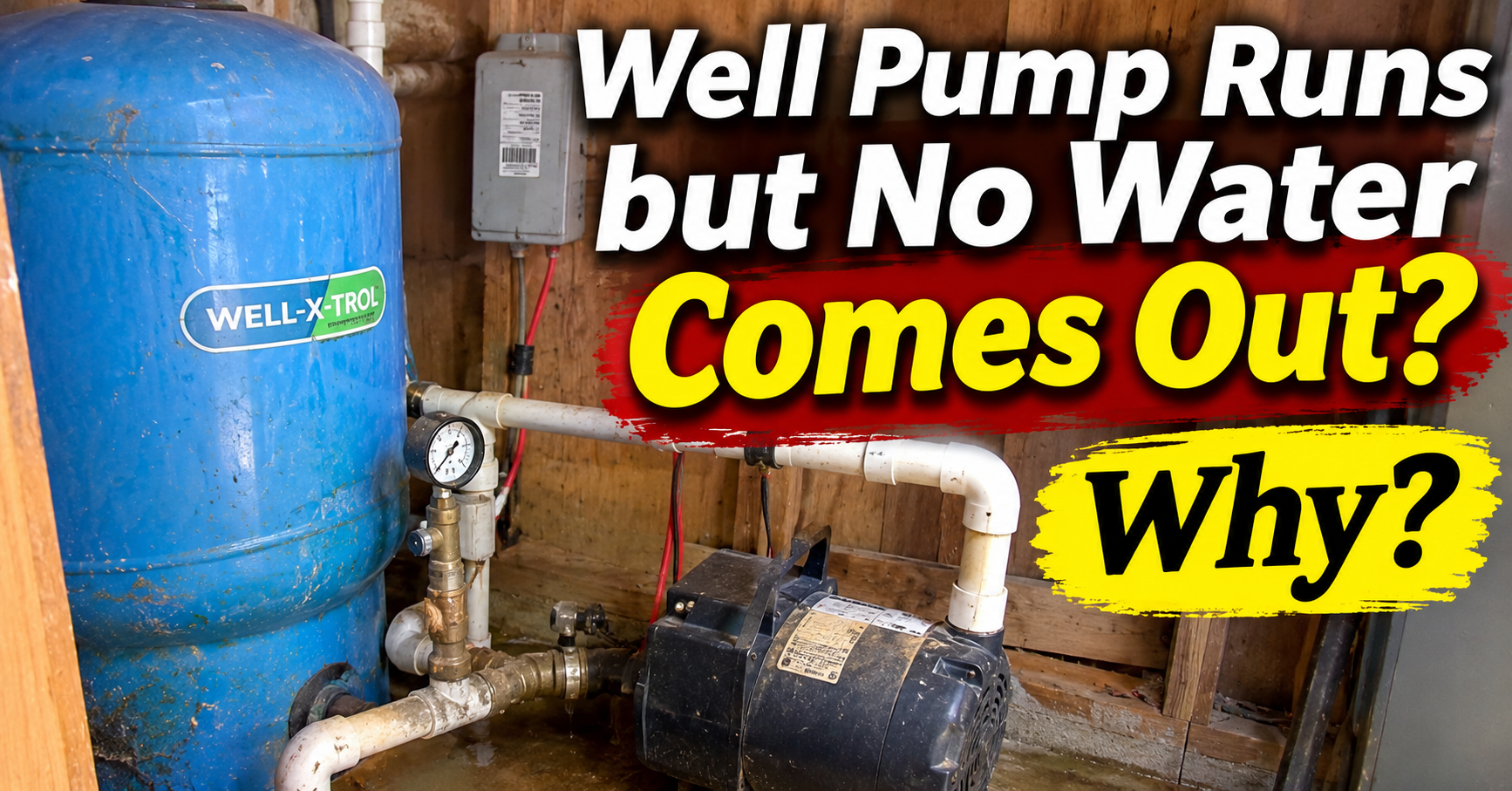
When a well pump seems to be running but no water comes out of the faucets, I treat it differently than an ordinary low-pressure problem.
This is not a good time to keep resetting breakers, opening and closing faucets, or letting the pump run while hoping it catches up. If a pump is actually running without moving water, it can overheat or be damaged. The first priority is protecting the pump, then figuring out whether the problem is in the house, at the pressure tank, or down in the well.
One detail matters right away: a submersible well pump is usually deep in the well and nearly silent from inside the house. Hearing a click at the pressure switch does not always prove the pump motor is running. A humming jet pump, a vibrating pipe, or a steadily climbing electric draw may tell a different story.
Before trying anything complicated, I look at the pressure gauge and the water situation inside the house.
The short answer when a well pump runs but there is no water
A well pump that is running but not delivering water may be dealing with a low well-water level, a broken pipe in the well, a failed check valve, a clogged intake, worn pump parts, a lost prime on a jet pump, or a closed valve somewhere in the system.
There can also be a simpler explanation. A shutoff valve may be closed, a filter may be badly clogged, or the pump may not actually be running even though the pressure switch clicked.
The safest first step is to stop the pump from running dry if you have no water and the pressure gauge is not building. Then work through the visible, low-risk checks before calling a well professional.



Shut the pump off if it is truly running with no water
If the pump is running continuously and no water is reaching the house, I would turn off the pump breaker or disconnect before investigating further.
A submersible pump relies on the water around it for cooling. A jet pump can also be damaged if it runs dry or loses its prime. Letting either one run for a long time without moving water can turn one repair into a more expensive one.
Do not keep cycling the power on and off to see if it suddenly starts working.
One careful check is reasonable. Repeated restarts are not.
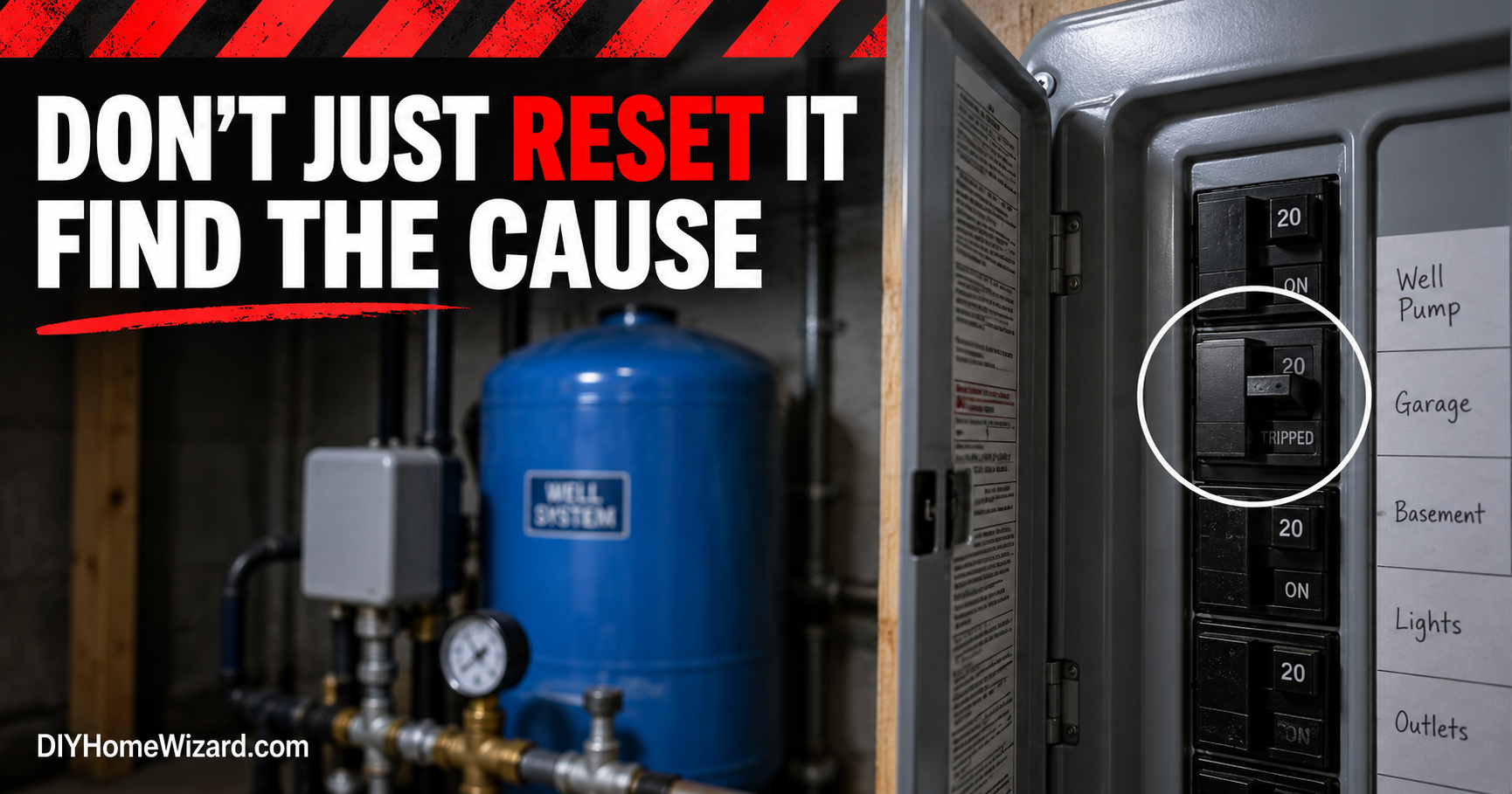
If the breaker has already tripped, reset it once at most. If it trips again, leave it off. Your existing guide on why a well pump breaker keeps tripping explains why repeated resets can make an electrical or motor problem worse.

Start with the pressure gauge
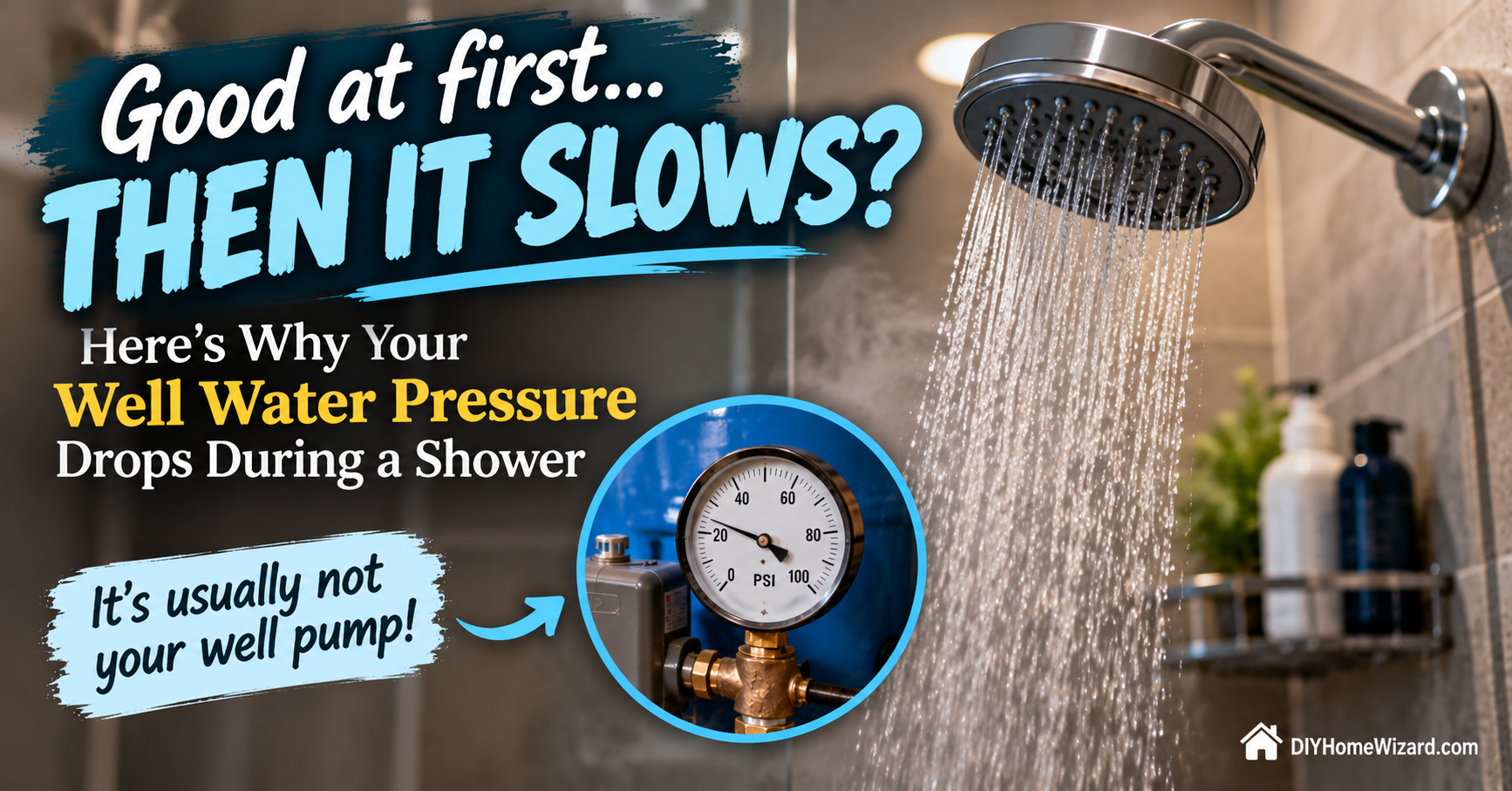
The pressure gauge gives the clearest first clue.
Look at the gauge near the pressure tank and take note of the number before changing anything. You do not need to know every part of the well system to learn something useful from that number.
There are three common patterns.
The gauge reads near zero and does not move
A gauge near zero while the pump is supposedly running means water is not making it back to the pressure tank.
That can happen when the well water level has dropped below the pump intake, the pump is worn out, the drop pipe inside the well is broken, the pump intake is clogged, or a check valve is preventing water from moving correctly.
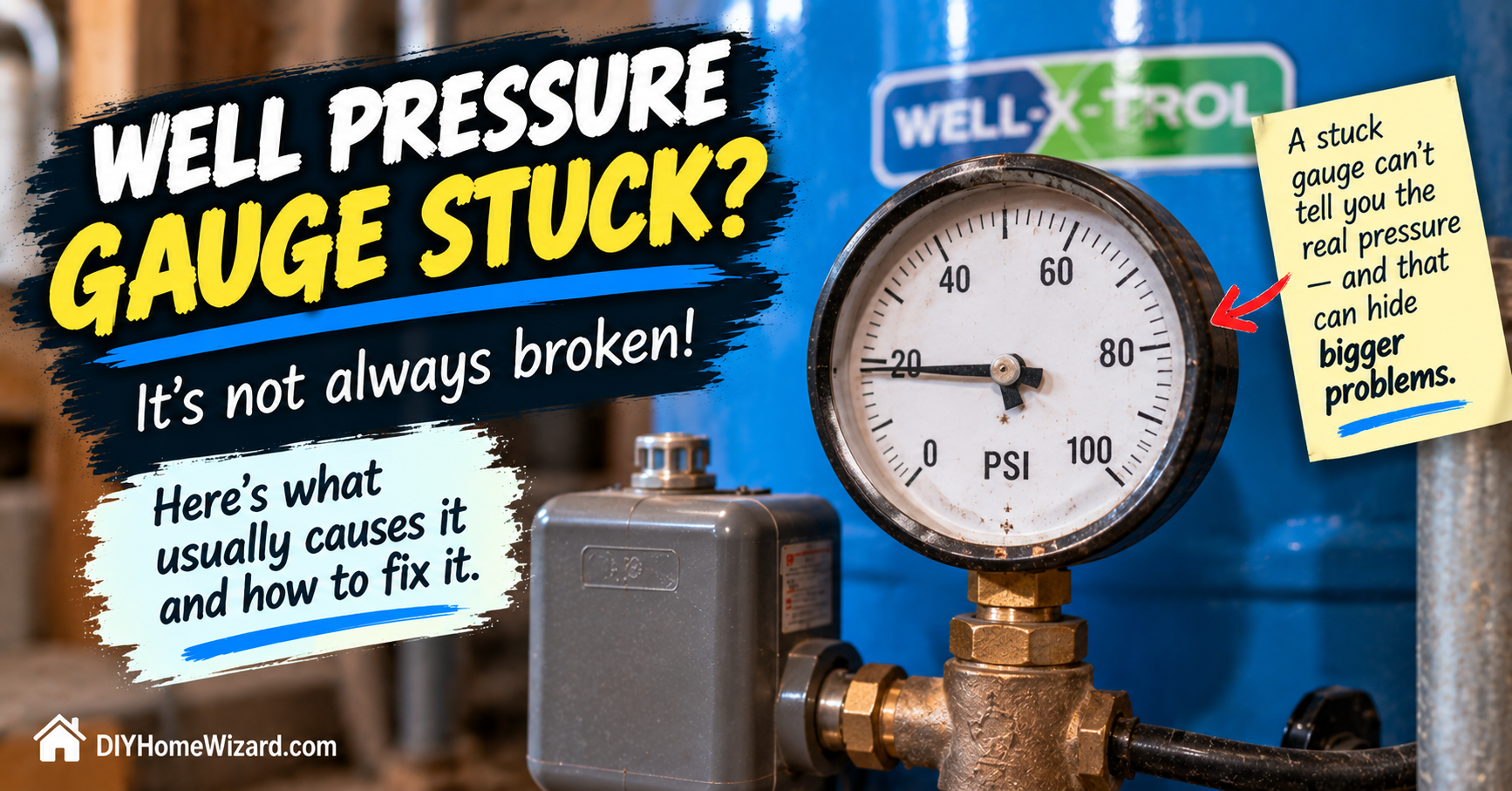
It can also happen when the gauge itself is bad, which is why I pay attention to whether it has been moving normally before this problem started. A guide to checking a stuck well pressure gauge can help if the needle seems frozen or does not match what the system is doing.
The gauge rises some, then stops or falls back
If the gauge climbs partway but cannot reach normal shutoff pressure, the pump may be moving some water but not enough.
Possible causes include a weak or worn pump, a low-yield well, a partly closed valve, a large leak, a damaged drop pipe, a clogged filter, or heavy water use somewhere that has not stopped.
I watch for whether the needle slowly climbs, stalls at one number, or rises and then drops back down. Those are different clues.
A steady climb toward normal pressure is much less concerning than a needle that sits at 10 or 20 PSI while the pump runs and nothing comes from the faucets.
The gauge reads normal pressure but there is still no water
Normal pressure at the tank with no water at a faucet points more toward a plumbing-side problem.
A closed valve, a blocked filter, a failed treatment system, frozen plumbing, or a problem limited to one part of the house becomes more likely.
If one bathroom has no water but the kitchen does, the well itself is probably not the main problem. If every cold-water faucet in the house is dry while the pressure tank reads normally, I would start looking between the tank and the house plumbing.
Make sure the pump is actually running
This gets overlooked because a pressure switch can make a clear click sound when water pressure drops.
That click only tells you the switch is calling for the pump. It does not guarantee the pump motor started.
With a jet pump, you may hear a motor hum, feel vibration, or see the pump body moving slightly. A jet pump is usually above ground, often near the pressure tank, in a basement, a well house, or a utility room.
With a submersible pump, the motor is down in the well. You may hear nothing at all. You might hear the pressure switch click or a control box relay operate, but the pump itself may remain silent.
If the pressure switch clicks and the gauge does not rise, the problem could still be electrical, mechanical, or down in the well.
I do not open a live pressure switch or control box to test it. Those components can carry dangerous voltage even when the system looks simple from the outside.


Check the easy plumbing issues first
Before assuming the pump needs to be pulled from the well, I look for things that can block water without requiring deep well work.
Start with visible valves.
A main shutoff valve near the pressure tank, water treatment equipment, sediment filter, or house supply line may have been closed accidentally during another repair. A valve handle turned across the pipe usually means closed. A handle lined up with the pipe usually means open.
That is not true for every type of valve, but it is a useful first look.
Then check for an obvious clogged filter. A badly clogged whole-house sediment filter can choke water flow, especially if the water suddenly turned dirty, sandy, or rusty.
I also look for treatment equipment that may be bypassed, stuck, or leaking. Water softeners, iron filters, and filter housings can cause confusing symptoms that feel like a well-pump problem.
Look for a leak inside the house or yard
A major leak can keep the system from building pressure.
Walk through the house and listen. A toilet that continues filling, a burst pipe in a crawl space, an open outdoor hydrant, or a hose left running can pull down pressure fast.
Look outside too.
A wet patch in the yard, a muddy area near the line from the well, water near a frost-free hydrant, or an unusually green strip of grass may point to a buried leak.
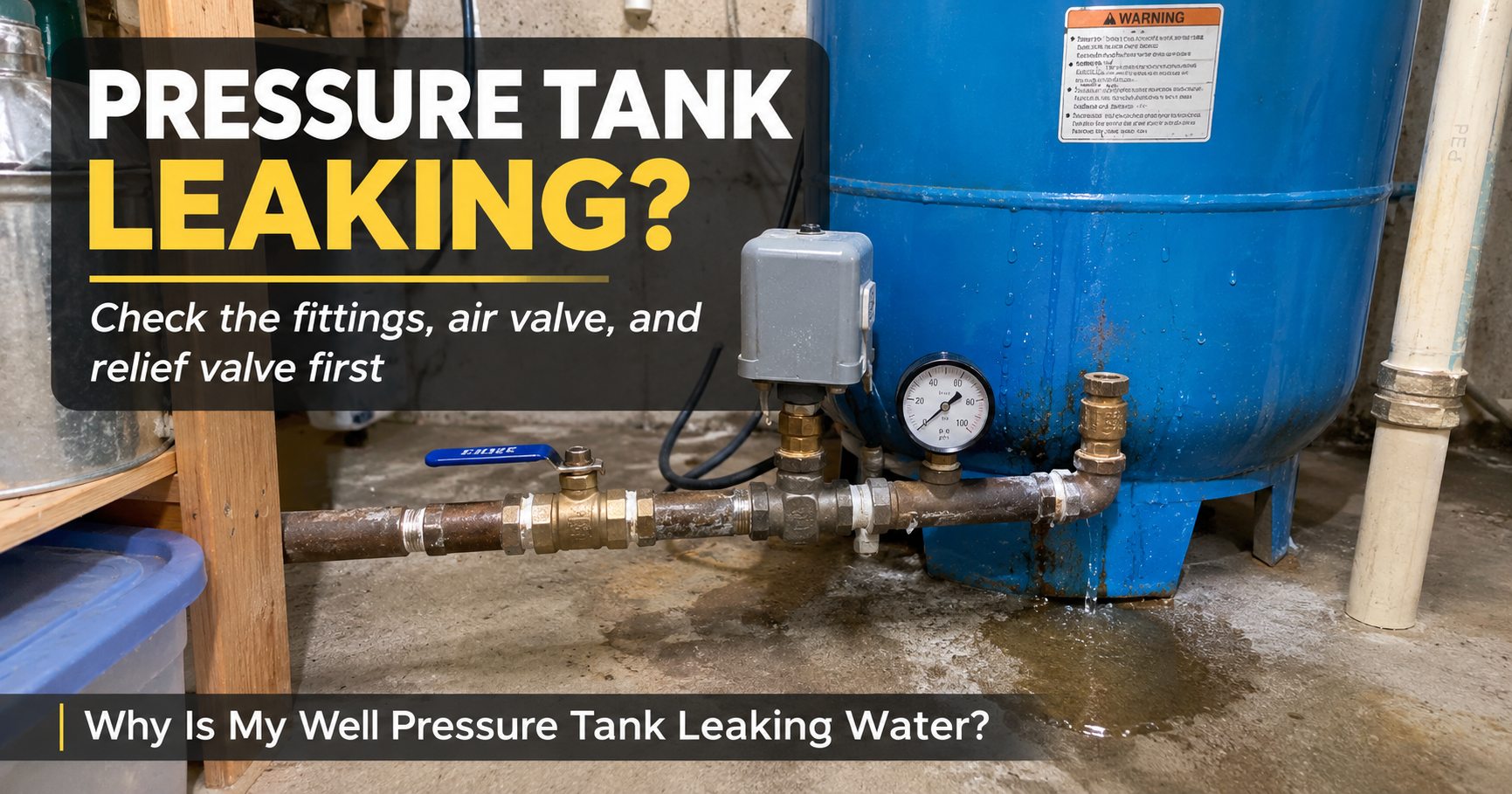
If the pressure tank is wet or leaking, do not assume it is always the cause of no water. But water around it deserves a close look. A leaking well pressure tank can be a fitting problem, condensation, or a failed tank shell, and each one affects the system differently.



A low water level in the well can cause no water at the faucet
A well can temporarily run low after heavy demand, drought, irrigation, livestock watering, filling a pool, or a pump that is moving water faster than the well can recover.
When that happens, the pump may run but pull air or very little water.
You may notice:
- Water pressure got weaker before it disappeared.
- Air sputtered from faucets.
- Water looked cloudy, sandy, or dirty.
- The problem started after unusually heavy water use.
- Water returns after the system rests for a while.
That does not prove the well is dry, but it is an important pattern.
I would not keep restarting a pump over and over if the water source may be low. Giving the well time to recover is safer than trying to force water that is not there.
A well contractor can measure static water level, pumping water level, pump depth, and recovery rate. Those are the numbers needed to tell whether the well itself is the issue.
A broken drop pipe can make the pump run with no water
The drop pipe carries water from a submersible pump up to the top of the well.
If that pipe cracks, splits, or separates at a fitting, the pump may move water but send it right back into the well instead of up to the pressure tank.
A broken drop pipe often creates a sudden total-loss situation. Things may have worked normally one day, then the pump starts running and the house has little or no water the next.
The pressure gauge may stay near zero or barely move.
Because the pipe and pump are down inside the well, this is not usually a repair I would try to diagnose beyond basic observations. The pump needs to be pulled to inspect the pipe, fittings, check valve, and pump itself.



A check valve problem can let water fall back into the well
A check valve is meant to keep water from running backward after the pump shuts off.
If it fails, sticks, leaks internally, or is installed incorrectly, water may drain back down the system instead of staying pressurized.
The exact symptoms vary. You may hear frequent pump starts, see pressure drop when nobody is using water, or find that the pump runs longer than normal before pressure builds.
A failed check valve does not always mean there will be zero water. But it can be part of the reason pressure will not hold or the pump cannot keep up.
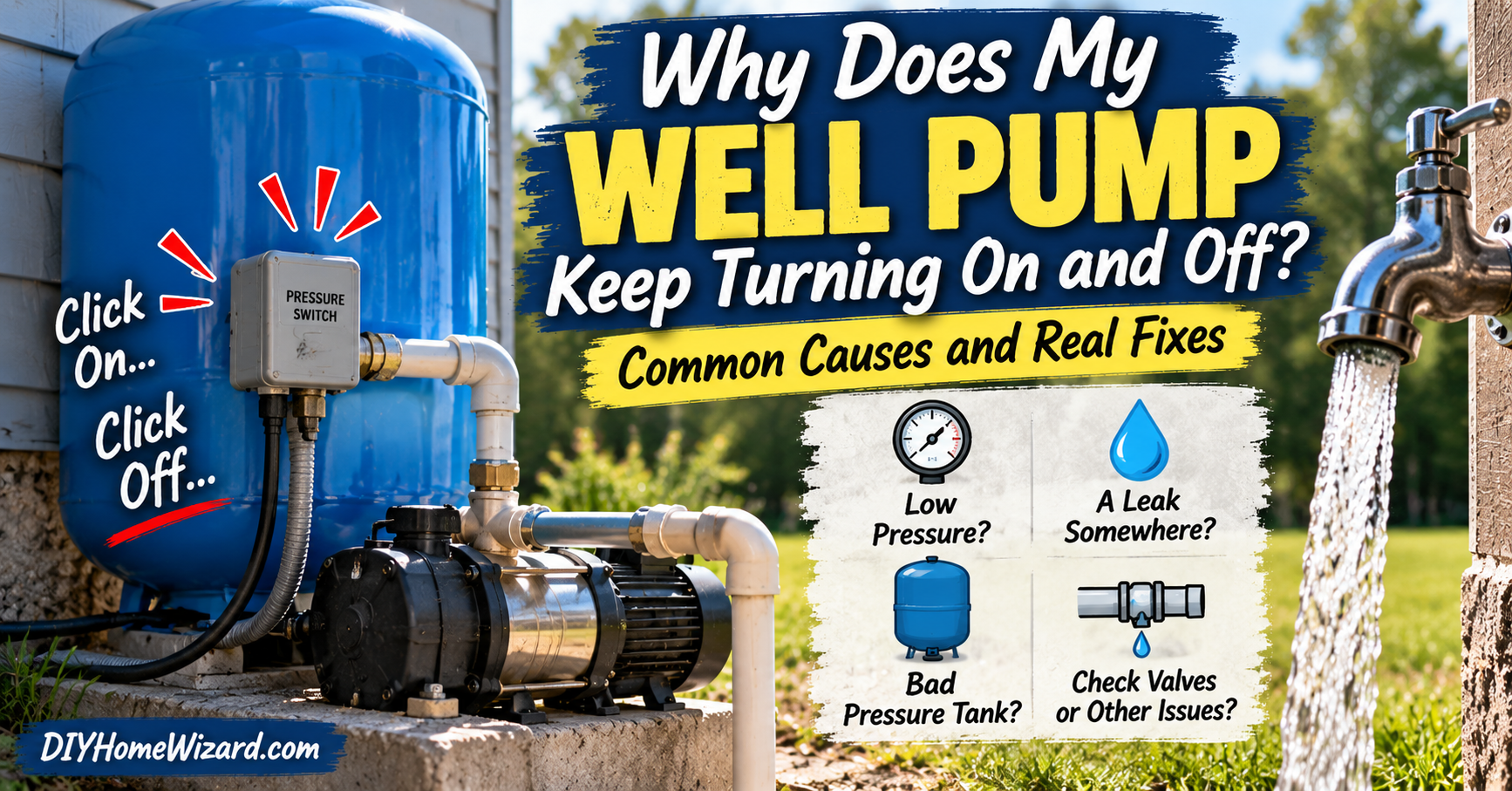
If your pump is starting and stopping every few seconds, that is a different but related problem. The full guide to a well pump that keeps turning on and off helps separate a waterlogged tank from a leak-back or pressure-control issue.
Jet pumps can lose their prime
A jet pump is usually above ground and pulls or recirculates water through piping. Unlike a submersible pump, it can lose prime.
When a jet pump loses prime, it may run and hum normally but fail to pull water up from the well.
This can happen because of:
- A leak on the suction side of the plumbing.
- A failing foot valve.
- A cracked fitting.
- Water level dropping below what the pump can lift.
- A drain plug or priming plug that is leaking.
- The system being drained or opened for a repair.
A jet pump may need to be primed again, but the correct process depends on the pump and setup. I would use the manufacturer’s instructions instead of guessing with water, plugs, and fittings. If it repeatedly loses prime, there is usually a leak or valve issue that still needs to be fixed.



A clogged intake or worn pump can cause weak or no water
Over time, sediment, iron buildup, sand, mineral scale, or wear inside the pump can reduce how much water it can move.
This may start as weak water pressure. The pump might run longer, struggle to reach shutoff pressure, or provide water that gets weaker during a shower or laundry cycle.
Eventually, it can turn into a pump that runs but does not deliver enough water to the tank.
A worn pump, blocked intake screen, damaged impeller, or broken internal coupling all require pulling the pump for a real diagnosis.
The useful homeowner observations are the timing and symptoms:
- Did water pressure decline slowly over weeks or months?
- Did it fail suddenly?
- Is there sand or sediment in the water?
- Does pressure improve after the well rests?
- Does the gauge rise at all?
- Does the pump run continuously or cut in and out?
Those details can save time when a well professional arrives.
Why no water may be a pressure-switch problem instead
A pressure switch tells the pump when to start and stop.
If the switch does not close when pressure falls, the pump may never receive the signal to start. If it clicks but the pump does not run, the problem may be farther down the electrical chain.
A worn switch, burned contacts, a blocked sensing port, a low-pressure cutoff switch, a control-box issue, damaged wiring, or a failed pump motor can all create a no-water situation.
The safest homeowner check is observing what happens when you open a faucet.
If the pressure gauge falls below the normal cut-in setting and there is no click at all, a switch or sensing issue becomes more likely.
If the switch clicks but the pump does not start, the issue may be in the control box, wiring, motor, or pump.
If the pump starts but no pressure builds, the issue moves more toward water supply, valves, plumbing, or the pump itself.
What not to do when the well pump runs but there is no water
A water outage is stressful, especially when it happens during a shower, laundry, or a busy day at home. But a few common reactions can make the repair more expensive.
I would avoid these:
- Repeatedly resetting a breaker that trips.
- Holding pressure-switch contacts together by hand.
- Opening a pressure switch or control box while power is on.
- Letting a pump run for a long time with no pressure increase.
- Changing pressure-switch settings to force the pump to run.
- Adding air to a pressure tank before understanding the actual problem.
- Turning random valves without noting where they started.
- Assuming a silent submersible pump is definitely dead.
- Assuming a clicking switch means the pump motor is running.
- Ignoring water near electrical components.
The goal is not to solve every possible well failure without help. The goal is to gather the clues that identify the right repair while avoiding extra damage.
When I would call a well professional right away
I would stop troubleshooting and call for service when:
- The pump runs but the gauge stays at zero.
- The pump runs continuously with no water delivery.
- The breaker trips again after one reset.
- There is a burning smell, sparking, smoke, or hot electrical equipment.
- Water is reaching the pressure switch or other electrical parts.
- The well may have run dry.
- The water has suddenly become sandy or muddy.
- The pump or drop pipe may need to be pulled.
- The pressure tank is damaged, rusted through, or leaking from the shell.
- The system pressure rises beyond its normal shutoff point.
A well contractor has the equipment to test voltage, amperage, pump performance, water level, cable condition, and pressure. Those tests are what separate a simple switch or valve repair from a pump, pipe, or well problem.
What to write down before calling for help
The details you gather can make a service call more efficient.
Write down:
- Whether all fixtures are out of water or only certain ones.
- What the pressure gauge reads.
- Whether the gauge rises, falls, or stays still.
- Whether you heard the pressure switch click.
- Whether the pump is humming, running, silent, or repeatedly clicking.
- Whether the breaker tripped.
- Whether there was heavy water use before the problem began.
- Whether air, sand, discoloration, or sputtering appeared first.
- Whether water is leaking around the pressure tank or pipes.
- Whether the problem began suddenly or got worse over time.
Those are not just random details. They help narrow the issue from the house plumbing toward the tank, controls, well pipe, pump, or water source.
Why is my well pump running but I have no water?
The pump may be running without sending water to the pressure tank because the well water level is low, the drop pipe is damaged, a check valve has failed, the pump intake is clogged, the pump is worn out, or a jet pump has lost prime. Check the pressure gauge, then shut the pump off if it is running without building pressure.
Should I turn off my well pump if there is no water?
If the pump is actually running and no pressure is building, turning it off is usually the safest move. A pump that runs dry or cannot move water can overheat and suffer damage.
Why does my pressure gauge read zero when the pump is running?
A zero gauge reading can mean the pump is not delivering water to the pressure tank. It may also mean the pressure gauge has failed. Watch whether the needle moves at all and have the system checked if the pump runs without pressure increasing.
Can a clogged filter cause no well water?
A severely clogged whole-house filter can greatly reduce or stop water flow to the house. Check whether the problem is on every fixture and inspect accessible filters before assuming the pump itself has failed.
Can a well run out of water temporarily?
Yes. Heavy demand, drought, a low-yield well, irrigation, or a pump that outpaces well recovery can temporarily lower water below the pump intake. Letting the system rest may allow the well to recover, but repeated problems need professional testing.
Can a bad pressure tank cause no water?
A bad pressure tank more commonly causes rapid cycling, uneven pressure, or frequent pump starts. It can contribute to a larger system problem, but a pump that runs with no water at all often points farther toward the well, pump, pipe, check valve, or water source.