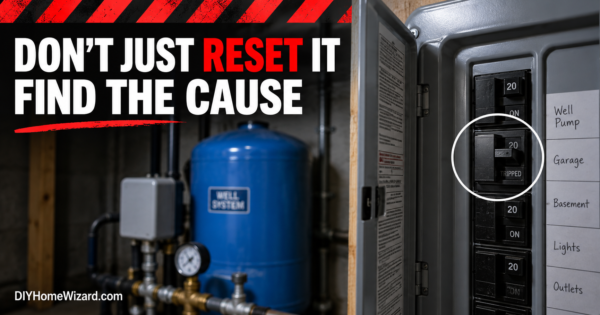
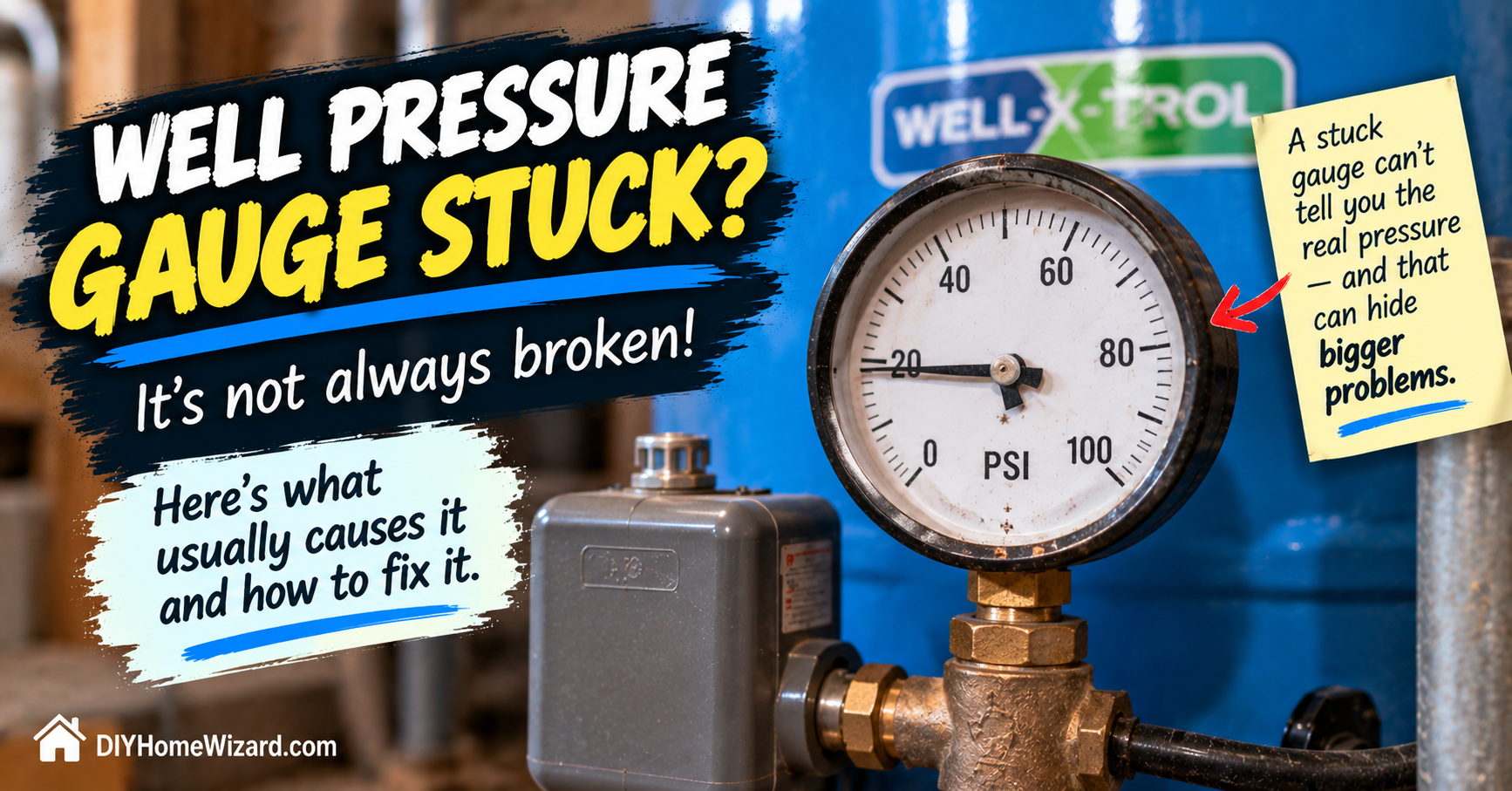
A well pressure gauge can get stuck because the gauge itself has failed, the tiny opening feeding it is clogged with sediment or rust, or the whole system has stopped changing pressure. The important part is figuring out which one you have before trusting a needle that may have quietly quit doing its job.
I have seen plenty of gauges parked at 40 or 50 PSI that looked perfectly convincing until I opened a faucet and realized the house pressure was obviously changing while that needle never moved an inch. A pressure gauge is supposed to be the honest one in the room. When it gets stuck, it can make every other well problem harder to diagnose.
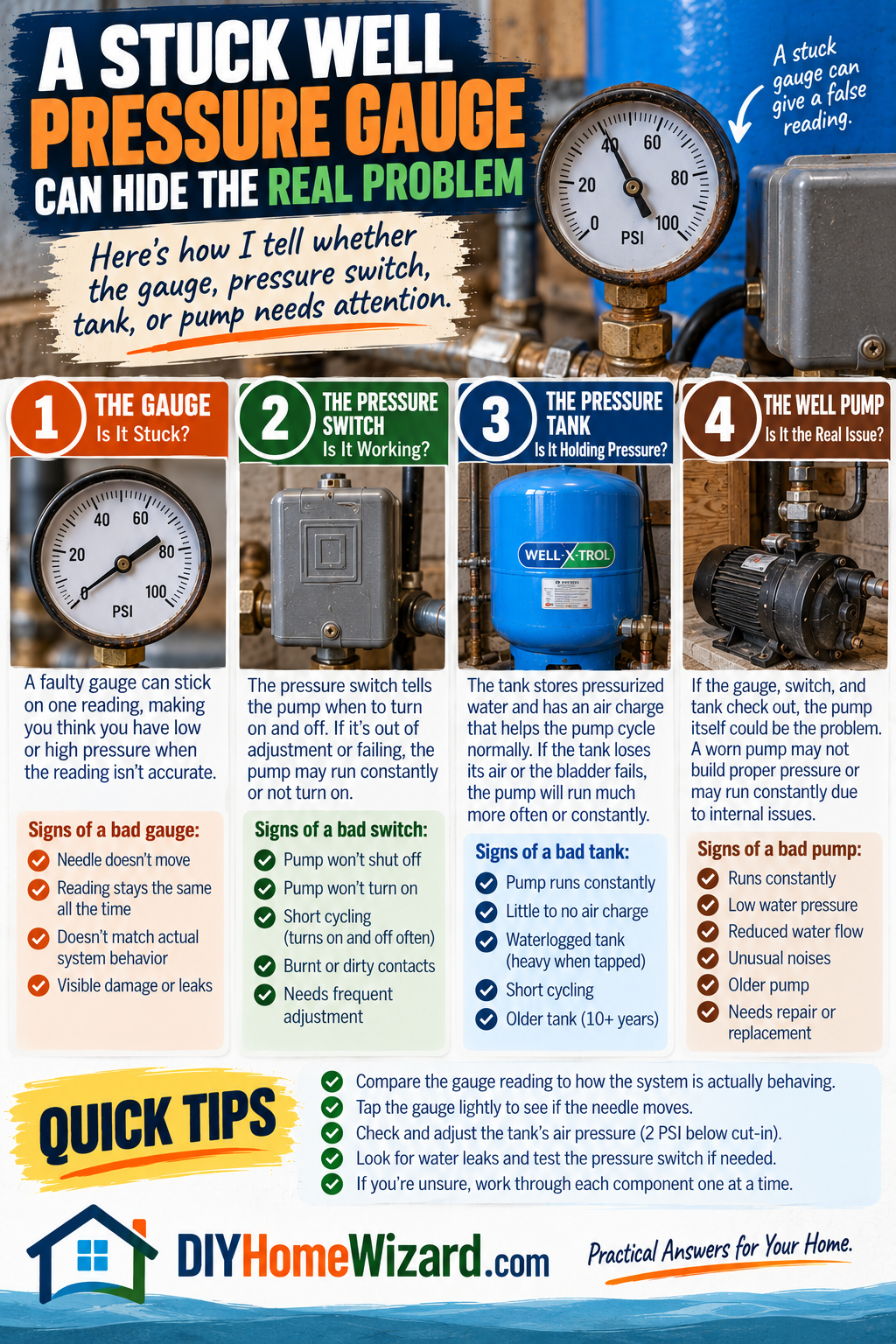
The Quick Answer
Your well pressure gauge is probably stuck if:
- The needle stays on the exact same number while water is being used.
- The pump starts and stops, but the gauge never reacts.
- The gauge reads pressure even after the system has been drained.
- Water pressure in the house is weak, strong, or surging, but the gauge insists everything is normal.
- The needle only moves after tapping the gauge.
- The gauge is rusty, fogged, leaking, or visibly damaged.
A stuck gauge is often a small repair, but it can hide a bigger issue. I do not adjust a pressure switch, add air to a tank, or assume the pump is bad until I know the pressure reading is real.



Why the Pressure Gauge Matters So Much
The pressure gauge tells you what is happening between the pressure tank, pressure switch, and pump.
On a common 40 and 60 PSI system, the pump should start when pressure falls to around 40 PSI and stop when it reaches around 60 PSI. The exact numbers vary by system, but the gauge lets you see the pattern.
Without a working gauge, you are mostly guessing.
You cannot reliably tell whether the pump is starting too late. You cannot tell whether it is reaching shutoff pressure. You cannot confirm whether the pressure tank is matched to the pressure switch. You also cannot easily tell the difference between a pump problem and a simple clogged filter.
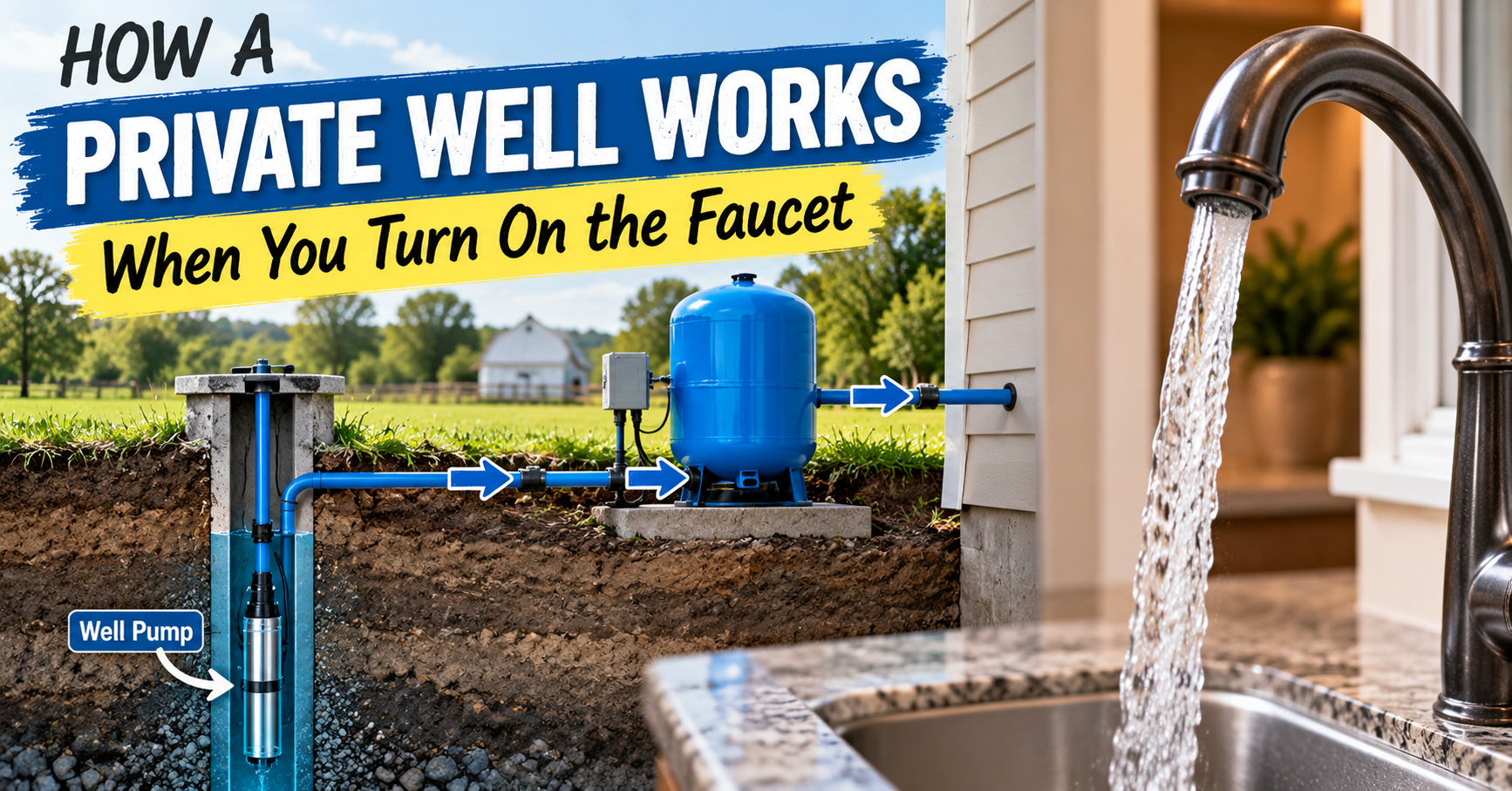
That is why I explain the entire sequence in how a private well works when you turn on the faucet. Once you understand where pressure is supposed to rise and fall, a bad gauge becomes much easier to spot.



First, Check Whether the Gauge Is Actually Stuck
Before declaring the gauge bad, I want to make the system do something that should change pressure.
The simplest test is to open a nearby faucet and watch the needle.
If water is coming from the faucet, system pressure should begin falling. On a conventional well system, the pressure gauge should move downward until the pump starts.
After the pump starts, close the faucet and watch again. The pressure should rise as the pump refills the tank. Eventually, the pump should shut off at its upper pressure setting.
If the gauge never moves during that whole sequence, it is very likely stuck.
A few things can make this test confusing:
- The pump may already be running when you begin.
- A pressure tank can supply water for a short time before the gauge visibly moves.
- A very slow faucet may not create enough demand for an obvious change right away.
- The gauge may move, but only a few PSI.
I usually open a bathtub faucet or an outdoor spigot for a moment because it makes the pressure change easier to see. I am not trying to waste water. I just want a clear answer.
The Most Common Clue: The Needle Never Leaves One Number
A gauge frozen at 40 PSI is common. So is one frozen at 50 PSI.
That does not mean 40 or 50 is the actual water pressure. It only means the gauge last decided it liked that number and has been sitting there ever since.
If the gauge says 50 PSI but the shower feels like someone is trying to rinse shampoo out of their hair with a garden mister, I do not assume the showerhead is the problem. The gauge may be lying.
Likewise, a gauge can stay at 20 PSI while the faucets feel normal. That can make a homeowner think the pump is weak when the system is actually working fine.
A stuck gauge is especially misleading during another repair. Somebody sees the needle frozen at 40 PSI, adjusts the pressure switch, adds air to the tank, or starts looking at pump replacement quotes. Meanwhile, the one bad part may be a gauge that costs far less than the guesswork it causes.


A Gauge Can Be Bad Even If It Looks Fine
The outside of a pressure gauge may look clean and normal while the internal mechanism has failed.
Most standard gauges use a small curved metal tube inside the housing. Pressure causes that tube to move, and a set of tiny mechanical parts moves the needle.
Those internal parts can stick, corrode, wear out, or become damaged by pressure spikes. The face may still look brand new, but the needle no longer responds correctly.
I do not trust appearance alone. A gauge earns trust by moving when the pressure changes.
A gauge that is off by only a few PSI can also create problems. It may not be completely frozen, but it could be reading 10 PSI high or low. That matters when you are trying to set pressure tank air charge or confirm pressure switch settings.
Rust and Sediment Can Plug the Gauge Connection
The gauge itself is not always the bad part.
It is usually installed on a tank tee or another fitting near the pressure tank and pressure switch. Water pressure reaches the gauge through a small opening. In a well system with iron, rust, sediment, or mineral deposits, that opening can gradually plug.
When that happens, the gauge may be alive and well, but it is no longer seeing the actual system pressure.
This can create strange behavior:
- The gauge reacts very slowly.
- It stays on one number for a long time and suddenly jumps.
- It reads pressure after you have drained the system.
- It gives a reading that does not match another gauge.
- It appears stuck, then begins working again for no obvious reason.
A clogged gauge port is more common than many people realize, especially on older systems with galvanized fittings. The outside of the fitting can look harmless while the inside is narrowed down to almost nothing.
The same kind of blockage can affect the pressure switch. If the pressure signal cannot reach the switch properly, the pump may start late, stop late, or behave inconsistently.
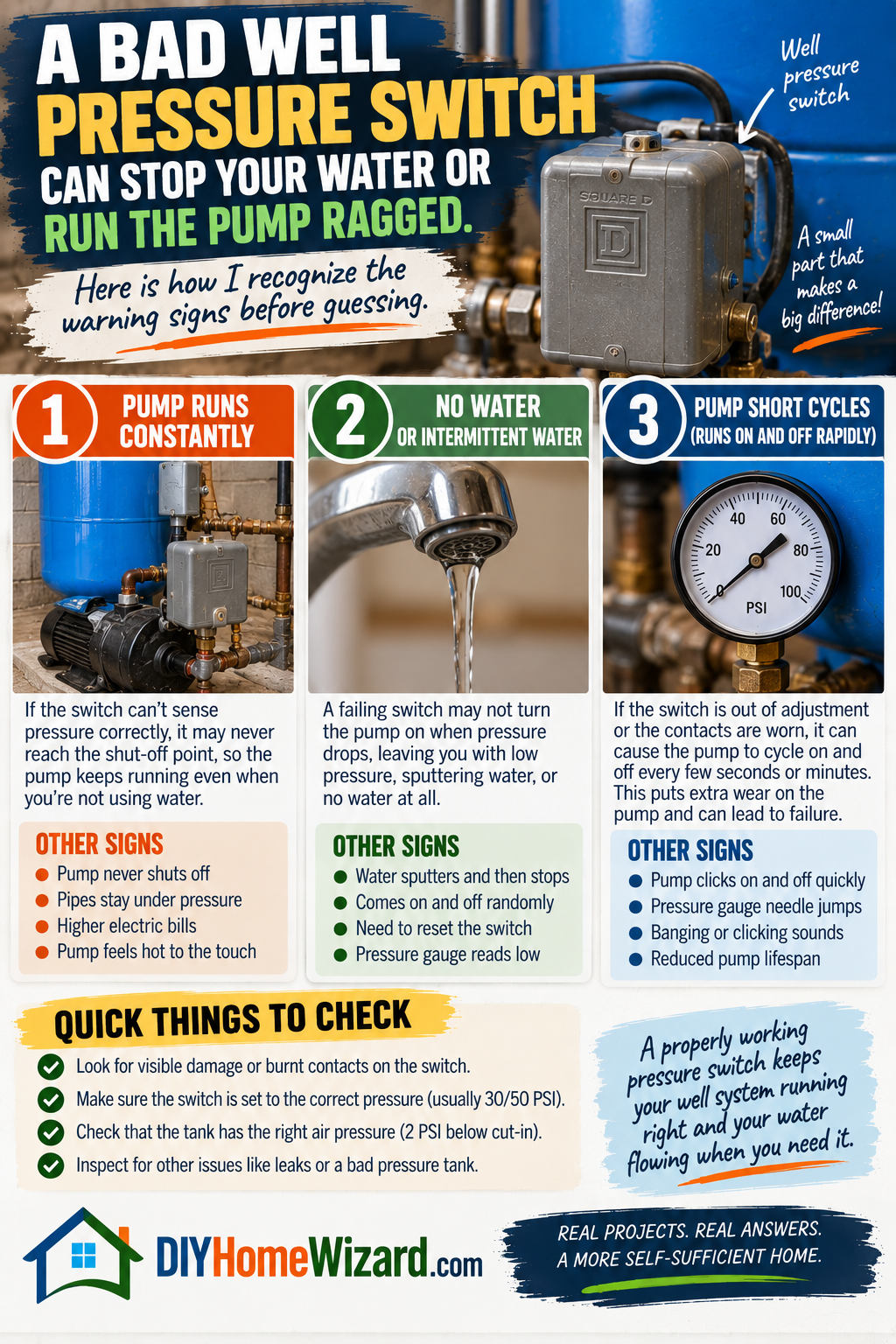
That connection matters enough that I covered it in what happens when a well pressure switch goes bad. Sometimes the switch is bad. Other times, it is doing its best while the little passage beneath it is packed with mineral buildup.



How I Compare the Gauge With Real Water Pressure
The easiest way to check a questionable gauge is to compare it with a second one.

A screw on pressure gauge that attaches to a hose bib, laundry faucet, or outdoor spigot is useful for this. I like having one around because it turns a vague suspicion into a simple comparison.
Here is the basic idea:
- Check the installed pressure gauge near the tank.
- Attach a second gauge to a nearby faucet or hose bib.
- Open water briefly and watch both readings.
- Let the pump run until it stops.
- Compare the readings again.
The two gauges may not match perfectly. A few PSI of difference is not shocking, especially if one gauge is older. A large difference tells you something is wrong.
If the house side gauge moves from 40 to 60 PSI while the tank gauge never leaves 48 PSI, the tank gauge or its connection is the obvious problem.
If both gauges stay low while water pressure is weak, the system may have a genuine low pressure issue. In that case, the gauge may be reporting the bad news accurately.

I do not place internal links in numbered steps, so I will mention this here instead: if both gauges show weak pressure, my guide to fixing low water pressure in a house can help narrow down whether the problem is demand, plumbing restriction, filtration, or the well system itself.
What the Gauge Should Do During a Normal Pump Cycle
A healthy gauge should tell a simple story.
When nobody is using water, it should rest near the pressure switch’s cutout setting. On many homes, that is around 50 or 60 PSI.
When you open a faucet, the needle should gradually move down.
When it reaches the cut in setting, the pump should start. The needle should then stop falling and begin moving upward.
After you close the faucet, the pressure should continue rising until the pump shuts off.
That is the normal cycle.
The timing varies from house to house. A large pressure tank, a small water demand, or a strong pump can make the process feel slow or fast. I care more about the sequence than the exact number of seconds.
When the story stops making sense, the gauge becomes one of the first things I question.


Gauge Symptoms and What They Usually Point To
The gauge stays at zero all the time
A gauge stuck at zero may be broken, disconnected from system pressure, or connected through a plugged passage.
It can also read zero because the system truly has no pressure. If water has stopped everywhere in the house and the pump is silent, zero may be an accurate reading.
The difference is whether the gauge changes when the pump runs. If the pump is clearly running and water pressure returns, but the gauge remains at zero, the gauge or its connection is likely the problem.
The gauge stays at the same pressure even after draining water
If you open a faucet and let water run until pressure should be gone, the gauge should move down.
A needle still showing 50 PSI after the water has drained is a strong sign it is stuck. A clogged gauge port can cause this too because pressure may be trapped between the blockage and the gauge.
The gauge jumps instead of moving smoothly
A gauge that moves in sudden jerks may be sticking internally. The sensing opening may also be partially blocked.
The system pressure itself can fluctuate, especially with a failing pressure tank, but the gauge should usually move in a reasonably smooth way.
The gauge needle shakes or vibrates
Some small movement can happen while the pump runs. A needle that shakes violently, bounces wildly, or flutters around one setting needs more attention.
The gauge may be failing. The system may also have rapid pressure changes caused by a waterlogged pressure tank, poor tank air charge, pump cycling, or a pressure switch issue.
The gauge shows unusually high pressure
Do not assume a high reading is wrong. Pressure that climbs above the expected cutout setting can be real and needs attention.
If you have a standard 40 and 60 system and the gauge reaches 75 PSI while the pump keeps running, shut the pump off and investigate. A stuck pressure switch, blocked pressure sensing connection, incorrect adjustment, or other control problem may be allowing excessive pressure.
A high reading can damage plumbing, fixtures, filters, and the pressure tank. This is not a situation where I would keep running water while hoping the needle gets bored and changes its mind.
When the Gauge Is Telling the Truth About a Bad Pressure Tank
A working gauge can expose a bad pressure tank.
If the pressure falls from 60 PSI to 40 PSI almost immediately after opening a faucet, then shoots right back to 60 as soon as the pump starts, the tank may not be providing enough stored water.
That pattern often leads to rapid pump cycling.
The gauge might be moving correctly. The problem is that pressure is changing far too quickly because the tank has lost its air cushion or developed an internal issue.
A healthy pressure tank lets you use a reasonable amount of water before the pump needs to start. The exact amount depends on tank size and settings, but it should not feel like the pump needs to run every time somebody rinses a toothbrush.
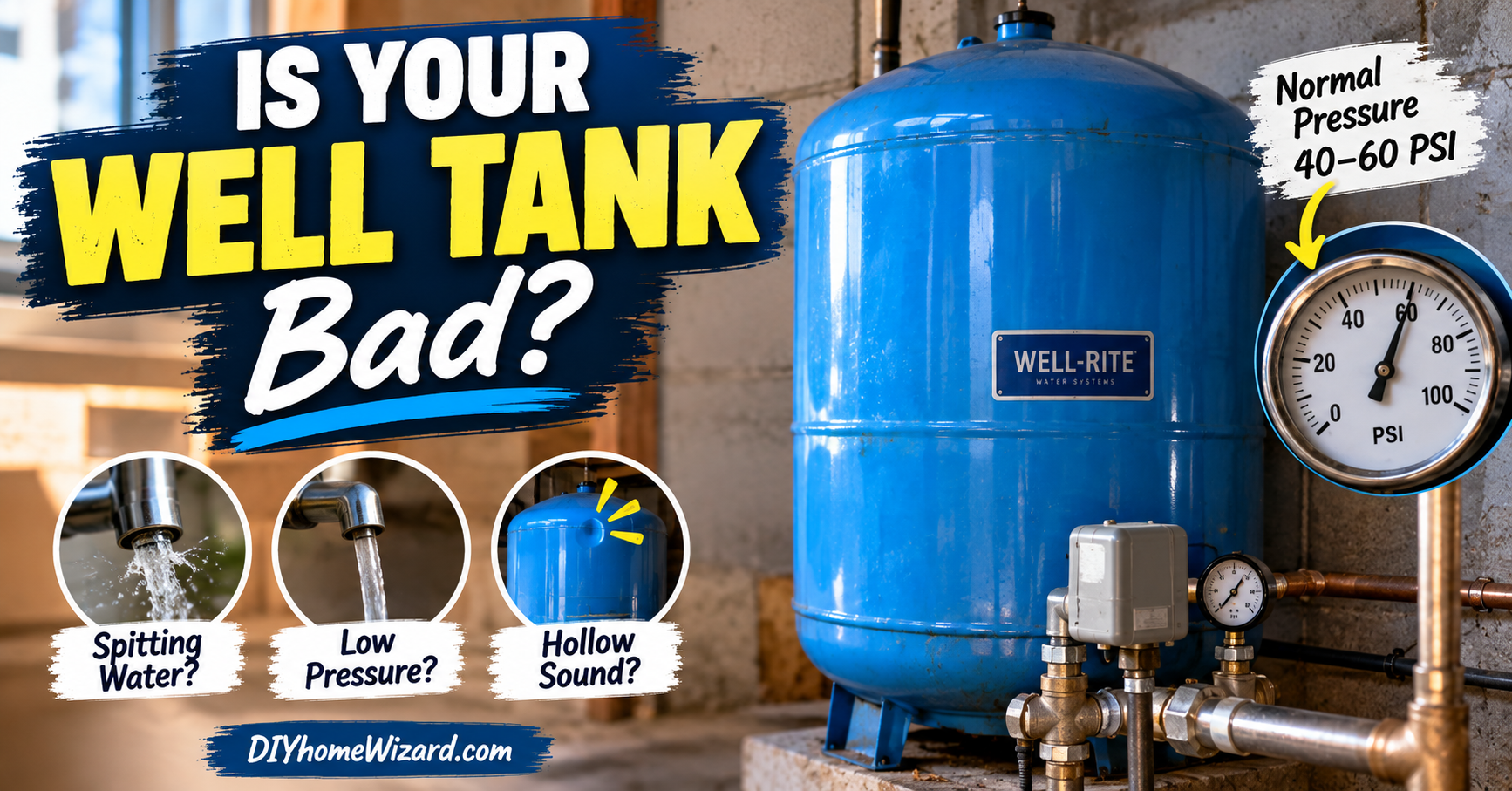
If you are seeing that kind of rapid rise and fall, read how to tell if a well pressure tank is bad. The gauge pattern is one of the best clues.



Do Not Set the Pressure Tank Air Charge With a Questionable Gauge
This is a mistake I want people to avoid.
The air charge in a well pressure tank is set in relation to the pressure switch cut in setting. On many systems, the tank precharge is set about 2 PSI below the cut in pressure.
For example, a 40 and 60 pressure switch often goes with a tank air charge around 38 PSI. A 30 and 50 system commonly uses around 28 PSI.
That measurement must be taken with the pump power off and water pressure fully relieved from the tank.
If your water pressure gauge is stuck or inaccurate, do not use its reading as the foundation for tank adjustment. You may end up setting the tank too high or too low, which can reduce usable water volume and make cycling worse.
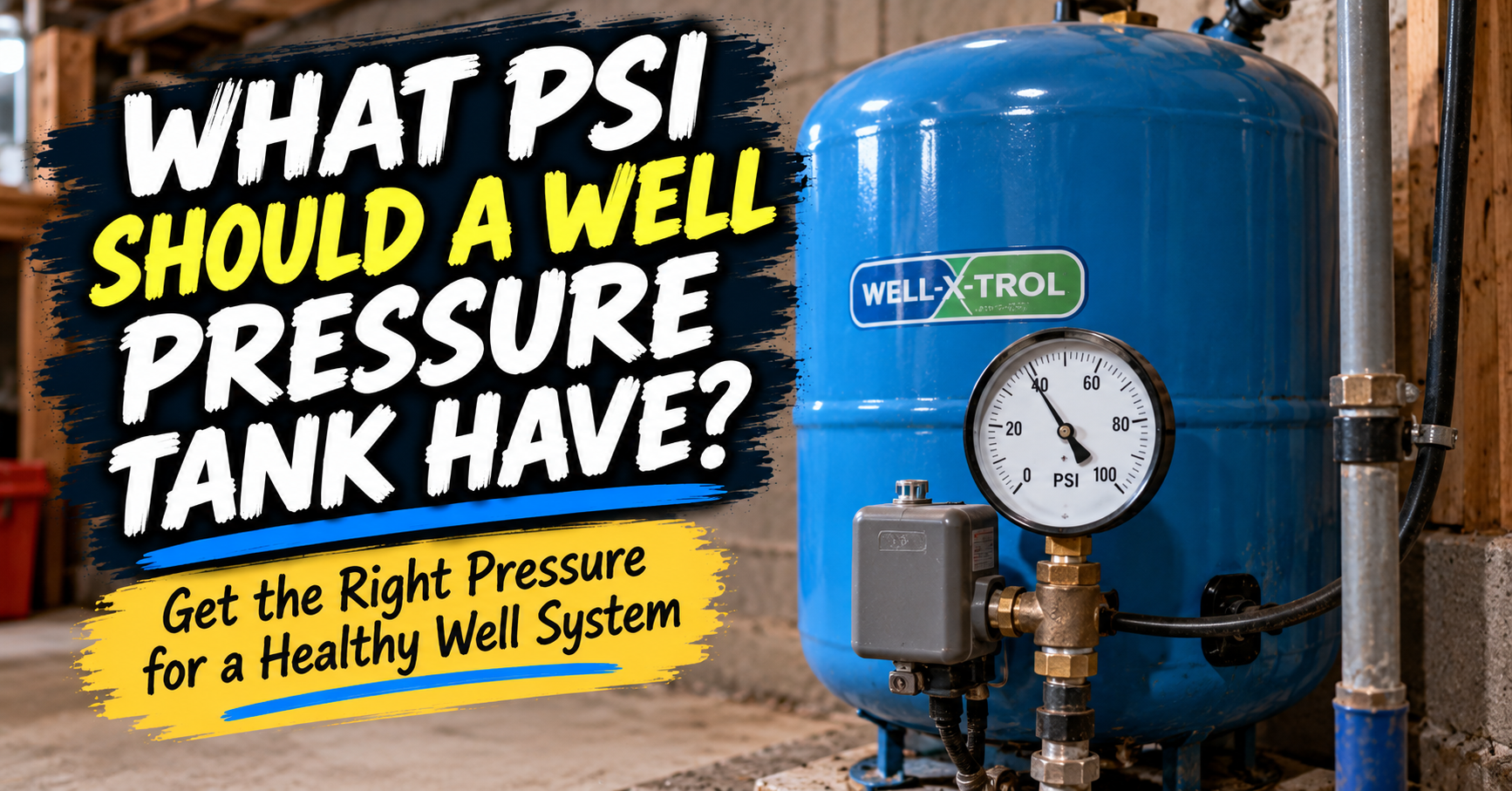
Before touching the tank air valve, it helps to understand what PSI a well pressure tank should have. The phrase “tank pressure” gets used for both water pressure and air pressure, and those are not the same thing.
Why a Stuck Gauge Can Make a Pump Look Bad
A homeowner may hear the pump running for a long time and see the gauge frozen at 40 PSI. It is easy to assume the pump is weak and cannot build pressure.
But if the gauge is stuck, the pump may actually be reaching 60 PSI and shutting down normally.
The opposite can also happen. The gauge is stuck at 60 PSI, so everything looks fine. In reality, the system pressure is falling to 15 PSI and the pump is not starting.
That is why I avoid diagnosing a pump from one old gauge.
If the pump runs but no water comes out, or if pressure will not rise, there are several possible causes. A weak pump, low water level, clogged intake, leak, failed check valve, or control issue can all be involved.
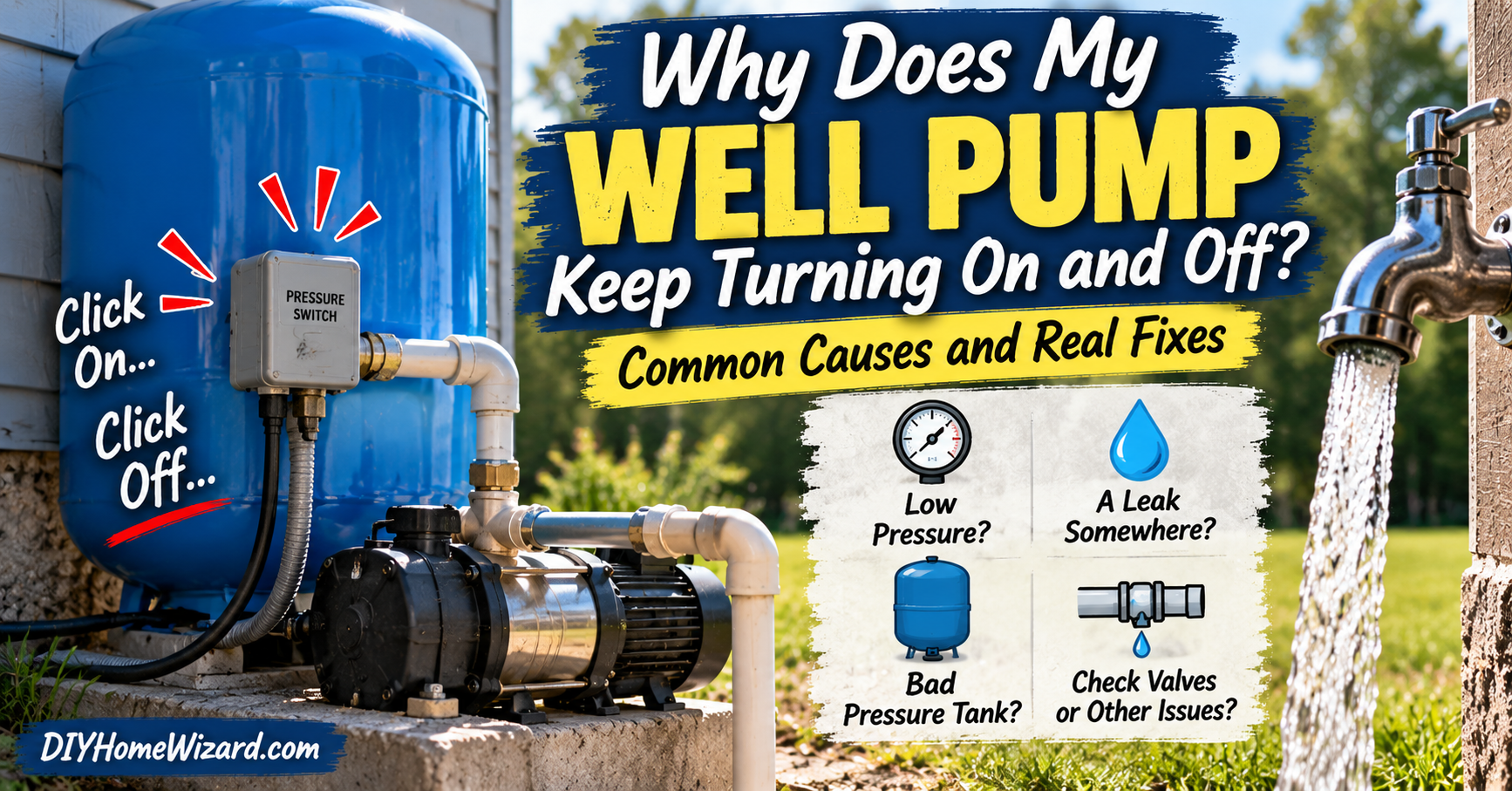
A clear look at normal pump operation is more useful than jumping straight to replacement. For example, why a well pump keeps turning on and off shows how the pump, tank, and pressure switch can each create a different cycle pattern.
Can You Tap a Stuck Well Pressure Gauge?
You can gently tap the side of the gauge with a fingertip while observing it, but I would not consider that a fix.
Sometimes a sticky needle moves after a light tap. That may confirm the gauge is sticking internally.
It may also continue to work for a few hours, a few days, or just until you stop looking at it. A gauge that needs encouragement has already told you it is not dependable.
Do not hit the gauge hard. Do not use a hammer. Do not twist it while the system is pressurized. A small gauge can become a small leak very quickly.
If a light tap makes it move, I treat that as evidence that replacement is justified.
Can You Replace a Well Pressure Gauge Yourself?
Replacing a well pressure gauge is often a straightforward plumbing repair, but it still deserves basic caution.
The gauge is connected to a pressurized water system. The pump may also start automatically while you are working near the tank tee and pressure switch.
Before removing a gauge, I would:
- Shut off power to the pump at the breaker.
- Verify the pump cannot start unexpectedly.
- Open a faucet and relieve water pressure.
- Confirm the existing gauge has dropped to zero, if it is capable of moving.
- Have a replacement gauge, thread sealant, and the right wrench ready.
- Inspect nearby fittings for corrosion or damage.
- Avoid placing strain on the pressure switch or plastic fittings.
- Restore power only after the new gauge is installed and leaks have been checked.
If the gauge shares a corroded fitting with the pressure switch, or if the tank tee looks heavily rusted, I would slow down. Removing one part can disturb another fitting that has been barely holding together for years.
This is also not the repair to tackle if you are unsure how to safely deenergize the pump circuit. Well pump wiring can involve 240 volts. A cheap pressure gauge is not worth taking chances around live electrical terminals.
What Kind of Gauge Should You Use?
For a typical residential well system, a liquid filled or dry pressure gauge with a range that comfortably covers your operating pressure is usually appropriate.
A 0 to 100 PSI gauge is common for systems that operate around 30 and 50 or 40 and 60 PSI. It leaves enough room to identify abnormal pressure without making the normal readings too hard to see.
I avoid choosing a gauge with an extremely high range for an ordinary home well system. A 0 to 300 PSI gauge may technically work, but the normal 40 to 60 PSI difference becomes harder to read accurately.
The thread size and mounting style must fit the existing connection. Many gauges use a bottom connection, but it is worth checking before ordering.
The best gauge is not necessarily the fanciest one. It is the one that fits correctly, reads clearly, and gives you a trustworthy answer when your water system starts acting strange.
What If the New Gauge Reads a Different Pressure?
A new gauge can make you wonder whether you fixed something or created a new mystery.
If the old gauge said 50 PSI and the new one says 42 PSI, the old gauge may simply have been inaccurate. That is why I take note of the original reading but do not treat it as gospel.
Watch several complete cycles with the new gauge.
Notice where the pump starts. Notice where it stops. Notice whether the tank provides a reasonable amount of water between cycles.
If the pressure switch was adjusted based on a bad old gauge, you may discover the real settings are not what you thought they were. Do not immediately start turning adjustment nuts. First, observe.
A system that has quietly operated at 35 and 55 PSI for years may still function fine. The question is whether the pump starts and stops consistently, the tank is properly matched, and the pressure feels acceptable in the house.
A New Gauge May Reveal a Pressure Switch Problem
This happens more often than people expect.
A homeowner installs a new gauge and suddenly sees that the pump is not starting until 25 PSI, even though they believed it was a 40 and 60 system. Or the pump is running past 65 PSI without stopping.
The old gauge hid the problem. The new gauge did not cause it.
If the new gauge shows the pump starting or stopping at unexpected pressures, inspect the pressure switch settings and behavior. A switch can be misadjusted, damaged, clogged, or have worn contacts.
The key is to make one change at a time. Replace the bad gauge, observe the real pressure cycle, and then decide whether the switch actually needs attention.
That order keeps a simple gauge replacement from becoming an accidental pressure switch adjustment project.
A Stuck Gauge Can Hide a Frozen or Blocked Pipe
In cold weather, a pressure gauge can become part of the clue trail.
If a pipe freezes, water flow may stop or become weak. The pressure gauge may remain high because the system is pressurized behind the blockage. Or it may fall quickly if the frozen section causes another problem elsewhere.
A gauge that stays high does not prove the plumbing is fine. It only tells you pressure exists at the gauge location.
The same idea applies to clogged filters, treatment equipment, and partially closed valves. Pressure may be normal at the pressure tank while flow is poor farther down the line.

If one faucet has low pressure while the rest of the house is fine, the well gauge is probably not the main character in that story. My guide to what causes low water pressure in a single faucet helps sort out those smaller, fixture specific problems.
When a Stuck Gauge Is Not the Main Problem
Sometimes a bad gauge is just one old part in a system that needs broader attention.
I would look beyond the gauge if you notice:
- The pump runs continuously and pressure never rises.
- The pressure tank is badly rusted or leaking.
- The pump starts every few seconds.
- The pressure switch contacts chatter, spark, or smell burned.
- The breaker trips when the pump starts.
- Water is cloudy, sandy, or suddenly full of sediment.
- The water level in the well may be low.
- The system cannot provide normal water even after the gauge is replaced.
In those cases, the gauge might still need replacement, but it is not the complete repair.
A gauge is a diagnostic tool. It reports the story. It is not always the reason the story is bad.
How I Keep a New Well Gauge Useful
Once the new gauge is installed, I take a minute to learn the normal cycle.
I watch the pressure when the pump starts.
I watch the pressure when it stops.
I pay attention to roughly how long the pump runs after a normal amount of water use.
I also take a quick look at the gauge anytime I am near the pressure tank. That habit makes it easier to notice a change before it turns into a no water emergency on a weekend.
A well system gives plenty of warning when you know what normal looks like. The trouble is that many of us do not look at it until the shower sputters, the dishwasher is halfway through a cycle, and everyone suddenly remembers there is a pump under the house somewhere.
Frequently Asked Questions
Can a well pressure gauge get stuck at 40 PSI?
Yes. A gauge can freeze at any number, including 40 PSI.
It may be stuck internally, or the small port feeding pressure to the gauge may be clogged. Open a faucet and see whether the needle responds. Comparing it with a second gauge is the best way to confirm the reading.
Why is my pressure gauge stuck at 60 PSI?
It may be stuck, especially if the pump has shut off and water use clearly lowers pressure without moving the needle.
A reading around 60 PSI can also be normal when the system is fully pressurized on a 40 and 60 setup. The important question is whether it drops when water is used and rises again when the pump runs.
Why does my well gauge show pressure with the water turned off?
If all faucets are closed and the pump has filled the tank, the gauge should show pressure. That is normal.
If you mean the gauge still shows pressure after the pump power is off and faucets have been opened long enough to drain the system, the gauge may be stuck or isolated by a clogged connection.
Is a 40 and 60 pressure gauge reading normal?
A system using a 40 and 60 pressure switch normally cycles between roughly those numbers.
The gauge should not remain at 40 or 60 all the time. It should move as water is used and as the pump refills the pressure tank.
Can a bad pressure gauge cause the pump to fail?
Usually, no. A standard mechanical gauge only reports pressure. It does not control the pump.
A bad gauge can lead to poor decisions, though. If you set the pressure switch or tank air charge using an inaccurate gauge, the system can end up operating poorly.
Why does my well pressure gauge bounce?
A little movement can be normal, but excessive bouncing can indicate a sticking gauge, rapidly changing system pressure, a waterlogged tank, pump cycling, or a control issue.
Watch whether the pump is cycling unusually often. If it is, the pressure tank deserves attention.
Should I replace the gauge and pressure switch together?
Not automatically.
If the pressure switch is operating consistently and the gauge alone is bad, replacing only the gauge may be enough. If the switch is corroded, unreliable, badly burned, or responding at strange pressures, replacing both during the same repair can make sense.
Is a pressure gauge on the pressure tank the same as a tire gauge?
No. The installed water pressure gauge measures water pressure in the plumbing system.
A tire style gauge is used at the pressure tank air valve to check the tank’s air precharge, and only after the water pressure has been fully relieved.
What I Would Do First
If your well pressure gauge appears stuck, I would start by opening a faucet and watching whether the needle moves.
If it does not, compare it with a second gauge at a hose bib or faucet. That one simple check can tell you whether you have a bad gauge, a clogged gauge connection, or a real well system problem.
Do not adjust the pressure switch just because the old gauge says a number you do not like. Do not add air to the tank based on a gauge you do not trust. And do not assume the pump is dying until you know the pressure reading is real.
A working gauge does not repair the well system, but it gives you something every repair needs: a reliable starting point.
Calder Voss writes about private wells, household water systems, and the practical lessons that become obvious only after a repair has already interrupted dinner.